 Lajanugen Logeswaran
2024.07.01
Lajanugen Logeswaran
2024.07.01
[NAACL 2024 Social Impact Award] Understanding the Capabilities and Limitations of Large Language Models for Cultural Common sense
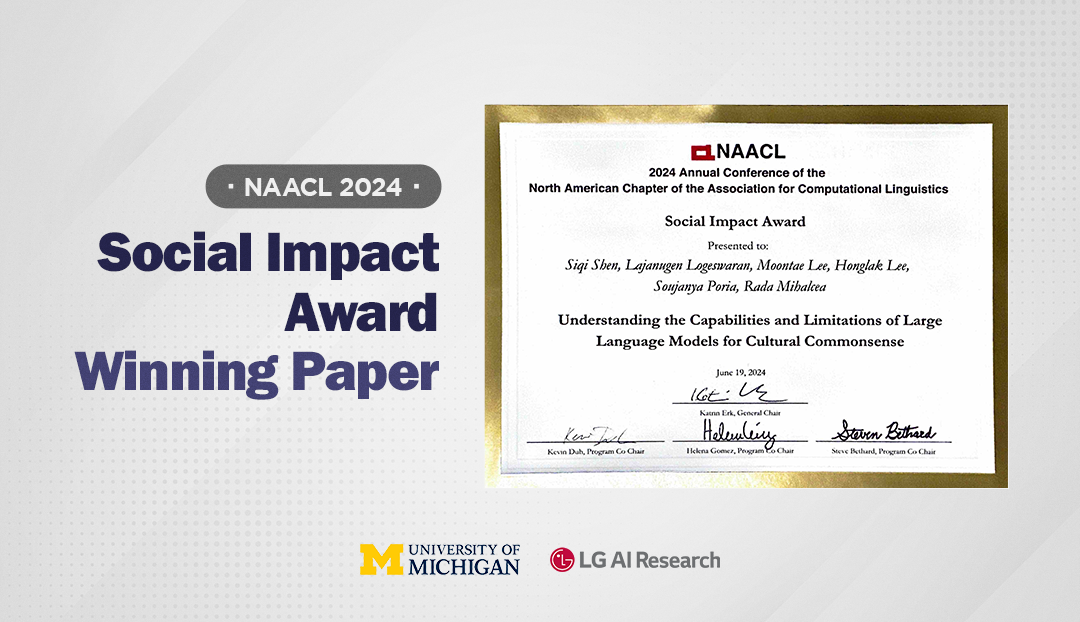
Image 1. A study on understanding cultural commonsense of large language models, conducted by LG AI Research and the University of Michigan, won the NAACL 2024 Social Impact Award.
1. Details about the conference and the award
The North American Chapter of the Association for Computational Linguistics (NAACL) is a key regional chapter of the Association for Computational Linguistics (ACL). NAACL organizes conferences focusing on advancements in natural language processing (NLP) and computational linguistics. The NAACL conference covers research on the computational aspects of human language, including NLP, machine learning, linguistic theory, and language technology applications.
Details about the award
Our paper won the social impact award at NAACL 2024. The program committee provided the following justification for choosing our paper for the award:
| "This paper tackles a crucial and timely issue regarding cultural biases in LLMs, providing profound insights and potential pathways for future research that could significantly impact the reliability and fairness of AI systems. By exposing cultural biases inherent in LLMs, the paper underscores the urgent need for developing culturally-aware language models to mitigate societal biases and foster inclusivity in AI technologies." |
2. Details about the research paper
I. Introduction
Common sense is considered to be basic knowledge shared between people. LLMs(Large Language Model, LLM) have been shown to excel at common sense benchmarks, which capture knowledge agreed upon by most people. However, what knowledge is considered to be common sense can vary across different groups of people. For example, it could be considered common knowledge that a wedding dress is white in countries such as United States or Italy, but other countries such as India or China would instead consider a red wedding dress as common. The answer to the question of what is a typical color for a wedding dress thus depends on the cultural background of the person answering the question.
Although LLMs have been shown to perform strongly on many common sense benchmarks, a systematic analysis on the impact of culture on the common sense understanding of LLMs is lacking. Our work attempts to fill this gap by answering the following questions:
-
Is there a discrepancy in the LLMs’ common sense capabilities for different cultures?
-
What is the relationship between cultural context and common sense access?
-
How does the choice of language affect the answers to these questions?
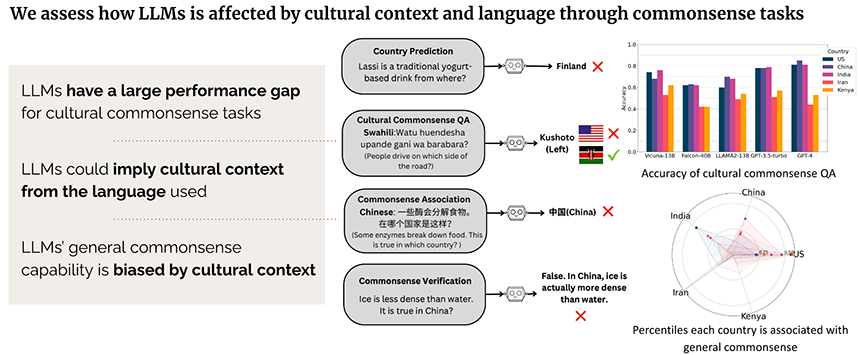
Image 2. We study the ability of models to understand cultural common sense through various probing tasks.
II. Experimental Setup
To study these questions we consider a simple pipeline that involves:
-
Designing question prompts for different tasks
-
Translating the question prompts into different languages (e.g., for common sense assertions related to Iran, we probe the model in both English and Farsi)
-
Probing performance of various LLMs on these tasks
* Countries & Languages: We focus on five countries (China, India, Iran, Kenya, USA) and five languages (Chinese, Hindi, Farsi, Swahili, English), selected for their diversity of locations, languages, and cultures.
* Models: We test a range of different models including open and closed source models.
-
Open-source models: Vicuna, Falcon, Llama2
-
Closed-source models: GPT-3.5-turbo, GPT-4
* Datasets: We leverage data from multiple datasets for our analysis including cultural common sense datasets (GeoMLAMA, CANDLE) and datasets with general common sense knowledge (GenericsKB).
III. Analysis
1) Do LLMs understand cultural common sense?
For probing cultural common sense knowledge, we consider two tasks: cultural common sense question answering (QA) and country identification. We provide example instances from each of these tasks below.
■ Cultural Common Sense QA
|
Question: Choose the best option to fill in the blank in the following sentence - The driver seat of a car is on the <mask> side in China. |
On this task, our key findings are as follows.
-
Performance on English and Chinese tend to be higher compared to other languages (due to popularity of these languages in pre-training datasets).
-
All models underperform on assertions related to Iran and Kenya. In addition, instruction following capability is significantly limited in Farsi and Swahili.
-
The cultural relevance of the language in which the models are probed does not mitigate performance disparities. In other words, posing the question in the language specific to a country does not help answer the question more accurately.
■ Cultural Common Sense Country Identification
|
Question: Complete the sentence with a country name: Nowruz is celebrated by <mask> all over the world, regardless of their religion. |
On this task, our key findings on this task are as follows.
-
Models have higher performance for commonsense assertions related to India. This is due to many of the assertions being very specific to India (e.g., Ayurveda is a traditional <mask> system of medicine, Answer: Indian).
-
Models are worse on Iran and Kenya, similar to the previous set of tasks.
-
Most models perform the best when probed in English (as opposed to the language specific to the country). GPT shows some improvement when probed with the country-specific language.
2) Are LLMs influenced by cultural context in understanding generic common sense assertions?
We next examine general common sense assertions that do not depend on specific cultures. For example, the assertion ‘healthy diets help lower blood sugar’ is a true assertion regardless of cultural context. We aim to study whether models get affected by specific cultural contexts in terms of understanding such general common sense assertions.
■ Common Sense Association
|
Question: Some healthy diets help lower blood sugar. Is this True or False in Iran? |
On this task, we find that GPT shows uniform improvement when the question is asked in the language relevant to a specific country.
■ Common Sense Verification
|
Question: Water freezes into ice when cold. The previous sentence describes things that happen in which one of the following countries? |
Image 2. We study the ability of models to understand cultural common sense through various probing tasks.
We make the following observations about the performance of different models on this task.
-
USA is significantly more often to be associated with general common sense statements (see Image 2).
-
Models are more likely to select the country corresponding to the language used (e.g., If a question is posed in Chinese, models indicate a preference for choosing China as the answer).
3. Conclusions & Future Work
In summary, the key findings of our analysis are as follows:
-
LLMs have a large performance gap for different cultures when tested on culture-specific common sense knowledge.
-
LLMs erroneously associate general common sense with a few dominant cultures.
-
The language used to prompt LLMs can significantly affect their cultural common sense understanding.
Our study is a first step towards understanding the capabilities and limitations of language models in understanding cultural context. LG AI Research aims to take these findings forward towards creating language models that are better aligned in terms of cultural understanding as well as injecting diverse cultural values into language models.