 Jinseok Yang
2026.03.24
Jinseok Yang
2026.03.24
[AAAI 2026] A Design Guide for Organizations Implementing Agentic AI
At AAAI 2026, an AI conference ranked among the world's top alongside NeurIPS, ICML, and ICLR, LG AI Research demonstrated our technical capabilities by presenting a total of four demo papers in the fields of causal inference, anomaly detection, and reinforcement learning. This year, only 18% of approximately 24,000 submitted papers were accepted, and only 72 papers, representing 28.5% of submissions, were selected for the demo track.
2. Introduction: Beyond the LLM era: Entering the Age of Agentic AI
The paradigm of artificial intelligence is rapidly shifting from passive AI, which supports simple text generation, to agentic AI, which sets its own goals and uses tools to solve complex problems. Consequently, the focus for companies is expanding beyond “LLMs that answer questions” to intelligent agents that understand work objectives (Goal), select necessary means (Tool), and execute procedures (Workflow). However, as autonomy increases, the problem of opacity arises: it becomes difficult to trace why an Agent made a particular decision, where errors occurred during execution, and whether the outcome violated policies, regulations, or operational rules. This issue repeatedly surfaced in the main/demo tracks of AAAI 2026 I reviewed, and it can be summarized as a common challenge: “How can we make an agent's actions or decision outcomes observable, and how can we structure this observability?”
Because LLMs are inherently probabilistic generative models, they can make decisions that “sound plausible but are operationally unstable.” An approach is needed that layers logical structure (ontology, rules, constraints, verification loops) on top to ensure the agent's actions remain consistent within domain knowledge and policy constraints.
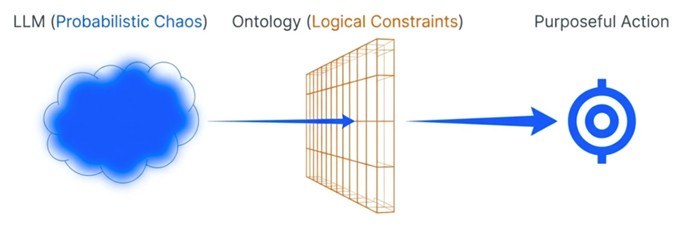
Ontology provides agents with a “logical framework,” serving as the foundation for companies to trust and control AI judgments. Particularly as agents progress to stages where they invoke multiple tools and manipulate external systems, understanding and leveraging how they adhere to specific rules based on certain grounds to reach particular outcomes becomes central to system design, more so than the quality of a single response. The following compares and summarizes, from an architectural perspective, existing LLM-centric systems and the autonomous agent trend observed at AAAI 2026.
| LLM-based chatbot (Passive AI) | Autonomous agent (Agentic AI) | |
| Decision-making structure | Probabilistic text generation from input | Active planning and execution to achieve goals |
| Knowledge utilization | Relies on inherent parameter knowledge | Logical reasoning using ontology and knowledge graphs |
| Reliability management | Post Hallucination Check | Ontology-based real-time observation and red teaming |
3. Main track insights: Structure Reasoning
The main track of this conference presented numerous studies on structural reasoning, combining knowledge graphs and LLM to improve inference performance while optimizing resource utilization. These studies share the common goal of simultaneously improving performance and optimizing costs by structurally reinforcing the LLM inference process.
This section examines two representative approaches to mitigate the hallucination problem in LLMs: PathMind[1], which selects the inference path most likely to reach the correct answer, and DoM[2], which compensates for the limitations of incomplete knowledge graphs (KG) through a multi-agent debate mechanism. Both studies share the common goal of making the answer generation process of LLMs more reliable by leveraging knowledge graphs.
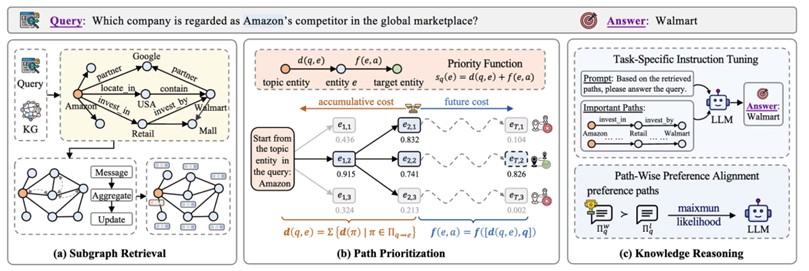
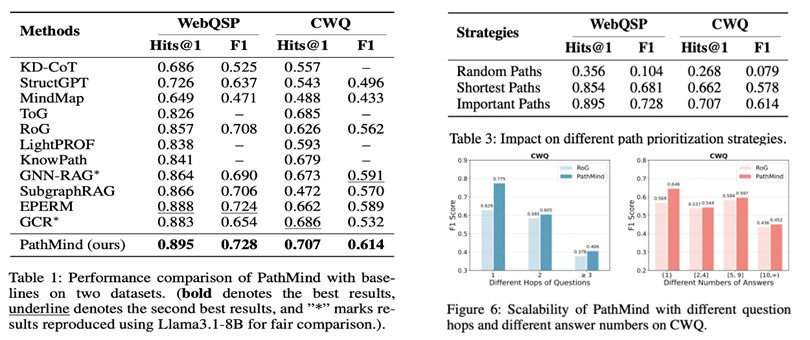
PathMind: A Retrieve-Prioritize-Reason Framework for Knowledge Graph Reasoning with LLMs[1]
PathMind introduced the Retrieve-Prioritize-Reason paradigm to address excessive API costs caused by indiscriminate path extraction in existing knowledge graph reasoning methods, leading to the use of noisy and unnecessary information.
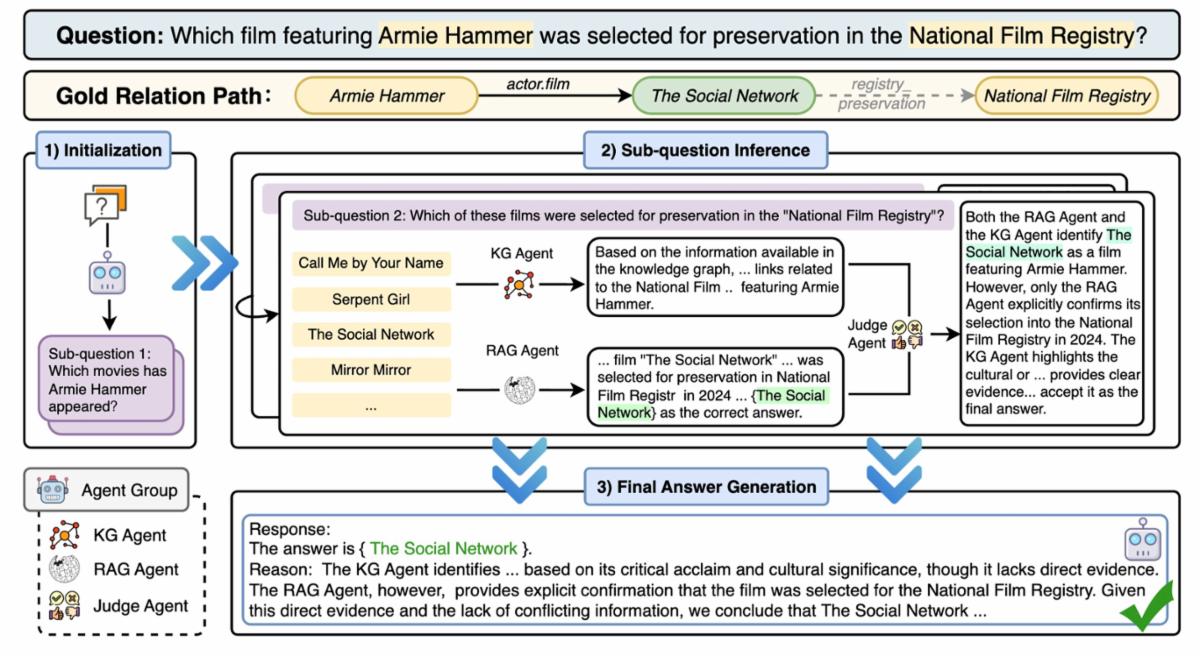
Debate over Mixed Knowledge: A Robust Multi-Agent Reasoning Framework for Incomplete Knowledge Graph Question Answering[2]
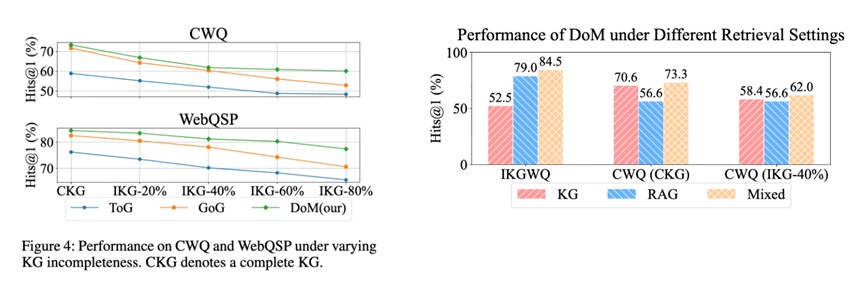
DoM originates from problems arising when knowledge graphs (KG) are incomplete, such as when core reasoning paths are broken or when structural reliability is difficult to ensure based solely on textual information. To address this, DoM introduces a Multi-agent Debate approach. Here, the KG Agent and RAG Agent each derive their own evidence, while the Judge Agent compares and evaluates these results to form a final conclusion. Through this process, it achieves more stable and reliable inference results even when the knowledge graph contains insufficient information.
4. Demo track insights: Designing observable and reliable agents
While the main track focused on enhancing agents' structural reasoning capabilities, the demo track explored challenges in transforming “the decision-making and execution processes of well-designed agents from a black box into a glass box.”
AgentGraph: A debugging interface that structures the agent execution process into an ontology[3]
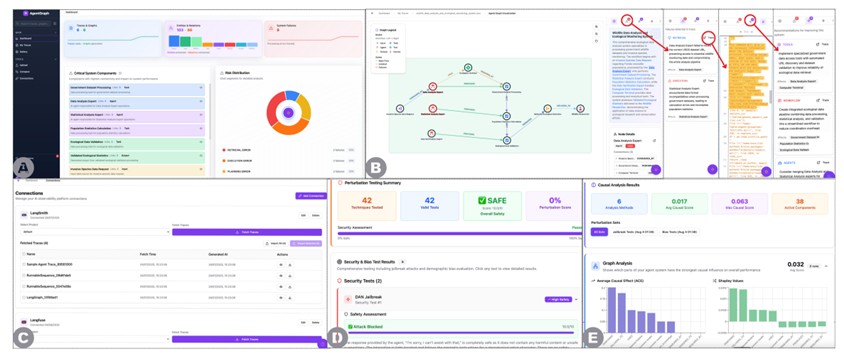
AgentGraph demonstrated a tool that makes it possible for humans to understand what the agent actually did. What was impressive in the demo was that it went beyond simply visualizing thousands of lines of execution logs; it restructured the agent, tasks, tools, and data flow into a single graph structure. This allows developers to intuitively grasp, at the architectural level, the decision flow an Agent followed to invoke a specific tool, where it got stuck in a loop, and which steps became bottlenecks. AgentGraph provides a foundation for answering a critical operational question: “Can we trust and safely deploy this agent?”
AgentSeer: Action-level Red Teaming targeting the entire agent execution path[4]
AgentSeer begins with the question: “Can we say an agent system is truly safe just because its final response appears safe?” In environments where multiple agents work in parallel, generating a single response involves sequential steps like memory access, tool calling, and LLM application execution, and memory leaks or unsafe tool usage can occur anywhere along this execution path.
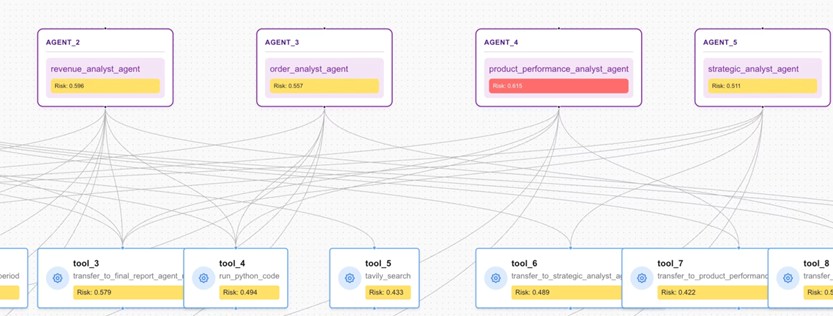
To address these issues, AgentSeer decomposes the agent's execution process chronologically and reconstructs all components into action units. It treats memory access, tool invocation, and LLM application calls as unified action primitives, clearly representing on the graph which component each action affects.
On this graph, AgentSeer performs jailbreak simulations and Red Team payload injections targeting each action and component, step-by-step verifying “what security risks could arise if this agent performed this action at this point.” This demonstrated vulnerabilities along the execution path that were difficult to capture with traditional outcome-driven security testing.
Omega: Converting the agent's choices into natural explanations[5]
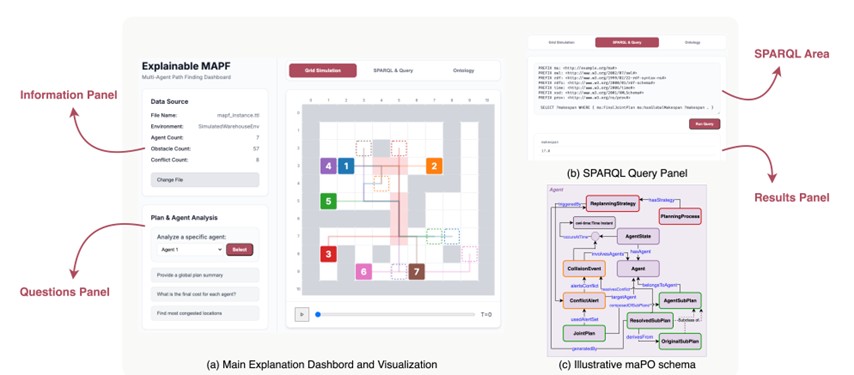
Omega is a tool focused on explaining why an agent behaved a certain way in human-understandable language. For systems operating in complex environments, such as robots or logistics agents (for example, in Multi-Agent Path Finding (MAPF) problems) it is difficult to determine the reason for choosing a specific path or action based solely on existing execution logs.
To address this, Omega leverages domain ontologies such as maPO to map complex agent execution logs into an ontology-backed semantic graph. It then interprets the execution path using SPARQL queries and generates natural language explanations with logical reasoning to answer questions like “Why did this agent choose this path?”
Through this approach, Omega demonstrated technology capable of presenting AI judgments in an explainable and verifiable form, even in high-risk operational environments where cause analysis and accountability must be clearly established following an incident.
5. Future Roadmap for the Agent Ecosystem
As demonstrated by numerous studies at AAAI 2026, agents are no longer mere automation tools. What matters now is not just building high-performing AI, but constructing systems that can logically explain how they reached their results, manage resources efficiently, and ensure the entire process is transparently observable. Agent architectures combining these elements will become the standard for enterprise agents going forward.
Agents equipped with ontological structures can evolve into true “AI Co-workers” that independently identify core issues aligned with a company's philosophy and operational context, collaborating with humans through advanced logical reasoning. This represents not mere automation, but a new form of intelligence capable of responsible judgment and trustworthy execution.
As I conclude, I pose one final question:
Will your company continue to entrust the fate of its business to AI within a black box?
Or will you seize the future of the autonomous economy through a transparent architecture designed with ontology?
Now is the golden time to move beyond mere adoption and establish a trustworthy agent strategy.
- 참고
- [1] Yu Lie et al., PathMind: A Retrieve-Prioritize-Reason Framework for Knowledge Graph Reasoning with Large Language Models
[2] Jilong Lie et al., Debate over Mixed-knowledge: A Robust Multi-Agent Reasoning Framework for Incomplete Knowledge Graph Question Answering, AAAI 2026
[3] Zekun Wu et al., AgentGraph: Trace-to-Graph Platform for Interactive Analysis and Robustness Testing in Agentic AI Systems
[4] AgentSeer: Visualizing and Evaluating Temporal Actions in Agentic AI Systems
[5] Bharath Muppasani et al., OMEGA: An Ontology-Driven Tool for Explaining Multi-Agent Path Finding