LG's first publicly released Vision Language Model, EXAONE 4.5
LG AI Research is introducing EXAONE 4.5. EXAONE 4.5 is LG’s first Vision Language Model (VLM) to be released using an open-weight approach.
Building on the language-processing-centric architecture of the existing EXAONE 4.0, we have integrated our proprietary Visual Encoder into an innovative model architecture. As a result, it has evolved into a true multimodal model capable of simultaneously understanding and processing not only text, but also visual information such as images.
To achieve this expansion, EXAONE 4.5 adopted a Native Multimodal Pretraining approach that trains on text and visual information together from the very beginning. Unlike methods that train visual and language modules separately and then simply combine or post-process them, this model was designed to naturally fuse the two types of information from the start, thereby maximizing multimodal understanding capabilities.
What’s more, we trained the model using a massive dataset to achieve top-tier, balanced performance across both language and vision fields. In particular, we focused on STEM(Science, Technology, Engineering, Mathematics) and the field of document understanding, which is in high demand in real-world industrial settings, and systematically carried out each stage of the process, from data collection to cleaning and processing. As a result, the model has demonstrated competitive performance on global general-purpose benchmarks and excels at complex document-based tasks as well as understanding Korean language and visual contexts.
1. Model Structure Design
The core objective of EXAONE 4.5’s development was to naturally extend the capabilities of the language model to the visual field. To achieve this, the model architecture was redesigned from the ground up. Below, we introduce the technical foundation of EXAONE 4.5 and the key elements of our efforts to improve inference speed.
1.1 Model Structure With Integrated Visual Encoder
EXAONE 4.5 is designed with a structure that integrates a proprietary Visual Encoder into EXAONE 4.0, LG AI Research’s proprietary large language model (LLM). The primary focus during the integration process was to minimize the increase in computational load caused by visual information processing and to ensure inference speed in real-world service environments. To achieve this, the Grouped Query Attention (GQA) method was adopted for the attention mechanism within the added Visual Encoder.
GQA is a structure that groups the queries used in attention operations into multiple groups, with each group sharing the same key and value heads. This was a practical choice because it reduces computational load and memory usage while maintaining model performance. Furthermore, as most modern inference frameworks (such as vLLM, TensorRT-LLM, and SGLang) natively support and optimize GQA technology, developers using EXAONE 4.5 can experience the same inference speeds with efficient hardware resource utilization without any additional work.

Image 1. EXAONE 4.5 model structure diagram
1.2 Improving inference speed through multi-token prediction
In the text generation phase, a new Multi-Token Prediction (MTP) module was introduced to improve model inference speed compared to EXAONE 4.0.
Existing language models have used an autoregressive decoding approach, which predicts only one token at a time and sequentially incorporates the results into subsequent predictions. While this approach has the advantage of an intuitive structure, it has limitations in terms of inference speed and computational efficiency because the entire model must be run every time a single token is generated.
MTP goes beyond predicting a single token, predicting and generating the next token and the one after that. This has improved inference speed by more than 1.5 times compared to existing methods, resulting in faster response times that users can actually perceive in real-world service environments.
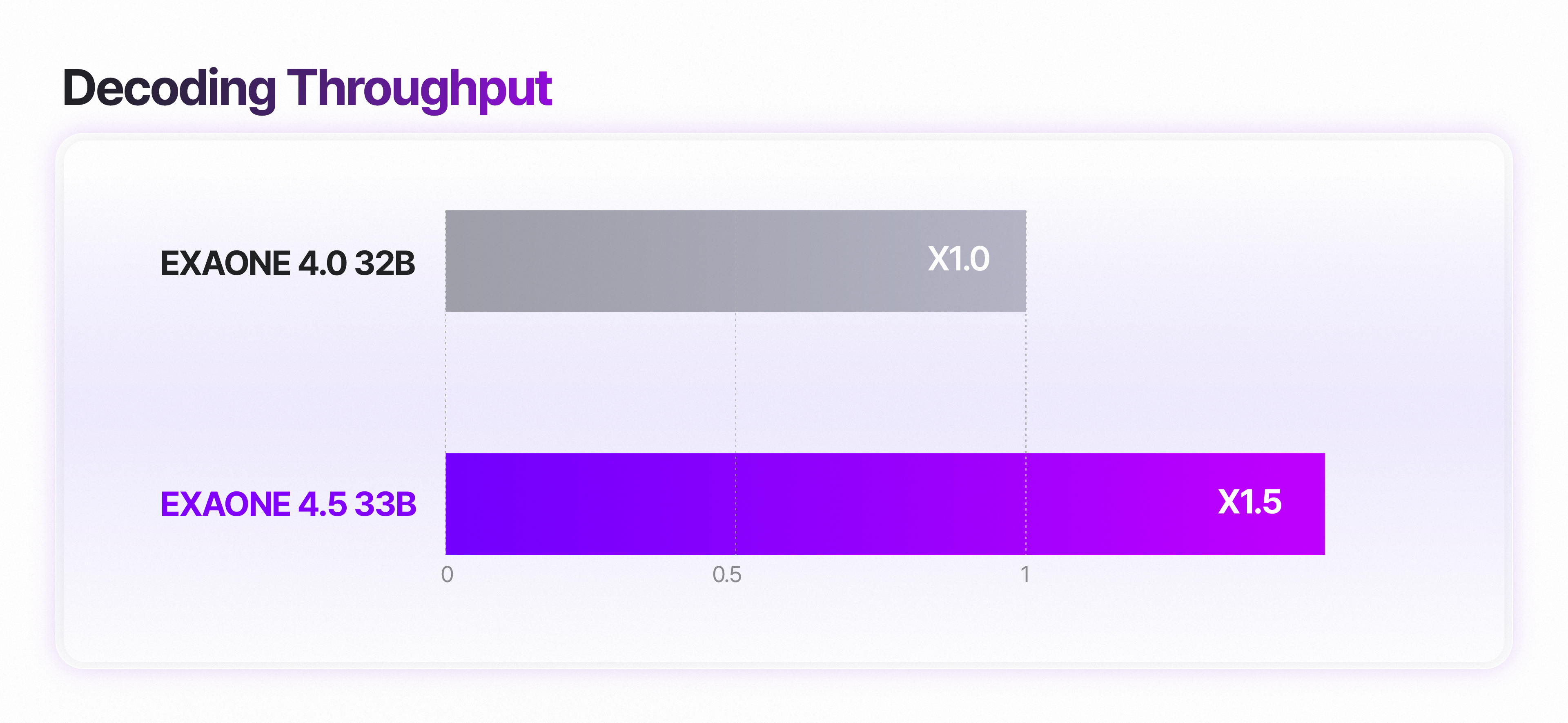
Image 2. EXAONE 4.5 Decoding Throughput
2. Model Training
The training of EXAONE 4.5 proceeded in two main phases: pre-training, which involved absorbing a vast amount of knowledge, and post-training, which involved fine-tuning the model for specific practical applications.
2.1 Pre-Training
The pre-training for EXAONE 4.5 combined text-centric knowledge acquisition with multimodal learning that integrates visual information. To equip the model with foundational knowledge, domain-specific expertise, and reasoning capabilities, we trained it on a large-scale text dataset, and applied a “Native Multimodal Pre-training” approach that seamlessly integrates visual information into the pre-training process, enabling the model to understand text and images without distinction.
The core objective of this pre-training was to fundamentally enhance the model’s reasoning capabilities. To achieve this, we synthesized high-quality data, including thinking trajectories, and incorporated it into the training process. This design ensured that the model did not merely derive the final correct answer but instead learned to follow a step-by-step reasoning process on its own.We instilled in the model’s foundation the logical flow it must follow when solving complex problems, as well as the intermediate steps required to reach a solution. This thinking trajectory-centered learning approach served as a crucial foundation for enhancing the model’s logical reasoning and problem-solving capabilities during the subsequent post-training phase.
2.2 Post-Training
Post-training is the process of aligning a model with a vast body of knowledge so that it can accurately understand the user’s intent and provide useful responses. The fine-tuning for EXAONE 4.5 was conducted in two stages: supervised fine-tuning (SFT) and reinforcement learning (RL).
During the SFT phase, we collected and processed large volumes of datasets from various domains to comprehensively cover the numerous scenarios users could encounter. In particular, we focused on building datasets for documents, which are in high demand in real-world business environments. We created specialized datasets to ensure that the model can accurately recognize and analyze industrial documents containing complex tables, formulas, and multi-column layouts, thereby enhancing the model’s practicality in corporate settings.
In the reinforcement learning (RL) phase that followed SFT, LG AI Research introduced the AGAPO algorithm, which we developed in-house.
Conventional state-of-the-art reinforcement learning algorithms had the limitation that if all the answer samples generated by the model were incorrect, they could not calculate an appropriate learning signal (advantage) and would discard that data. In contrast, the AGAPO algorithm is designed to identify learning signals even within incorrect answers.
Asymmetric Sampling: Rather than discarding groups of samples that are all incorrect, a penalty (negative reward) is assigned to the flawed reasoning paths that cause the errors, thereby encouraging the model to avoid logical errors on its own.
Group & Global Advantages: Training stability was enhanced by calculating rewards in two stages: evaluating individual response groups and considering the data distribution at the global batch level.
Exploratory Token Preservation: By removing the clipping constraint, which was previously applied in existing algorithms to ensure training stability, it protects exploratory tokens, which serve as branching points in complex inference processes, from being omitted during training.
By applying the AGAPO algorithm, EXAONE 4.5 has enhanced its logical reasoning capabilities while also ensuring learning efficiency.
3. Performance Evaluation
The performance of vision-language models (VLMs) must be comprehensively evaluated not only in terms of their ability to recognize objects in images, but also in their capacity to logically link visual information with textual context and perform complex reasoning. Both academia and industry utilize standard benchmarks that cover a wide range of difficulty levels and domains, including university-level domain knowledge, mathematical reasoning, and visual question answering (VQA).
To validate the performance of EXAONE 4.5, we conducted a comparative evaluation against major open weight and commercial VLM models that are currently gaining attention in the global market. In the Vision domain, we selected Qwen 3.5 27B, Qwen 3 VL 235B-A22B, Qwen 3 VL 32B, Claude Sonnet 4.5, and GPT-5-mini as comparison models, while in the Text and Agent domains, we selected the previous version, EXAONE 4.0 32B, and the K-EXAONE 236B model as comparison models.
3.1 Performance evaluation of the Vision field in the industrial field
For vision-language models (VLMs) to be adopted in real-world industrial settings, they must go beyond simple image recognition and possess STEM (science, technology, engineering, and mathematics)-based visual reasoning capabilities and the ability to understand specialized documents. Image 3 summarizes the performance of EXAONE 4.5 and comparison models on key benchmarks related to visual document understanding.
Visual reasoning in the general field: On the MMMU-Pro, which requires reasoning in the general field, Qwen 3 VL 32B outperformed GPT-5-mini and Claude Sonnet 4.5, demonstrating that it can surpass the performance of major commercial models even in expert-level knowledge processing.
Visual reasoning in mathematics: On the MathVision, WeMath, and LogicVista benchmarks, which evaluate visual math problem-solving abilities, Qwen 3 VL 32B outperformed not only Qwen 3 VL 32B but also Qwen 3 VL 235B. It also demonstrated superiority over commercial models such as GPT-5-mini and Claude Sonnet 4.5 in most categories.
Academic and chart analysis: On CharXiv (RQ), which requires chart and diagram comprehension and reasoning capabilities, it significantly outperformed Qwen 3 VL 32B, GPT-5-mini, and Claude Sonnet 4.5. It also achieved excellent results on ChartQA Pro and AI2D, which evaluates diagram comprehension.
Text extraction: It outperformed some commercial models, such as GPT-5-mini, on OCRBench_v2 and OmniDoc_v1.5, tests designed to evaluate optical character recognition (OCR) and document understanding capabilities, demonstrating its practical applicability.
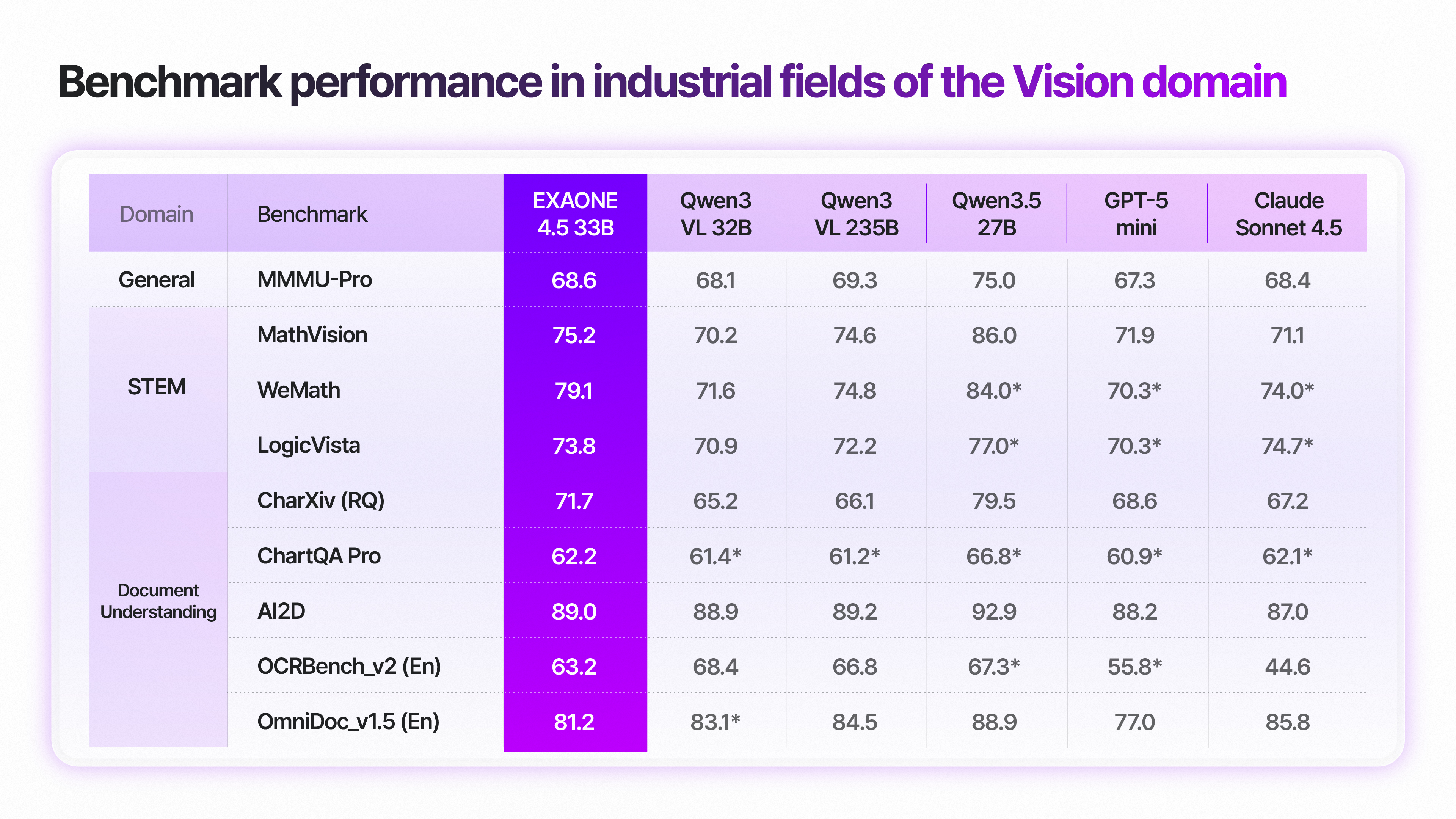
Image 3. Benchmark performance in industrial fields of the Vision domain
3.2 Performance evaluation of the Vision domain in the general field
While EXAONE 4.5 is specialized for professional and document-related tasks, it also demonstrates performance on par with, or even surpassing, major global commercial models in everyday visual information processing and benchmarks that reflect Korean culture.
Visual reasoning: On the Blink benchmark, which comprehensively evaluates various visual tasks, we confirmed performance superiority over commercial models, as well as the Qwen 3 VL 32B and Qwen 3 VL 235B. Additionally, on the MMStar benchmark, the model achieved general visual understanding capabilities that surpassed those of commercial models.
Hallucination suppression: On HallusionBench, which measures visual hallucinations, the model achieved higher scores than commercial models.
Korean visual-language understanding: On k-viscuit and KRETA, Korean-specific visual-language benchmarks, the model demonstrated superior performance compared to Qwen 3 VL 32B.
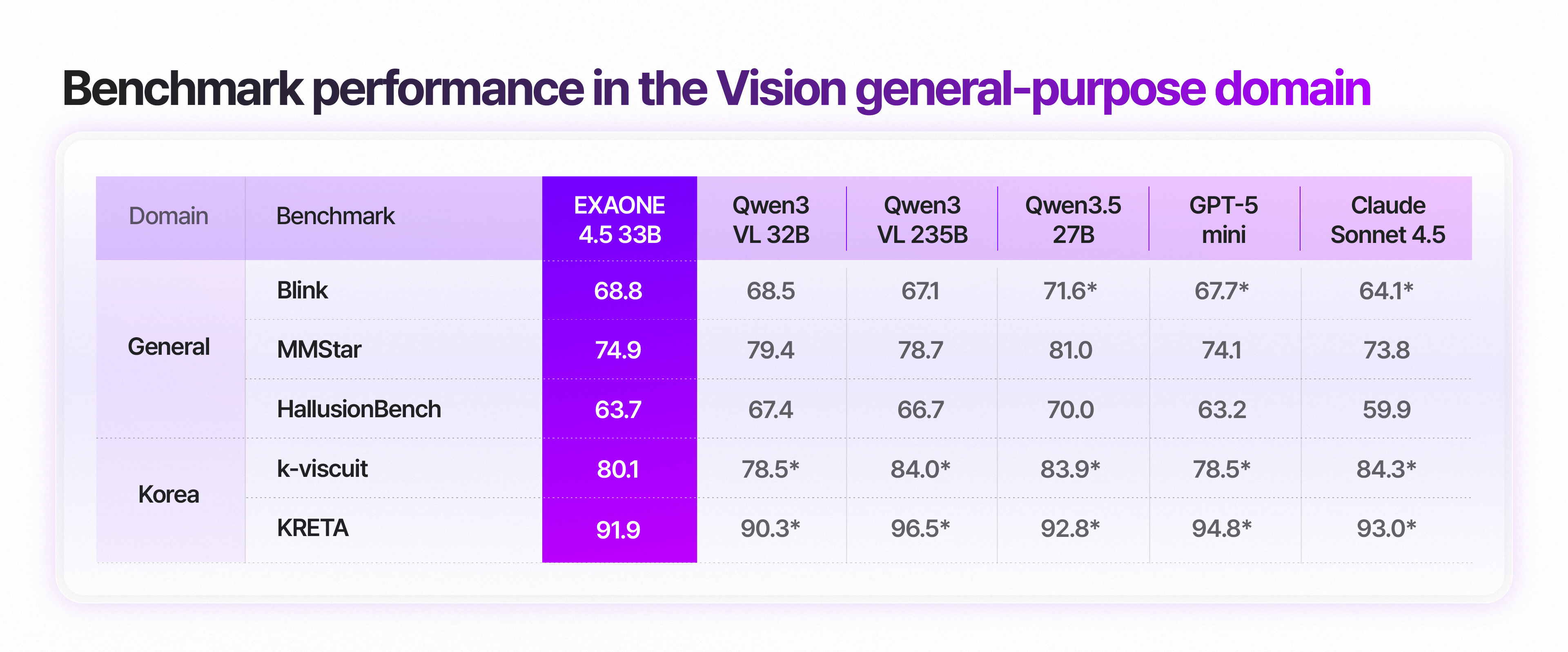
Image 4. Benchmark performance in the Vision general-purpose domain
3.3 Performance evaluation in text and agent fields
Finally, here are the performance evaluation results for EXAONE 4.5’s text inference and agent capabilities. This model achieved performance on par with or exceeding that of its predecessor, EXAONE 4.0, as well as K-EXAONE, which has a significantly larger parameter scale.
Reasoning in the general field: On the MMLU-Pro benchmark, which requires reasoning across general fields, we confirmed superior performance compared to EXAONE 4.0 and achieved results on par with K-EXAONE.
Mathematical and scientific reasoning: It slightly outperformed K-EXAONE on both AIME25, which measures mathematical reasoning, and GPQA-D, which evaluates expert-level knowledge reasoning.
Programming: It also outperformed K-EXAONE on LiveCodeBench v6, which measures coding ability, demonstrating improvements over its predecessor in the implementation of complex algorithms and code generation.
Agent: On the Tau2 benchmark, which evaluates tool-using capabilities, performance improved significantly compared to EXAONE 4.0. This demonstrates the agent’s potential for understanding and executing complex workflows.
Instruction execution: IFBench and IFEval, which demonstrate the model’s ability to comply with complex user constraints, have also shown significant improvements compared to the previous version. The model can now precisely follow the complex conditions and stringent guidelines required in real-world industrial settings.
Long-text context understanding: Performance on the AA-LCR, which evaluates understanding of long contexts, has improved by more than three times compared to the previous version and is now on par with K-EXAONE. Even with a relatively lightweight model, it is capable of processing large-scale documents.
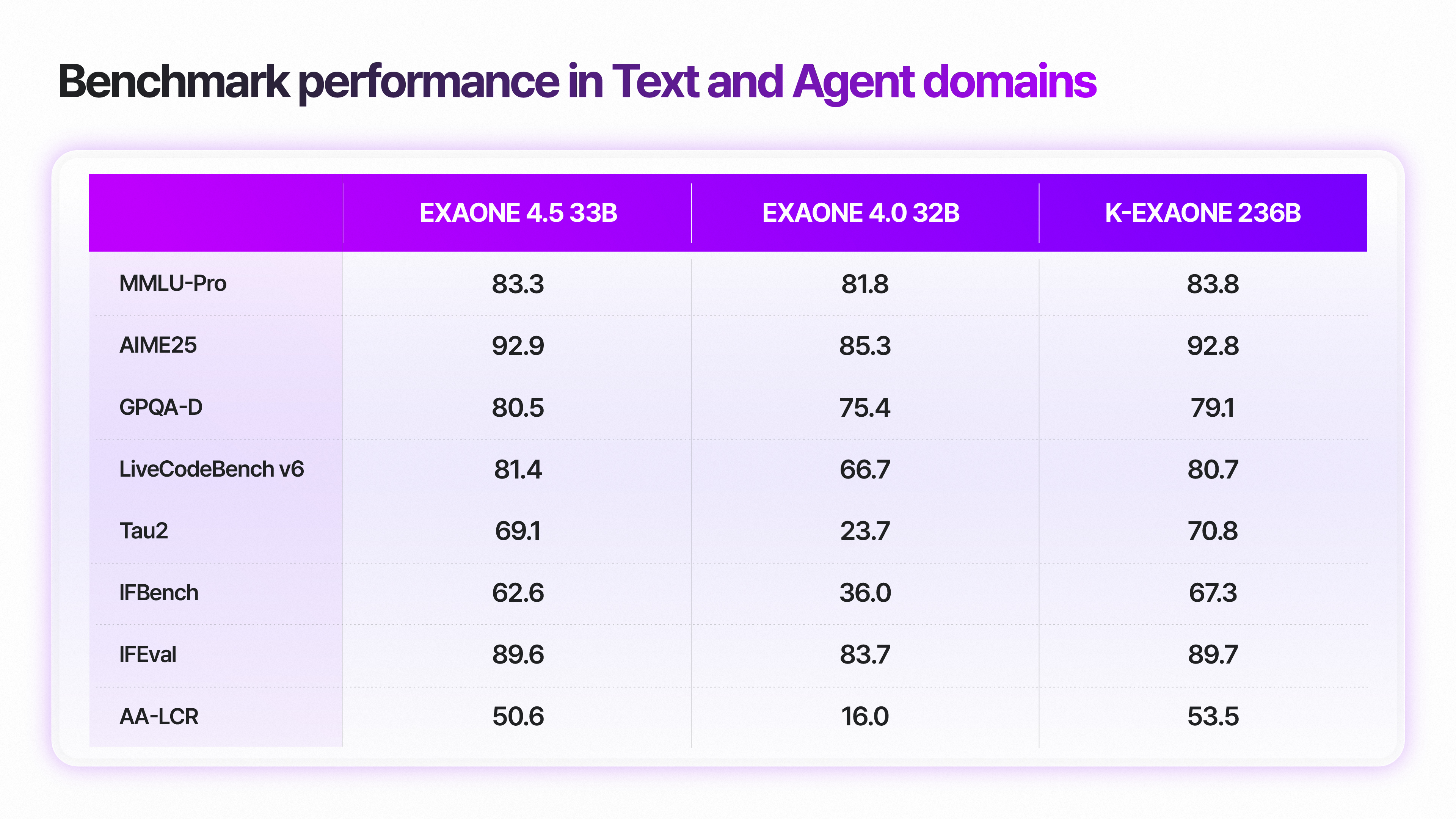
Image 5. Benchmark performance in Text and Agent domains
4. Conclusion
EXAONE 4.5 is a model that breaks down the barriers between language and vision, taking the application of AI in real-world industrial settings to the next level. We hope that the release of this open weight model will help invigorate the global ecosystem of researchers and developers. We ask for your continued support as EXAONE continues to take on new challenges and evolve through research, development, and partnerships.
EXAONE 4.5 Hugging Face →
EXAONE 4.5 Technical Report →