
BSH1_e8f43de41.png Seohui Bae 2026.08.05

[CVPR 2026] Beyond Video World Models: What Should We Predict About the Future?
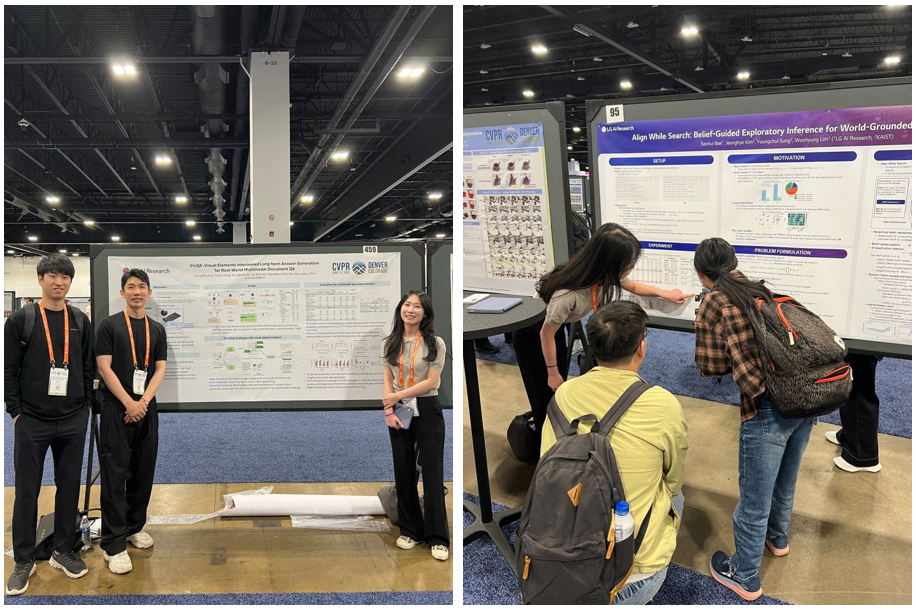
 

Image 1. LG AI Research at CVPR 2026


One of the most recurring themes across sessions and papers at CVPR 2026 was the concept of the world model.

Today, the term world model is most commonly associated with foundation models such as the Genie family, which generate action-controllable videos or playable environments.[1,2] In this narrow sense, a world model takes past observations and actions as input and predicts—or simulates—how the environment will evolve in response to future actions.

However, the term world model has historically encompassed a much broader class of models than video generators alone.

In model-based reinforcement learning (MBRL), world models have long referred to models that learn the latent dynamics of an environment and enable planning or policy improvement within that learned latent space.[3,4] Meanwhile, Joint Embedding Predictive Architectures (JEPA) introduced a different perspective on representation learning by predicting abstract latent representations rather than reconstructing pixels.[5] More recently, robot learning has shifted toward world models that predict task-relevant structures—such as object trajectories, 3D traces, or point flows—instead of generating entire future frames.[10,11]

The research presented at CVPR 2026 reflects this broader evolution. Not every world model predicts the same notion of the future.

Some models generate future observations as videos conditioned on actions.[6] Others predict semantic changes directly within the feature space of vision foundation models.[8] Still others estimate the 3D motion required for robotic manipulation,[10,11] or learn physical dynamics from observed scenes to extrapolate future physical states.[12]

This article examines world model research at CVPR 2026 through two fundamental questions.

First, what aspects of the world should a model represent and predict?
A model may generate complete future observations, predict changes in semantic representations, or estimate task-relevant variables such as object motion, 3D geometry, or physical state.

Second, what is the predicted information ultimately used for?

Predicted futures may support interactive simulation, representation learning, planning, robot control, or uncertainty-aware exploration.

These questions also closely relate to Align While Search (AWS),[9] the work presented by LG AI Research at CVPR 2026.

Unlike conventional world models, AWS neither generates future frames nor explicitly learns transition dynamics. Instead, it addresses decision-making under partial observability. The agent continuously updates its belief about the external world based on accumulated observations and uses that belief to select exploratory actions that reduce uncertainty. Rather than rolling out possible futures, AWS infers the hidden state of the current world that is most relevant for making effective decisions.

In the remainder of this article, we first examine action-controllable video generation from the perspective of learned simulators. We then explore research that represents the future through predictive latent features rather than full image synthesis, followed by approaches that predict 3D traces and point flows for robotic manipulation, and methods that learn physical dynamics to model future state evolution. We subsequently introduce AWS as an example of belief-space inference, a complementary paradigm to forward prediction. Finally, we discuss which forms of world representation may prove most valuable for real-world decision-making in electronic design automation (EDA), an active area of research and development at LG AI Research.

The central question running throughout this article is straightforward yet profound:

How complete does a world model need to be when predicting the future? More importantly, what constitutes a sufficient representation of the world for effective decision-making—and how should we model it?


1. 
Understanding World Models Through Two Dimensions: Representation and Function

A world model can be broadly defined as a model that predicts future states based on an agent's observations and actions.

pθrt+1:H,htat:t+H1

Here, ht denotes the latent state summarizing the observation and action history up to time t, while rt represents the world representation that the model aims to predict. Depending on the formulation, rt may correspond to future video frames, learned latent features, object trajectories, 3D geometry, or physical states.

From this perspective, world models can be understood along two orthogonal dimensions.

The first dimension concerns what representation of the world the model predicts:

rt  xt, ,zt,τt ϕt 
Where:
  1. xt denotes observable visual observations (e.g., image or video frames), 

  2. zt denotes learned predictive latent representations, 

  3. τt represents task-space structures such as trajectories or 3D traces, and 

  1. ϕt represents physical states that capture geometry and dynamics. 

The second dimension concerns how the predicted representation is ultimately used.

Even when a model generates future videos, its objective may differ substantially. One goal may simply be to produce visually realistic videos, while another is to serve as a learned simulator that enables an agent to evaluate the consequences of different actions. Conversely, a model need not generate human-interpretable videos at all. If predicted latent representations or trajectories contain sufficient information for planning and control, they can serve equally well as the underlying world representation.

Consequently, these representations should not be viewed as forming a strict hierarchy:

VideoFeatureTracePhysics

Rather, each representation preserves different aspects of the environment, and its suitability depends on the downstream decision-making problem.

Video representations preserve complete observations but are computationally expensive to generate. Latent features are significantly more efficient but require careful choices about which semantic information should be retained. Task-space representations such as trajectories and point flows directly capture the motion required for manipulation while intentionally discarding appearance information. Physical-state representations facilitate long-horizon extrapolation but require models capable of learning richer underlying dynamics.

Viewed through this lens, the world models presented at CVPR 2026 are best understood not as points along a single spectrum, but as different design choices regarding which aspects of the world should be represented and why. Throughout this article, we examine how each model selects an appropriate representation of the world and how that representation aligns with its intended downstream role.


2. Predicting Future Observations: Action-Controllable Video World Models

Today, the term world model is most closely associated with action-controllable video generation, exemplified by the Genie family of models.[1,2]

These models learn latent environment dynamics—and often latent action representations—from large-scale video datasets, enabling the generation of interactive environments that respond coherently to user inputs or agent actions.[1]

Formally, this class of world models can be expressed as

pθ(xt+1:t+H,xtat:t+H-1)

where xtdenotes an observed frame and at denotes an action.

 
Given a sequence of actions, the model generates the corresponding future observation sequence. If it can faithfully roll out how the environment evolves in response to those actions, the model effectively serves as a learned simulator capable of replacing or complementing the real environment during training or planning.[1,2]

Representing future states as videos offers several compelling advantages. The generated trajectories are directly interpretable by humans, preserving rich visual information including object appearance, scene layout, background context, and camera motion. Moreover, if the generated environment maintains sufficient controllability and temporal consistency, agents can be trained within the simulated environment or evaluate multiple candidate action sequences before acting in the real world.

However, achieving this goal requires substantially more than generating visually realistic videos.

A useful world model must produce futures that are causally consistent with the agent's actions. It must preserve object identities, maintain coherent scene geometry over extended time horizons, and accurately model the consequences of interactions. A visually convincing video does not necessarily imply an accurate simulation of environmental dynamics.

For this reason, it is important to distinguish generative quality from world-model fidelity. While the former measures perceptual realism, the latter evaluates whether the generated future faithfully captures the underlying dynamics that matter for decision-making. The ultimate objective of an action-controllable world model is not merely to synthesize realistic videos, but to predict futures that support reliable planning and interaction.

2.1. Motus: Unifying Video, Action, and Understanding in a Single Model
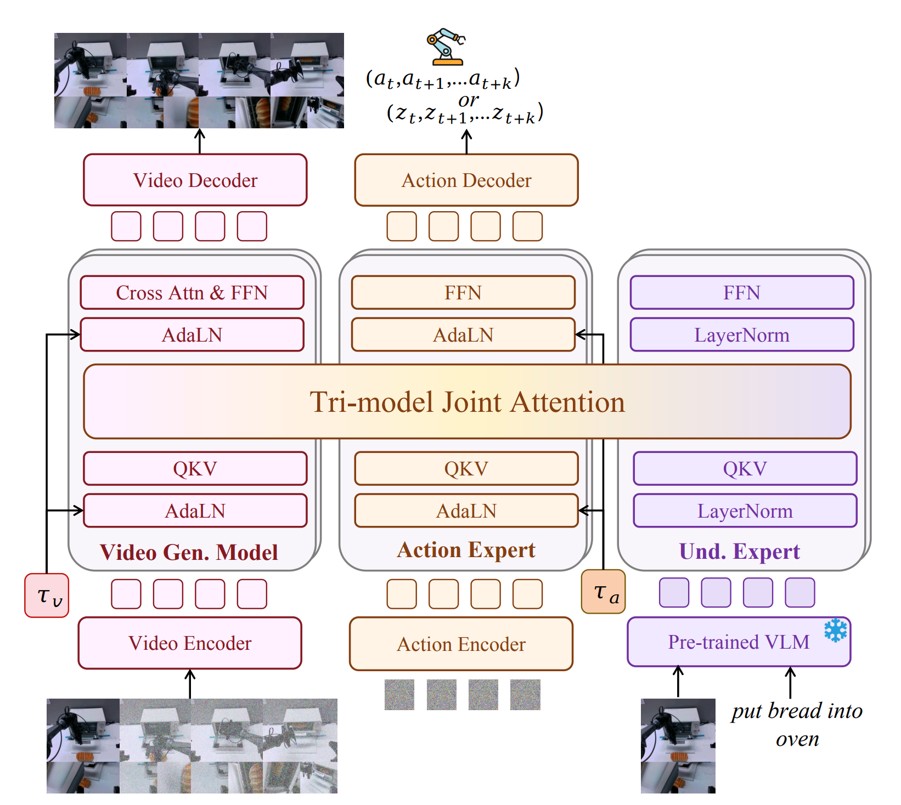
One notable example presented at CVPR 2026 is Motus, which seeks to unify video generation and robot action modeling within a single architecture.[13]

Conventional embodied AI systems typically decompose these capabilities into separate models: one for video generation, another for environment understanding, and yet another for action prediction. Motus instead integrates specialized experts for perception, video generation, and action modeling into a unified framework, allowing a single model to switch seamlessly among multiple operating modes, including world modeling, vision-language-action prediction, inverse dynamics, video generation, and joint video-action prediction.

A particularly important component of Motus is its notion of latent actions.

Action labels in robot datasets vary substantially across embodiments, hardware platforms, and control interfaces, making it difficult to learn transferable action representations directly from raw control commands. Motus addresses this challenge by representing the visual changes between consecutive observations as latent actions derived from optical flow. This representation enables the model to learn motion patterns that are shared across heterogeneous video and robotic datasets, independent of the underlying embodiment.

This work illustrates how action-controllable video world models are evolving beyond environment generation toward general-purpose foundation models that jointly connect perception, prediction, and control. Rather than treating future video generation and control prediction as independent modules, Motus models both modalities within a shared architecture so that they can benefit from common supervision and shared motion representations.

At the same time, it is important not to interpret every modeling objective within Motus as the same type of world model.

Video generation, inverse dynamics, and action prediction each learn different conditional distributions and serve distinct purposes. The primary contribution of Motus is therefore not to reduce these tasks to a single prediction objective, but to demonstrate that they can be unified through a shared representation of motion spanning both visual observations and robot actions.

Despite their flexibility and interpretability, video-based world models come with a significant computational cost.

Generating every pixel of a future scene requires modeling not only task-relevant dynamics but also visual details such as texture, illumination, background appearance, and camera noise—much of which may be irrelevant to downstream decision-making.

This naturally motivates an alternative question: instead of predicting entire future observations, can we predict only the information that actually matters?

The next line of research explored at CVPR 2026 takes precisely this direction, replacing pixel-level prediction with predictive feature representations that capture the semantic information necessary for understanding and decision-making, without reconstructing the complete visual scene.

Image 2. Motus


3. Predicting Predictive States Instead of Future Observations
Not every world model needs to generate future frames that are directly interpretable by humans.

If the representation preserves the information required for an agent to evaluate the consequences of its actions or perform downstream perception tasks, predicting future latent representations may be sufficient. In many cases, forecasting a compact predictive state is both more efficient and more closely aligned with the requirements of downstream decision-making than reconstructing every pixel.

This class of world models can be formulated as
pθ(zt+1:t+H,ztc)
where zt denotes a learned latent representation produced by an encoder, and c represents conditioning information, such as actions, language instructions, or observed temporal context. In action-free video forecasting, cmay not include explicit actions at all.

The central idea is not to reconstruct future observations in their entirety, but rather to preserve the predictive information necessary to distinguish among future states.

Because the model no longer needs to retain every detail required for pixel reconstruction, it can significantly reduce computational complexity while learning representations that are more directly aligned with downstream tasks such as semantic forecasting, depth prediction, or scene understanding.

3.1. DeltaWorld: Predicting Semantic Change Rather Than Future Frames
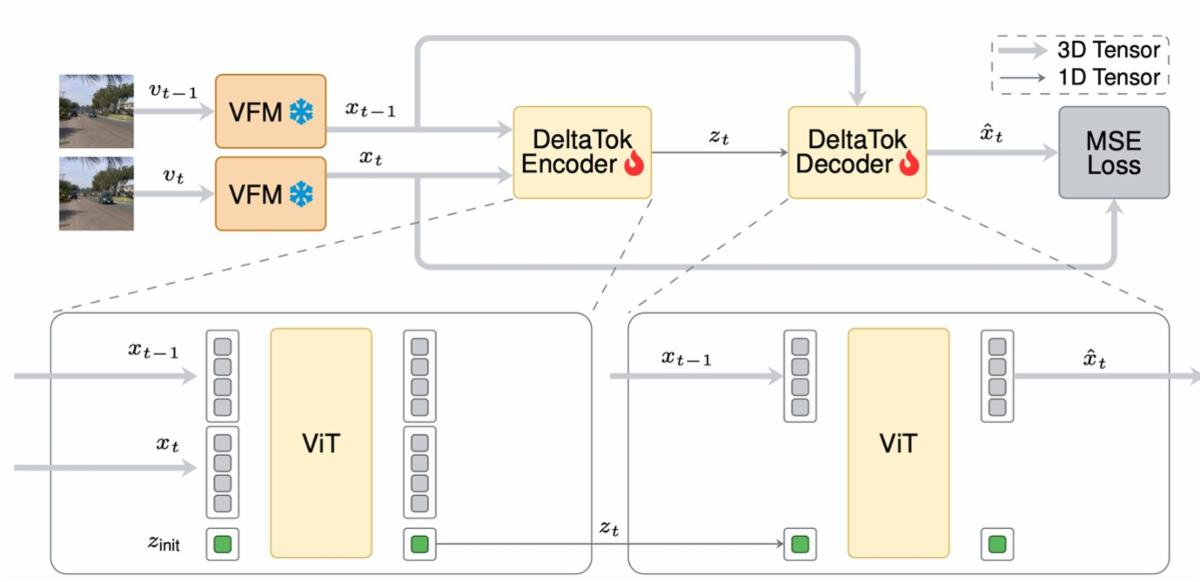
DeltaWorld provides a compelling example of generative world modeling in a predictive feature space rather than in pixel space.[8]

Conventional video world models typically represent each frame using hundreds or even thousands of spatial tokens and autoregressively predict every token in future frames. However, consecutive frames rarely differ everywhere. In most real-world videos, only a subset of objects moves, or the camera viewpoint changes, while much of the scene remains unchanged.

DeltaWorld exploits this observation by introducing DeltaTok, which compresses the feature difference between consecutive frames—computed by a vision foundation model—into a single continuous delta token.
δt=Tψ(F(xt)-F(xt-1))
The world model then predicts future sequences of delta tokens:
pθ(δt+1:t+Hδt)
where F denotes the feature extractor of a vision foundation model and Tψ is a tokenizer that compresses feature differences into compact latent tokens.

Rather than generating future frames directly, DeltaWorld predicts semantic changes in feature space.

This representation dramatically reduces computational cost. In the authors' example, a 512 × 512 frame that would normally require 1,024 spatial tokens is compressed into a single delta token, making it substantially more efficient to model multiple plausible futures simultaneously through multi-hypothesis forecasting.
Importantly, the goal of DeltaWorld is not simply to compress and reconstruct videos more efficiently.

Instead, the predicted latent representations are evaluated according to how well they support downstream scene understanding tasks such as future semantic segmentation and depth forecasting. In other words, the quality of the predictive state is measured not by perceptual realism, but by how accurately it captures the semantic evolution of the future scene.

DeltaWorld therefore illustrates an important shift in the design of world models: the objective is no longer to generate every observable detail of the future, but to predict only those aspects of the future that are informative for perception and decision-making. This perspective aligns closely with the broader trend discussed throughout this article—that the most useful world representation is determined not by its visual fidelity, but by its utility for the downstream task.

Image 3. DeltaWorld [12]


4. Predicting Motion for Control: 3D Traces and Point Flows
In robot manipulation, predicting every pixel of a future scene is often less important than understanding how objects and the robot itself will move in three-dimensional space.

Visual attributes such as texture, lighting, and background are essential for photorealistic rendering, but they may contribute little to deciding where a gripper should move or how an object should be manipulated. For many manipulation tasks, the geometry of motion—not visual appearance—is the representation that matters most.

From this perspective, the future world state can be represented not as a sequence of video frames, but as a task-space trajectory:
pθ(τt+1:t+H,ot at:t+H-1 g)
where τt denotes the 3D motion of objects, end-effectors, or scene points, and g represents the task goal or a language instruction.

Rather than predicting how the future will look, these models predict how the world will move.

4.1TraceGen: Preserving 3D Motion Instead of Pixels
TraceGen takes this idea one step further by predicting future motion in 3D trace space rather than in pixel space.[10]

A trace represents the scene-level trajectories of manipulated objects and robot end-effectors. By abstracting away appearance, background, and camera variations, the representation preserves the geometric structures that are directly relevant to manipulation.
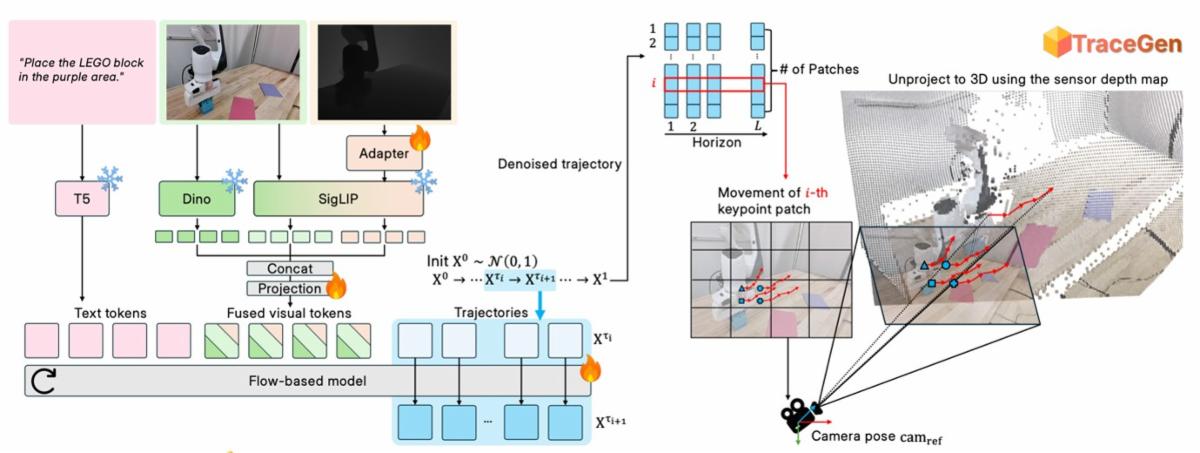
This choice offers an important advantage: it enables human demonstrations and robot executions to be represented within a shared motion space.

Although different robot platforms employ different embodiments, joint configurations, and control interfaces, the underlying scene-centric motion—how an object moves from one location to another—is often transferable across embodiments. Trace representations explicitly capture this common geometric structure.

To exploit this property, TraceGen introduces TraceForge, a large-scale dataset that converts heterogeneous human and robot videos into a unified collection of 3D traces. Using this representation, the model learns transferable motion priors that generalize across robots and tasks. With only a small number of demonstrations from a target robot, TraceGen can adapt to new manipulation tasks and environments while avoiding the computational overhead associated with pixel-space video generation, resulting in substantially faster inference.

In TraceGen, representation compression serves a purpose beyond computational efficiency.

The trace representation explicitly encodes the invariances that matter for robotic manipulation. Differences in camera viewpoint, appearance, and visual texture are intentionally discarded, while the geometric relationships between manipulated objects and robot end-effectors are preserved.

In other words, the representation is designed not to preserve everything, but to preserve exactly what is needed for downstream control.

This highlights a broader principle that recurs throughout world model research: the choice of representation is ultimately dictated by the downstream decision-making problem. A useful world model is not necessarily the one that reconstructs the most information—it is the one that retains the information that matters most for the task at hand.

Image 4. TraceGen [8]


4.2. PointWorld: Predicting Action-Conditioned 3D Scene Dynamics
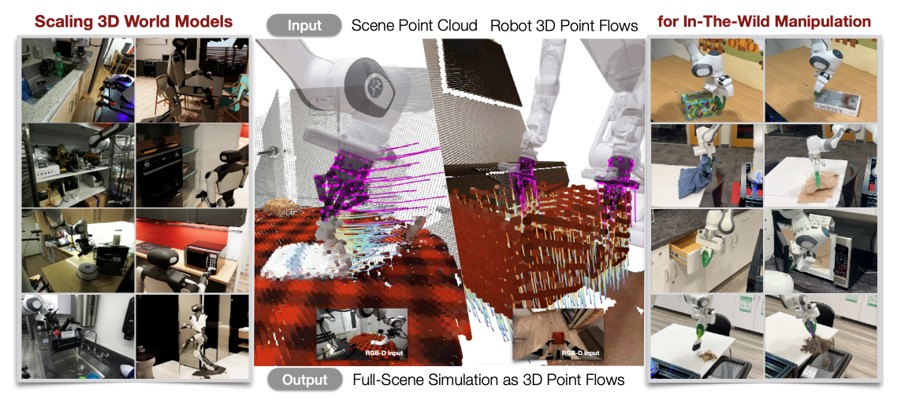
While TraceGen focuses on transferable motion representations, PointWorld models how an entire 3D scene evolves in response to an agent's actions.[14]

Rather than representing the future as pixels or trajectories alone, PointWorld predicts 3D point flows. Given one or a few RGB-D observations together with a sequence of robot actions, the model estimates how every point in the observed scene will move through three-dimensional space.

Formally, the model can be expressed as
pθ(Δ,Pt+1:t+HPtUt:t+H-1)
where Pt denotes the observed 3D point cloud of the scene, Ut represents the robot action encoded as a 3D motion flow, and ΔPt denotes the predicted displacement of each scene point resulting from the executed actions.

A key innovation of PointWorld lies in how actions are represented.

Instead of describing robot actions using embodiment-specific variables—such as joint angles or end-effector commands—the model represents actions as the 3D flow induced by the robot's motion in space. This geometric formulation enables actions from different robot embodiments to be expressed within a common representation, facilitating transfer across heterogeneous robotic platforms.

PointWorld also demonstrates how an action-conditioned world model can be directly integrated into model predictive control (MPC).

Given multiple candidate action sequences, the model rolls out the corresponding future point flows and evaluates how each action changes the scene. The controller can then select the action sequence that brings the environment closest to the desired goal.

In this setting, the output of the world model is not a video for human interpretation, but a 3D state transition that can be evaluated directly by the control objective.
Although TraceGen and PointWorld both predict future 3D motion, they emphasize different aspects of world modeling.

TraceGen focuses on learning transferable motion priors from heterogeneous human and robot videos by representing manipulation as scene-level 3D traces. PointWorld, in contrast, predicts the action-conditioned consequences of candidate robot actions within the current scene and uses those predictions directly for planning and control.

Together, these two works highlight an important principle: the prediction space of a world model should be aligned with the downstream action space.

A useful world model is not necessarily the one that reconstructs every observable detail of the environment. If it can accurately and efficiently predict the state variables required for decision-making, a more compact representation may serve as an even more effective simulator than a photorealistic video model.

Image 5. PointWorld [14]


5. Modeling Physical State Evolution: Learned Physics Dynamics
While video- and trajectory-based world models focus on what the future will look like or how objects will move, physics-based predictive models seek to capture the underlying dynamics that govern state evolution.

Instead of directly predicting observations, these models learn how latent physical states change over time.

A general formulation of latent dynamics can be written as
dhtdt=fθ(h(t))h(t+Δt)=ODESolve(fθ, ,h(t) Δt)
where ht denotes a latent physical state containing information such as velocity, acceleration, or material properties, and fθ represents the learned dynamics governing how the state evolves over time.

Unlike previous world models that primarily predict future observations, this formulation focuses on learning the transition rule itself.

5.1. ParticleGS: Learning Physical Dynamics for Future Scene Evolution
One representative example from CVPR 2026 is ParticleGS, which models dynamic 3D scenes through the lens of a physical particle system.[15]

Conventional approaches to dynamic 3D reconstruction typically learn time-conditioned deformations that accurately interpolate between observed frames. While effective for reconstructing the observed time interval, such methods often struggle to extrapolate reliably beyond the available observations because they primarily learn appearance changes rather than the underlying physical dynamics.
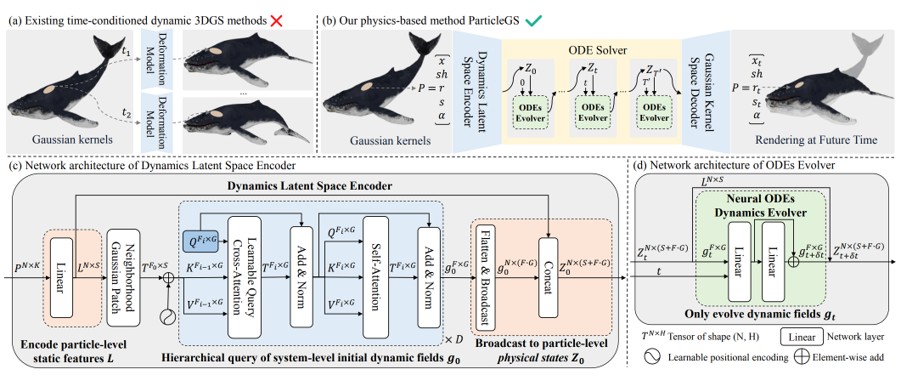
ParticleGS addresses this limitation by treating every 3D Gaussian as a physical particle.

The scene is decomposed into two components: static properties that remain constant and an initial dynamic state that evolves over time. An encoder first maps each Gaussian into a latent physical state, a Neural ODE-based dynamics module models its continuous-time evolution, and a decoder transforms the evolved latent state back into Gaussian deformations for rendering future scenes.

The process can be summarized as
hi(0)=Eψ(Gi)hi(t)=ODESolve(fθ, ,hi(0) t)Gi(t)=Dω(hi(t))
where Gi denotes an individual 3D Gaussian and hit represents its latent dynamic state.

Importantly, describing ParticleGS as a physics-based model does not imply that Newtonian equations or explicit material simulators are hard-coded into the architecture.

Instead, the model learns latent physical dynamics directly from video observations without relying on predefined physical laws. In this sense, ParticleGS is better understood as a learned dynamics model equipped with a physics-inspired inductive bias—namely, physical state decomposition and continuous-time evolution—rather than as an explicit physics simulator.

ParticleGS also illustrates an important distinction between visual interpolation and physical extrapolation.

A model that smoothly reconstructs frames between observed timestamps does not necessarily predict what happens after the observations end. Accurate long-horizon prediction requires more than learning correlations between time indices and appearance. The model must instead learn how latent states evolve according to consistent transition dynamics.

This distinction becomes increasingly important as prediction horizons grow longer.

During long rollouts, even small transition errors accumulate over time. As a result, maintaining dynamics consistency—including properties such as continuity, conservation, and physically plausible interactions—often becomes more critical than producing visually realistic individual frames.

From this perspective, physics-based world models represent another point in the broader design space explored throughout this article. Rather than asking what the future should look like, they ask a fundamentally different question: what physical principles govern how the world changes over time?

Image 6. ParticleGS [15]


6. Align While Search: Belief and Belief-Conditioned Simulation
Having examined several paradigms of world modeling presented at CVPR 2026, we can now position Align While Search (AWS)—the work presented by LG AI Research—within this broader landscape.[9]

To begin, it is useful to clarify what AWS is not.

A conventional world model typically learns a transition model such as
pθ(ot+1,htat) or pθ(st+1,stat),
where the objective is to predict future observations or latent states conditioned on the current state and action.

AWS does not learn such a transition model. It is neither a video-based simulator that generates future observations nor a learned latent dynamics model.

Instead, AWS uses a frozen large language model (LLM) as two complementary inference operators:
  1. a belief updater that infers latent world structure from observations, and  

  1. a belief-conditioned approximate simulator that predicts the consequences of candidate actions. 


From Policy Learning to Belief Inference

Consider an embodied LLM agent operating in an environment such as ALFWorld, where it must complete a task such as "Put the mug into the trash bin."

The agent never observes the entire environment at once. Instead, it only perceives its current room and nearby objects, and must decide where to explore next based on these partial observations.

Conventional supervised fine-tuned (SFT) agents tend to replay exploration trajectories frequently observed during training. While they do explore, their exploration is often weakly grounded in the current observations. When the environment layout differs from those seen during training, these agents continue following average exploration patterns rather than adapting their behavior to the structure of the current environment.

AWS reframes this failure as a problem of posterior inference over latent environment structure.

Each environment is assumed to be governed by an underlying latent variable ϕ, representing high-level semantic structure—for example, the household type, spatial organization, or object co-occurrence patterns. Together with the target object's location l, the latent variable becomes
z=(ϕ, l).
Given the interaction history
ht=(ot), a<t),
the agent maintains a posterior belief
bt(z)=p(zht).

Hierarchical Belief Representation
Exact posterior inference is intractable because the latent variable ϕ resides in an open-ended natural language space.

AWS therefore introduces a hierarchical approximation:
q(zht)=q(ϕht)q(l,ϕht).
The higher-level belief represents a small set of natural-language hypotheses describing household-level structure, while the lower-level belief models the target object's location as a categorical distribution conditioned on each hypothesis.

The first LLM invocation serves as a posterior updater.

Given a new observation ot+1 and the current belief qtz, the frozen LLM performs
qt+1(z)=F(qt,(z),ot+1at).
Rather than generating an action directly, the LLM revises hypotheses about the latent world structure and projects those hypotheses into updated beliefs over object locations.

In this formulation, the LLM functions as an approximate Bayesian inference engine rather than merely a policy generator.

Belief-Conditioned Simulation
The second LLM invocation is used for action evaluation.

Suppose the agent wishes to evaluate a candidate action a. It must estimate what observation may result after executing that action.

Instead of prompting the LLM without context, AWS conditions the simulation on the agent's current belief:
o~'~SLLM(·ht,a,qt(z))
This conditioning is the key innovation.

The question is no longer simply
"What would I observe after taking this action?"
but rather
"Given everything I have observed so far, and given my current belief about the hidden structure of this environment, what am I likely to observe after taking this action?"

Consequently, AWS rolls out futures that are conditioned not only on the interaction history but also on the latent world structure inferred from that history.

Information-Seeking Action Selection
These belief-conditioned simulations are then used to approximate the expected information gain of each candidate action.

Instead of greedily selecting the action that appears closest to the goal, AWS explicitly chooses the action expected to reduce uncertainty about the latent variable zas much as possible.

Formally,
argmaxaEo~'~LLM(·ht,a,qt)DKLq(zht,a,o~')q(zht)+λRalign(a,ht)
The selected action therefore maximizes not only task progress but also the expected reduction in uncertainty regarding the hidden environment.

AWS as World Modeling Through Belief
From this perspective, AWS is not a world model in the conventional sense.

It does not learn transition dynamics, generate future observations, or construct a latent dynamics model from data.

Nevertheless, AWS is closely connected to the broader discussion of world modeling because it employs a frozen LLM as a belief-conditioned approximate simulator.

The important point is not that the LLM simulator perfectly predicts the future. Rather, by conditioning simulation on the current belief, AWS produces predictions that are substantially more relevant for the agent's decision-making process.

The resulting decision loop is
observationbelief updatebelief‐conditioned simulationinformation‐gain actionnew observation
Belief is therefore not merely an intermediate representation. It serves as the central interface connecting perception, simulation, and exploration.

Viewed in this light, AWS demonstrates that under partial observability, effective world modeling need not rely on learning an explicit dynamics model. Instead, maintaining an accurate belief over the hidden world state—and conditioning approximate simulation on that belief—can produce more grounded exploration and more informed action selection.

7. Toward World Models for Electronic Design Automation
The examples discussed so far illustrate that the appropriate representation of the future depends fundamentally on the downstream application.

Video generation, predictive latent features, 3D traces, point flows, physical states, and belief representations all capture different aspects of the world because they support different forms of decision-making.

This naturally raises a broader question:
What should an agent predict when the environment is not a physical world, but an engineering design process?

To explore this question, we turn to an ongoing research effort in the Data Intelligence (DI) Lab at LG AI Research, where we are developing AI agents for electronic design automation (EDA), with a particular focus on printed circuit board (PCB) design.

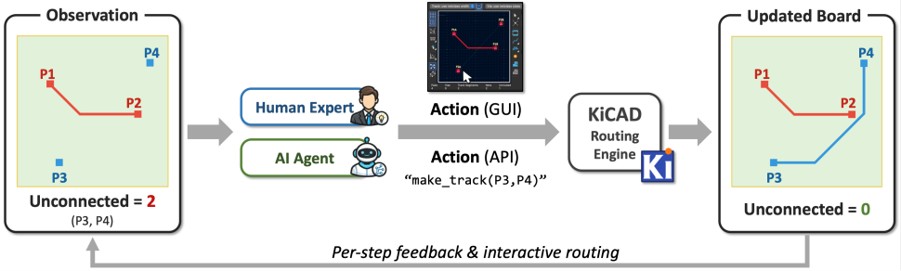
Our recently proposed PCBWorld framework[16] provides an engine-grounded environment in which an AI agent incrementally designs printed circuit boards by executing native operations in KiCad. After each design action, the agent observes the updated board state together with the results of Design Rule Checking (DRC), allowing it to interact with the design environment through the same engineering workflow used by human designers.

This setting presents a fundamentally different notion of world modeling. Rather than predicting future images or object trajectories, the agent must reason about how design decisions alter the evolving state of an engineering artifact—a question we explore in the remainder of this article.

Image 7. PCBWorld [16]


World Models for PCB Design: Predicting Long-Term Design Consequences
The state of a PCB design is fundamentally different from that of a physical environment. Rather than consisting of images or object trajectories, it is composed of structured engineering information, including board geometry, component placement, routing topology, and design constraints.

Formally, the design state can be represented as
st=Gt, ,N, ,Pt, ,Rt, ,Ct,
where Gt denotes the board geometry, N the netlist, Ptthe component placement, Rt the routing state, and Ct the design constraints and resource state.

Actions correspond to native CAD operations such as moving components, adding routing segments, changing routing layers, inserting vias, or performing rip-up operations.

Within PCBWorld, the outcome of every action—as well as all hard design constraints—is computed exactly by the underlying KiCad engine:
st+1=Tengine(st,at).
Because the environment already provides exact one-step state transitions, learning another model to predict these transitions is of limited value.

Instead, the more important question is how today's design decisions influence future design feasibility.

A routing action that is locally valid may later block routing paths for other nets, exhaust routing resources within a congested region, or ultimately force expensive rip-up operations. These long-range interactions are difficult to assess from immediate state transitions alone.

From this perspective, a world model for PCB design should not attempt to reconstruct future board states. Rather, it should predict the long-term consequences of candidate design actions.

This can be formulated as
y^t:t+H=Mθst,,at:t+H-1,

where y^ may include quantities such as completion probability, dead-end risk, remaining routability, future routing congestion, and expected rip-up cost. 

The central question therefore shifts from
"Can this routing action be executed?" to "Does this routing action preserve the feasibility of completing the remaining design?"

Rather than replacing the deterministic design engine, such a learned model serves as a planning surrogate that rapidly evaluates a large number of candidate actions before invoking exact verification.

The resulting planning pipeline becomes
Candidate generationLearned predictionEngine verification.

In this formulation, the role of the world model is no longer accurate one-step state prediction. Instead, it is to estimate the long-term constraint interactions induced by candidate actions and thereby guide efficient search over the design space.

What's Next
The world model research presented at CVPR 2026 demonstrates that the term world model no longer refers to a single architecture or modeling paradigm.

Although action-controllable video generation has become the most visible direction in recent years,[1,2] emerging work on predictive latent representations, robot motion representations, physical dynamics, and belief-space reasoning suggests that the appropriate notion of a world model depends fundamentally on the application domain.[7–9]

Consequently, evaluating a world model solely by asking "How realistically can it generate the future?" is no longer sufficient.

A more fundamental question is:
What aspects of the future must an agent predict in order to make better decisions?

For natural images and embodied robotics, pixels and videos provide rich priors about the surrounding environment. In contrast, precision engineering domains such as PCB design require representations that preserve connectivity, geometry, constraints, and resource allocation rather than visual appearance.

Moreover, when an exact deterministic design engine is available, generating future observations becomes considerably less important than predicting how candidate actions affect long-term feasibility and design objectives.

Another intriguing research question is whether the rich visual priors learned from large-scale natural video datasets can transfer effectively to precision engineering domains such as CAD.

Whether these representations ultimately outperform domain-specific structured models or specialized spatial encoders remains an open empirical question. Their value should be evaluated not only in terms of representation quality, but also through sample efficiency, generalization, and planning performance.

Ultimately, the goal is not to identify a universally optimal world representation.

Rather, it is to determine which prediction target provides sufficient information for decision-making in a particular task, and to measure how much that representation actually improves search and planning.

At LG AI Research, we are exploring this direction through PCBWorld, combining an exact CAD engine with learned predictive models to build engine-grounded design agents.

Our long-term vision is to develop planning components that leverage structured design states extracted from KiCad to predict how candidate routing actions influence future routability and constraint interactions. These predictions can then guide search by identifying the most promising design branches while selectively invoking exact engine verification only where necessary.

From this perspective, the future of world modeling may lie not in generating increasingly realistic worlds, but in learning the most decision-relevant representation of the future for each domain.
참고

[1] Jack Bruce, Michael D. Dennis, Ashley Edwards, Jack Parker-Holder, Yuge Shi, Edward Hughes, Matthew Lai, Aditi Mavalankar, Richie Steigerwald, Chris Apps, Yusuf Aytar, Sarah Bechtle, Feryal Behbahani, Stephanie C. Y. Chan, Nicolas Heess, Lucy Gonzalez, Simon Osindero, Sherjil Ozair, Scott Reed, Jingwei Zhang, Konrad Zolna, Jeff Clune, Nando de Freitas, Satinder Singh, Tim Rocktaschel. *Genie: Generative Interactive Environments*. arXiv:2402.15391, 2024.

[2] Google DeepMind. *Genie 2: A Large-Scale Foundation World Model*. Technical report / blog post, 2024.

[3] David Ha, Jurgen Schmidhuber. *World Models*. arXiv:1803.10122, 2018.

[4] Danijar Hafner, Jurgis Pasukonis, Jimmy Ba, Timothy Lillicrap. *Mastering Diverse Domains through World Models*. arXiv:2301.04104, 2023.

[5] Mahmoud Assran, Quentin Duval, Ishan Misra, Piotr Bojanowski, Pascal Vincent, Michael Rabbat, Yann LeCun, Nicolas Ballas. *Self-Supervised Learning from Images with a Joint-Embedding Predictive Architecture*. arXiv:2301.08243, 2023.

[6] Jiatao Gu, Ying Shen, Tianrong Chen, Laurent Dinh, Yuyang Wang, Miguel Angel Bautista, David Berthelot, Josh Susskind, Shuangfei Zhai. *STARFlow-V: End-to-End Video Generative Modeling with Normalizing Flows*. CVPR 2026 Spotlight. arXiv:2511.20462, 2025.

[7] Chenting Wang, Yuhan Zhu, Yicheng Xu, Jiange Yang, Ziang Yan, Yali Wang, Yi Wang, Limin Wang. *InternVideo-Next: Towards General Video Foundation Models without Video-Text Supervision*. CVPR 2026. arXiv:2512.01342, 2025.

[8] Seungjae Lee, Yoonkyo Jung, Inkook Chun, Yao-Chih Lee, Zikui Cai, Hongjia Huang, Aayush Talreja, Tan Dat Dao, Yongyuan Liang, Jia-Bin Huang, Furong Huang. *TraceGen: World Modeling in 3D Trace Space Enables Learning from Cross-Embodiment Videos*. CVPR 2026. arXiv:2511.21690, 2025.

[9] Seohui Bae, Jeonghye Kim, Youngchul Sung, Woohyung Lim. *Align While Search: Belief-Guided Exploratory Inference for World-Grounded Embodied Agents*. CVPR 2026. arXiv:2512.24461, 2025.

[10] Varun Varma Thozhiyoor, Shivam Tripathi, Venkatesh Babu Radhakrishnan, Anand Bhattad. *Objects in Generated Videos Are Slower Than They Appear: Models Suffer Sub-Earth Gravity and Don’t Know Galileo’s Principle...for now*. CVPR 2026. arXiv:2512.02016, 2025.

[11] Pedro M. P. Curvo, Jan-Willem van de Meent, Maksim Zhdanov. *MSPT: Efficient Large-Scale Physical Modeling via Parallelized Multi-Scale Attention*. CVPR 2026. arXiv:2512.01738, 2025.

[12] Tommie Kerssies, Gabriele Berton, Ju He, Qihang Yu, Wufei Ma, Daan de Geus, Gijs Dubbelman, Liang-Chieh Chen. *A Frame is Worth One Token: Efficient Generative World Modeling with Delta Tokens*. CVPR 2026 Highlight. arXiv:2604.04913, 2026.

[13] Hongzhe Bi, Hengkai Tan, Shenghao Xie, Zeyuan Wang, Shuhe Huang, Haitian Liu, Ruowen Zhao, Yao Feng, Chendong Xiang, Yinze Rong, Hongyan Zhao, Hanyu Liu, Zhizhong Su, Lei Ma, Hang Su, Jun Zhu. Motus: A Unified Latent Action World Model. CVPR 2026. arXiv:2512.13030, 2026

[14] Wenlong Huang, Yu-Wei Chao, Arsalan Mousavian, Ming-Yu Liu, Dieter Fox, Kaichun Mo, Li Fei-Fei. PointWorld: Scaling 3D World Models for In-The-Wild Robotic Manipulation. CVPR 2026. arXiv:2601.03782, 2026

[15] Jinsheng Quan, Qiaowei Miao, Yichao Xu, Zizhuo Lin, Ying Li, Wei Yang, Zhihui Li, and Yawei Luo. ParticleGS: Learning Neural Gaussian Particle Dynamics from Videos for Prior-Free Physical Motion Extrapolation. CVPR 2026. arXiv:2505.20270, 2025

[16] Hyungseok Song, Junseok Park, Won-Seok Choi, Seohui Bae, Han-Seul Jeong, Youngjoon Park, Soonyoung Lee. PCBWorld: A Benchmark Environment for Engine-Grounded PCB Design Automation. arXiv:2607.05915, 2026.