A company's sustainable growth driver lies not in reports, but in the tabular data and field-tested know-how accumulated on the ground—such as production line sensor values, failed experiment logs, and expert judgment criteria. This tabular data is a vital asset underpinning decision-making across industries, including clinical risk prediction, credit scoring, predictive equipment maintenance, and manufacturing quality control.
Tree-based boosting models such as XGBoost, LightGBM, and CatBoost have long served as the de facto standard for tabular data prediction. However, this approach has a key limitation: each new dataset requires separate training, consuming substantial labeled data and computational resources every time. LG AI Research introduces 'EXAONE Tabular,' a foundation model for classification and regression on structured (tabular) data, offering a fundamentally different approach that eliminates this retraining burden altogether.
'EXAONE Tabular' was pretrained entirely from scratch using only self-generated synthetic data, without using a single row of real tabular data. It takes a labeled support set together with an unlabeled query set as input and produces predictions instantly, without any parameter updates. Built as separate models specialized for classification and regression, a single pretrained model can generate predictions on new data by using the given tabular examples as context (in-context learning)—without any dataset-specific training.
EXAONE Tabular is particularly robust to data containing missing values or errors, a property built directly into its training. Because the synthetic data used for pretraining was generated to include scenarios with missing values, the model achieves stable performance even amid the imperfections characteristic of real-world field data. It is already deployed in critical manufacturing processes such as battery cell defect detection, demonstrating the practical value of field-data-driven AI innovation by predicting finished product quality and proactively flagging potential defects.
TabArena is a benchmark featuring 51 real-world prediction tasks (38 classification, 13 regression). In accuracy vs. latency comparisons, 'EXAONE Tabular' positioned itself on the Pareto frontier across both classification and regression tasks through a single forward-pass inference taking just 0.605 seconds per 1,000 samples. Notably, in classification, it recorded the highest Elo score on the overall leaderboard, outperforming TabPFN-3 (53M)—a model 2 to 3 times larger—by about 125 points, and surpassing TabICLv2 (28M) by an even wider margin. It also outperformed AutoGluon, a 4-hour AutoML pipeline for tabular data, across both tasks. In terms of overall dataset-level win rate, 'EXAONE Tabular' demonstrated a 65–92% win rate against all foundation models except TabFM, proving that its superiority is consistent and not limited to specific datasets.
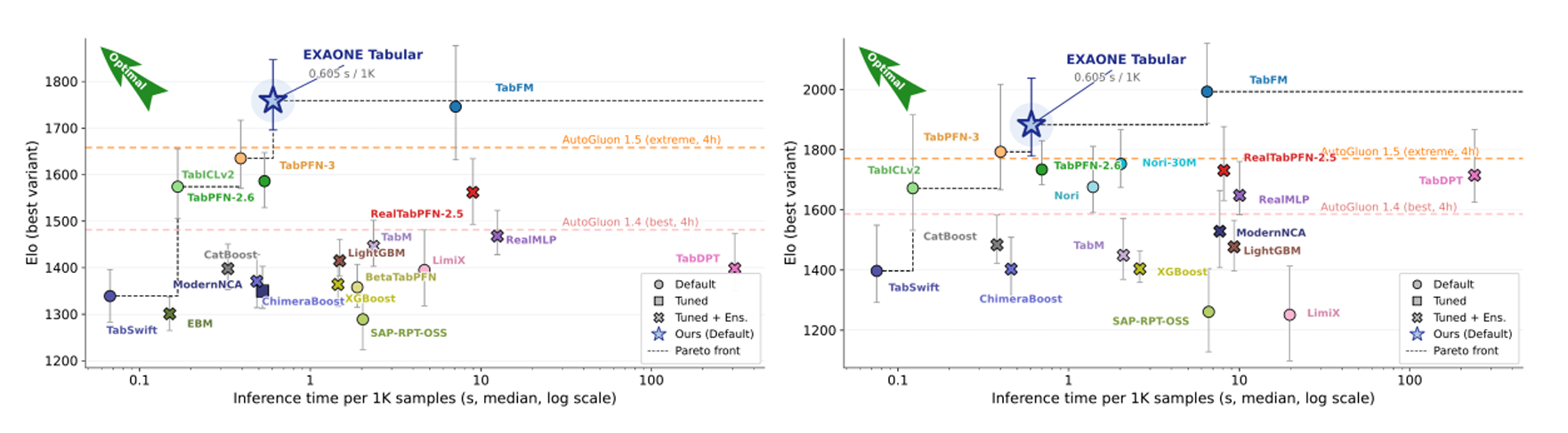
Figure 1. Accuracy (Elo) vs. Inference Latency Pareto Frontier (Left: Classification, Right: Regression).
EXAONE Tabular (represented by the star) lies on the Pareto-optimal frontier in both tasks with only a single forward pass (0.605s per 1K samples).
(Source: EXAONE Tabular 1.0 (http://arxiv.org/abs/2608.25774))
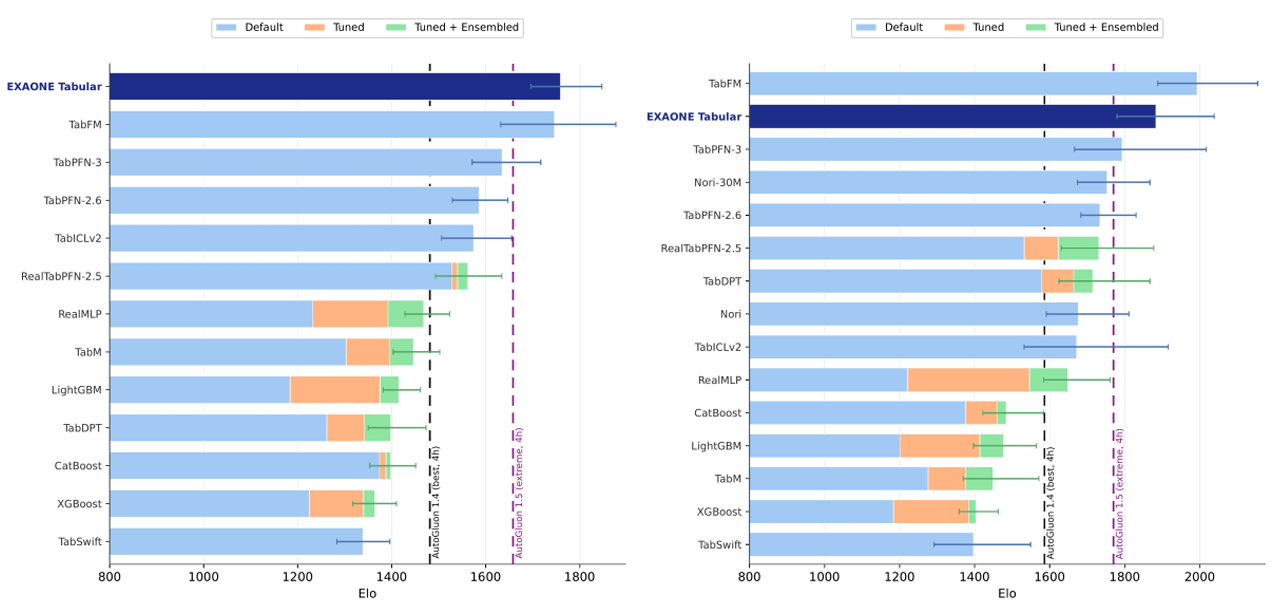
Figure 2. Effects of Tuning (Orange) and Ensembling (Green) vs. Default Settings (Left: Classification, Right: Regression).
While most GBDT and neural network models require hours of tuning to reach top performance, EXAONE Tabular achieves top-tier results out of the box with zero tuning.
(Source: EXAONE Tabular 1.0 (
http://arxiv.org/abs/2608.25774))
■ Proven Performance Across 4 Public Benchmarks
Beyond TabArena, LG AI Research verified its performance across four public benchmarks: 'BCCO,' which includes numerous datasets with missing values, 'TALENT,' which spans large-scale classification and regression datasets, and 'ScoringBench,' which evaluates the quality of predictive distributions.
The most notable result isn't the accuracy scores themselves, but the fact that they were achieved with far fewer parameters. Across the BCCO (106 classification, 50 regression datasets) and TALENT (188 classification, 100 regression datasets) benchmarks, 'EXAONE Tabular' placed a close 2nd in classification behind Google's TabFM—0.792 vs. 0.799 on BCCO and 0.857 vs. 0.863 on TALENT—while still outperforming similarly sized models such as TabICLv2 and TabPFN-3 in both benchmarks. In regression, it took 1st place, surpassing even TabFM at 0.799 vs. 0.792 on BCCO and 0.736 vs. 0.733 on TALENT. In both benchmarks, the classification gap with TabFM was under 1%: while TabFM relied on an ensemble of 32 models and 1.64B parameters, 'EXAONE Tabular' achieved this performance using only an 8-model ensemble and 20.81M parameters—roughly 1/80th the parameter count. This translates directly into practicality: comparable performance with far less compute, making the model readily deployable in the field.
On ScoringBench (102 regression datasets, 28 baseline models), which evaluates the accuracy of predictive distributions, 'EXAONE Tabular' ranked 1st in average rank across both point estimation metrics (R², RMSE) and the distribution evaluation metric (CRPS), demonstrating its ability to go beyond simple point estimates and precisely capture prediction uncertainty.
■ Key Technology ① Cross-Axis Summary Transformer (CAST)
At the core of 'EXAONE Tabular' is an in-house neural network architecture called 'Cross-Axis Summary Transformer (CAST)'. Existing tabular foundation models often rely on a two-stage structure where features within each row are compressed into a single fixed vector before being passed to a separate row-level module. In contrast, CAST alternates between feature-axis attention within individual samples and sample-axis attention conditioned on the support set within each feature across every Transformer layer. These operations are mediated by 'item summary tokens' and 'feature summary tokens'. This allows cell-level representations to be maintained throughout the entire network while gradually refining feature interactions and support-set contextual information as layer depth increases.
Figure 3. (1) SCM-Based Synthetic Data Generation: Generates training tasks by combining causal graphs, functional mechanisms, and missingness/noise patterns.
(2) CAST’s Cross-Axis Attention Architecture: Column summaries ($S_c$) and row summaries ($S_r$) exchange information exclusively through cell representations.
(3) Task-Specific Heads: Performs task-tailored training using dedicated heads for classification and regression, respectively.
(4) In-Context Learning Inference: Takes a support set and a query set as inputs to output class probabilities or predictive distributions.
(Source: EXAONE Tabular 1.0 (http://arxiv.org/abs/2608.25774))
■ Key Technology ② Pre-Training Built Purely on Synthetic Data
The most notable aspect of the 'EXAONE Tabular' training process is that it did not use a single piece of real-world tabular data. Instead, LG AI Research built a proprietary generator based on Structural Causal Models (SCM). It randomly generates Directed Acyclic Graphs (DAGs), assigns relationships using mechanisms like non-linear transformations and tree-based rules, and applies post-processing (e.g., categorical variable discretization and non-linear feature distortion) to precisely recreate distributions likely to occur in real data. Missing values were also carefully injected to mimic real-world missingness patterns, securing training signals close to practical conditions.
Thanks to pre-training on distributions and missingness patterns that closely mirror reality, 'EXAONE Tabular' accepts missing values directly as input without requiring separate imputation, reflecting the presence or absence of values directly into feature representations. On the BCCO benchmark, which contains a high proportion of missing values, it placed 2nd in classification and 1st in regression, proving robust performance under conditions close to real-world deployment. This synthetic data design, untethered to any specific industry or domain, forms the foundation for its generalizable predictive capabilities applicable to unseen real-world datasets.
EXAONE Tabular: A New Alternative for Structured Data Prediction
With 'EXAONE Tabular', LG AI Research has proactively secured technological leadership in the structured data AI market—where global tech giants are fiercely competing—expanding EXAONE's footprint beyond text and vision into tabular data processing and prediction.
The inference software and technical documentation are available on GitHub and Hugging Face, supporting for research and educational purposes, with separate licensing available for commercial use. Starting in the second half of this year, LG AI Research plans to initiate full-scale validation work in biotech and healthcare and finance, as well as driving diverse applications and innovations in manufacturing.
Hugging Face →
GitHub →
 Moonjung Eo
2026.09.09
Moonjung Eo
2026.09.09