 Seungdong Yoa
2026.11.05
[ICLR2026] Beyond Static Benchmarks: An Agent-Centered Dynamic Assessment Protocol (ATAD) for Evaluating LLM Reasoning Capabilities
1. Limitations of existing static benchmarks and new motivation
The static benchmarks currently widely used for evaluating LLMs have the following structural limitations.
● Performance Saturation: The latest LLMs have already surpassed human-level performance on static benchmarks, leading to a loss of ability in distinguishing performance differences between models.
● Data Contamination: Evaluation data is included in the large-scale pre-training process, causing models to memorize it and resulting in inflated leaderboard scores.
● Format Overfitting: Model developers tune the system to specific formats within the dataset, creating a feedback loop where scores rise without any actual improvement in general-purpose reasoning capabilities.
● Short Lifespan: Once a benchmark is conquered, building a new one requires an enormous amount of time and resources, making sustainable evaluation difficult.
Due to these issues, there has been a growing need for dynamic evaluation, a method that prevents data corruption and allows the model to continuously evolve in line with advancements in the model itself.
However, while existing dynamic benchmarks have been limited to simply generating or scaling problems, ATAD distinguishes itself by introducing an “agent-centric three-party interaction structure (Teacher-Orchestrator-Student).” In particular, the Orchestrator is solely responsible for validation, preventing a loss of clarity and an increase in ambiguity that can occur as the difficulty level rises, and by identifying the points where the student agent fails, enabling “Failure-Driven Sample Finalization”, it has created a high-quality benchmark protocol that more precisely reveals the model’s actual blind spots.
In particular, when creating problems in the field of Text Anomaly Detection, researchers consistently face a major challenge: the “trade-off between clarity and difficulty.” This is because, unlike in mathematics or science, language does not have clear mathematical formulas or fixed answers; consequently, attempting to increase the difficulty often results in ambiguous correct answers, while making the correct answer too clear makes the problem too easy, causing it to lose its discriminative power.

Figure 1. Comparison of text anomaly detection issues between existing benchmarks and ATAD[1]
For example, existing benchmarks often insert a completely out-of-context sentence, such as “Oil prices fell following an OPEC announcement,” into a passage with “A tennis champion withdrew due to an injury.” While the correct answer is obvious, this is a trivial problem for state-of-the-art LLMs.
ATAD, on the other hand, is far more sophisticated. Within the context of “AI is revolutionizing healthcare,” it induces a subtle shift in topic, such as listing technical benefits like treatment plan optimization or real-time vital sign monitoring, only to suddenly raise ethical concerns about AI. This creates a challenging problem that requires advanced linguistic and logical reasoning skills, while still maintaining a clear basis for the correct answer.
2. ATAD Protocol Structure and 7 Text Anomaly Detection Tasks
ATAD addresses this problem by introducing a protocol in which three AI agents interact, rather than using a fixed dataset. Unlike mathematics or code, natural language lacks clear formulas, making text anomaly detection a rigorous stress test to validate whether it is possible to increase the difficulty while maintaining clarity.
● Teacher Agent (Questioner): Generates basic problems; if a Student answers a problem correctly, it generates increasingly difficult variations based on the analysis.
● Orchestrator Agent (Validator): Strictly validates the logical consistency, clarity, and fairness of the generated problems to prevent ambiguous or inappropriate adversarial difficulty increases.
● Student Agent (Solver): Solves the validated problems. When a Student fails a problem, that problem is confirmed as the final benchmark item (Failure-Driven Sample Finalization).
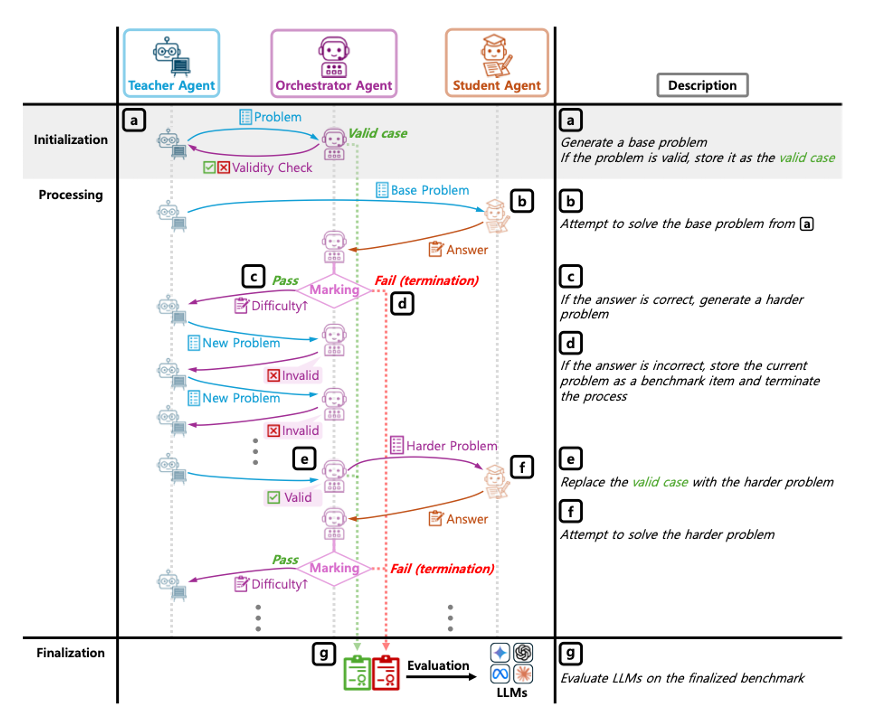
Figure 2. ATAD’s Teacher-Orchestrator-Student-based dynamic evaluation protocol[1]
Representative tasks include Sentence Context Anomaly (T1), which finds semantic deviations in context; Referential Ambiguity (T5), which finds ambiguity in demonstrators or pronouns; and Tone/Style Violation (T7), which finds inconsistencies in style and tone. Each task validates the model's various reasoning capabilities from multiple angles.
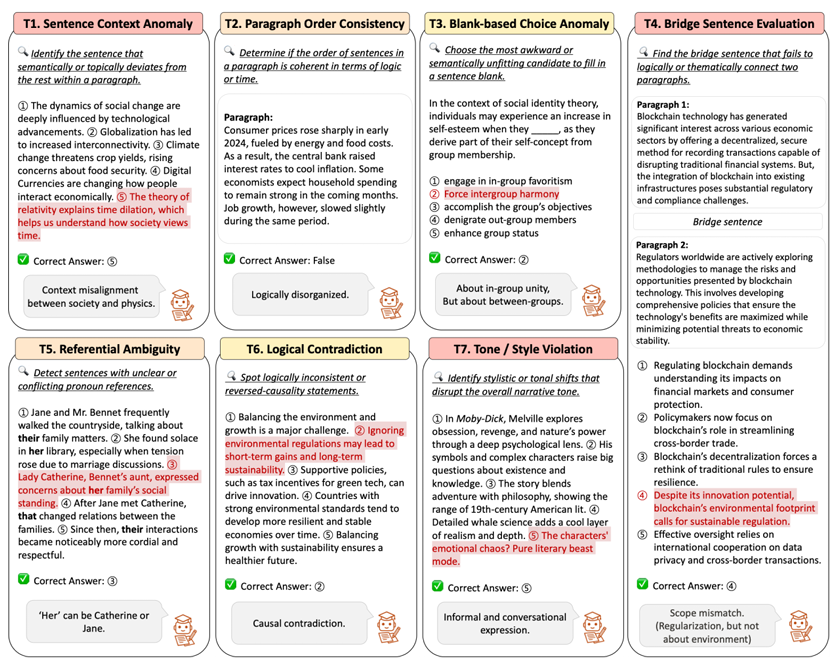
Figure 3. Examples of 7 text-based anomaly detection tasks defined by ATAD[1]
First, the performance patterns of LLMs varied across tasks. Even models that showed relatively high performance on average performed worse than other models on specific tasks, and no single model consistently demonstrated the highest performance across all seven tasks. This demonstrates that each model has its own unique strengths and weaknesses (blind spots) in different reasoning abilities, such as contextual understanding, logical connections, reasoning of the target of instructions, and stylistic judgment. In the actual experiments, performance patterns also varied significantly among models depending on the type of anomaly.
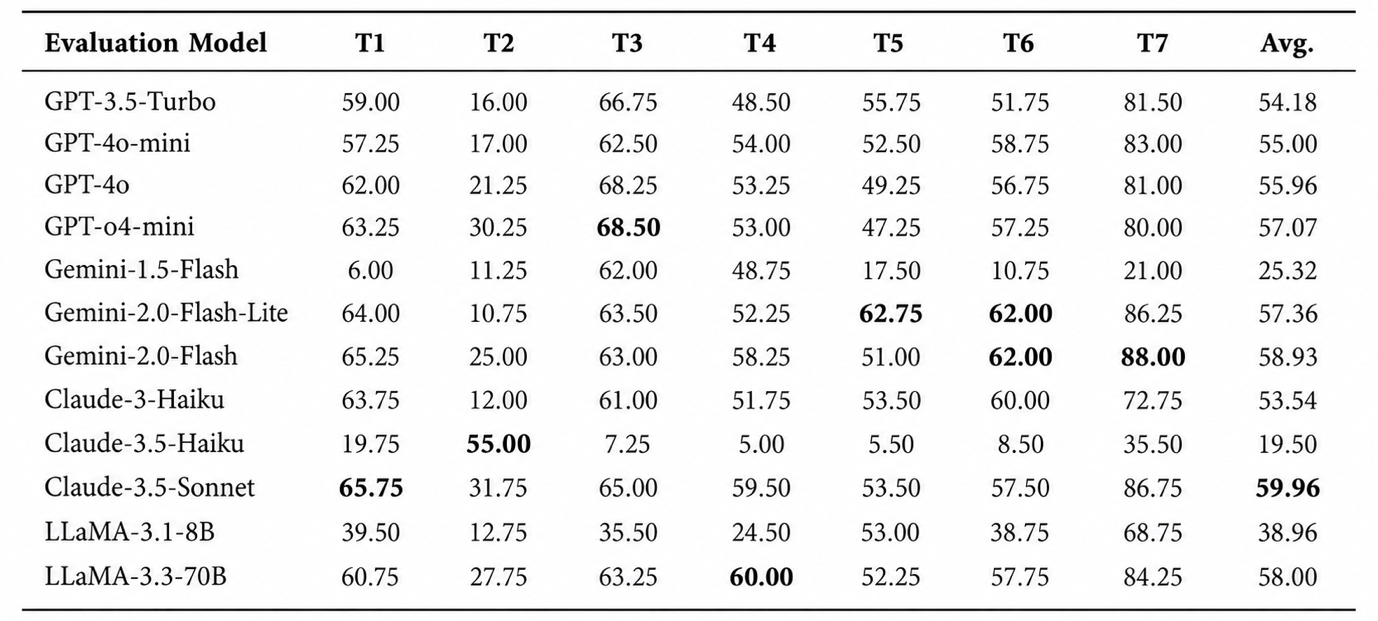
Table 1. Performance comparison by LLM across 7 tasks of the ATAD benchmark[1]
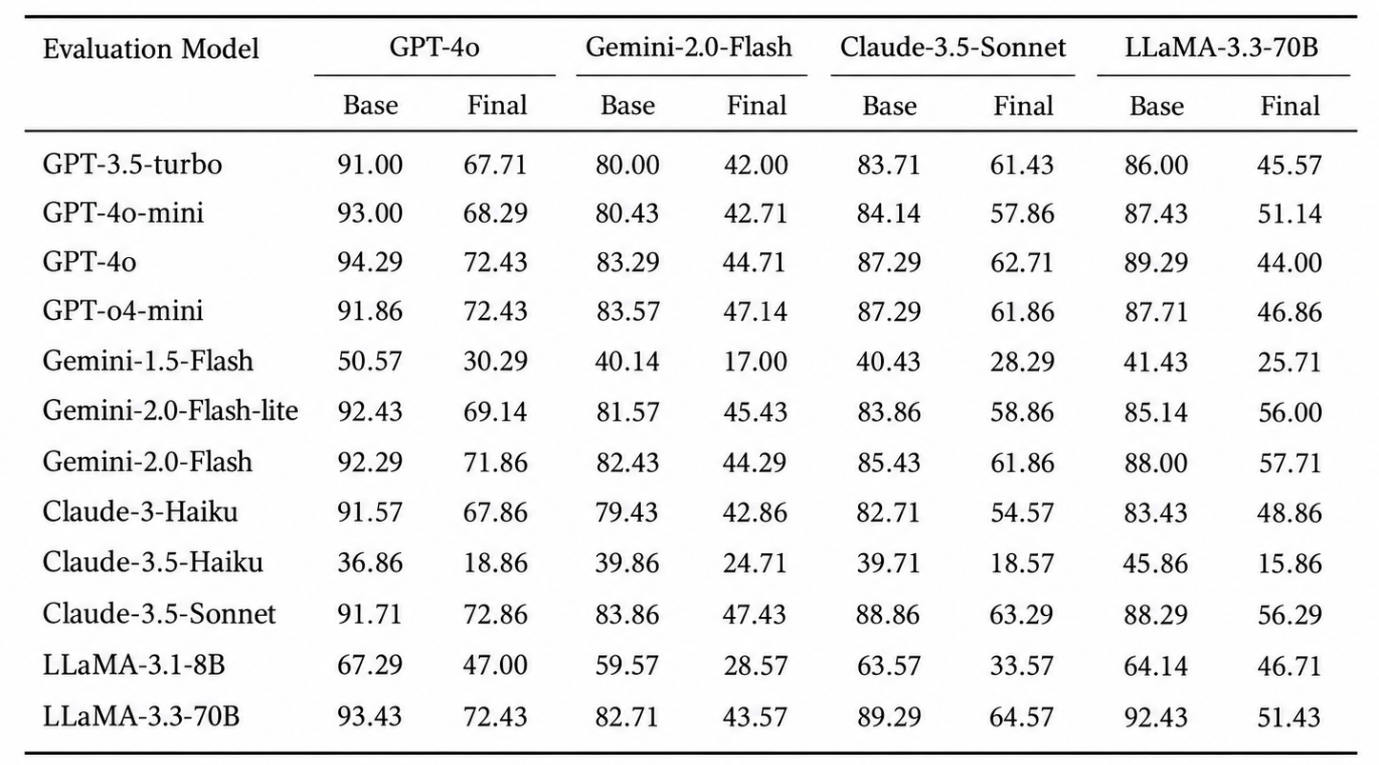
Table 2. Comparison of LLM performance on the base problem and the final problem generated through ATAD[1]
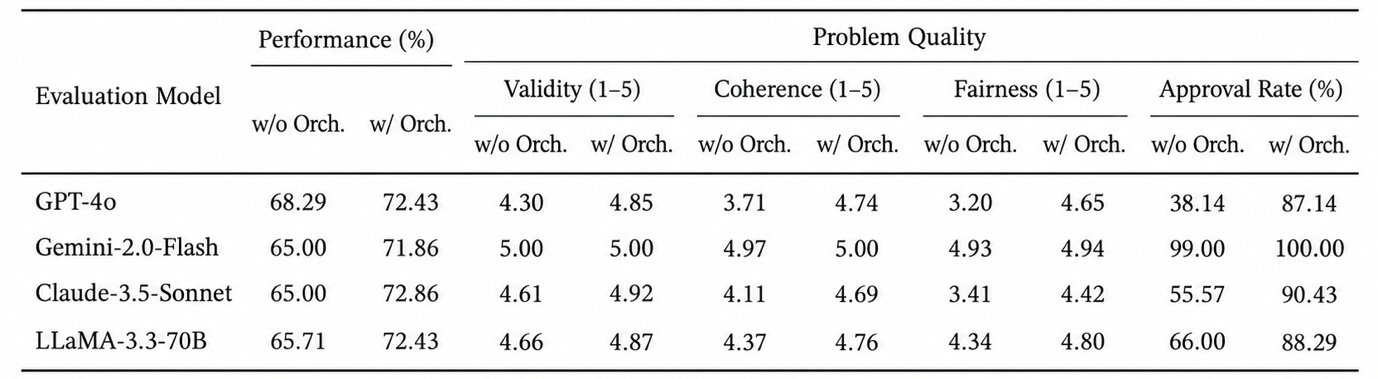
Table 3. Comparison of problem difficulty and quality based on whether the Orchestrator is applied[1]
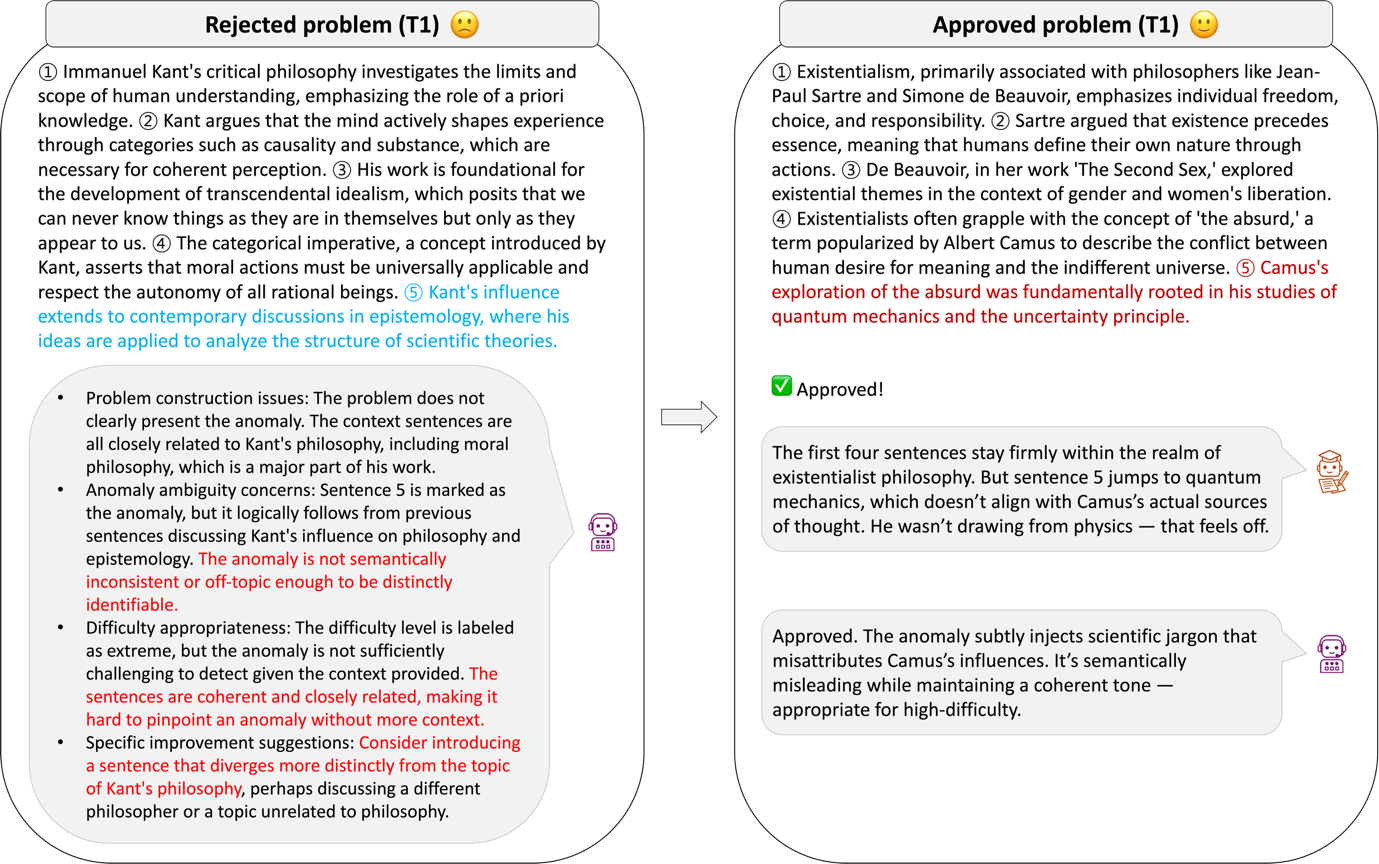
Figure 4. Example of problem improvement through Orchestrator feedback[1]
In contrast, ATAD defines a benchmark not as a fixed set of data, but as a protocol through which the Teacher-Orchestrator-Student interact. Currently, when the Student solves a problem, the Teacher generates a more difficult problem, and the Orchestrator validates that the problem remains clear and fair. Therefore, even if a more powerful model emerges to take on the role of the Student, the difficulty of the evaluation can be raised again to match that model’s capabilities.
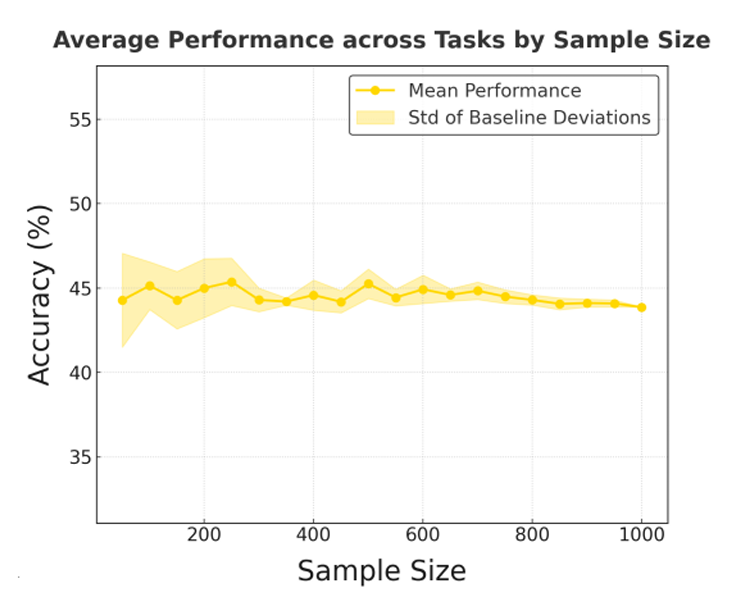
Figure 5. Stability of evaluation performance according to the number of benchmark samples[1]
- 참고
- [1] Seungdong Yoa, Sanghyu Yoon, Suhee Yoon, Dongmin Kim, Ye Seul Sim, Junhyun Lee*, Woohyung Lim*. From Static Benchmarks to Dynamic Protocol: Agent-Centric Text Anomaly Detection for Evaluating LLM Reasoning. In International Conference on Learning Representations (ICLR), 2026.
[2] Dan Hendrycks, Collin Burns, Steven Basart, Andy Zou, Mantas Mazeika, Dawn Song, Jacob Steinhardt. Measuring Massive Multitask Language Understanding. In International Conference on Learning Representations (ICLR), 2021.
[3] Karl Cobbe, Vineet Kosaraju, Mohammad Bavarian, Mark Chen, Heewoo Jun, Lukasz Kaiser, Matthias Plappert, Jerry Tworek, Jacob Hilton, Reiichiro Nakano, Christopher Hesse, John Schulman. Training Verifiers to Solve Math Word Problems.