 Hyeseung Cho
2021.06.03
Hyeseung Cho
2021.06.03
Hyeseung Cho, the Researcher Who Thinks Up AI That Benefits the World
She chose to become an engineering sciences researcher, and AI has become a reliable supporter and enabler of her choice. We met with Data Intelligence Lab Researcher Hyeseung Cho, who searches for solutions among vast amounts of data with equal parts of seriousness and fun.
Falling in Love with Audio Signals
Hyeseung Cho majored in electronic engineering in university and graduate school. Feeling that a university education wasn’t enough for her to foray out into society, she decided to attend graduate school. Audio signal processing was her first area of study.
“I had a chance to edit some audio during high school when I was preparing for the school festival, and I saw what an audio signal looked like for the first time then. I edited while looking at these waves, and though it was simple and quite fun. I’d forgotten about all this after going to university, and I ended up participating in an audio recognition project in my signal processing class. I was happy to see those signals again. I decided to research audio signal processing because I found multimedia signals such as audio and video, which are closer to us in our everyday lives, more interesting than the semiconductors and RF signals that are usually studied in electronic engineering.”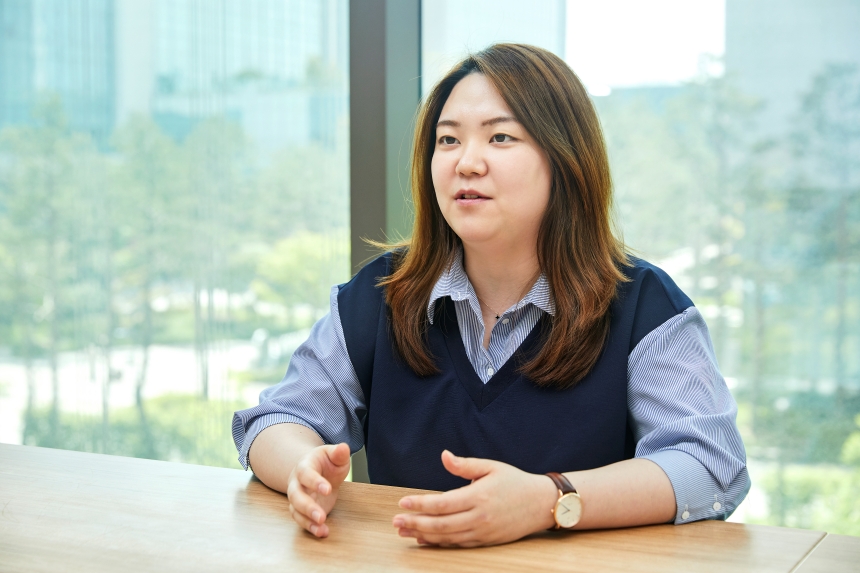
As an audio signal researcher, Hyeseung Cho was given an opportunity to speak at the world-renowned audio signal processing international society “Interspeech” in 2015. This is where she first encountered “deep learning.”
“I’d applied machine learning to audio signal processing in undergraduate school, but I didn’t know much about deep learning back then. I even asked a close researcher at the event what deep learning was. There were many papers already dealing with deep learning, and I could see the changes it was causing on signal processing. Finding it fun and fascinating, I began to study deep learning in earnest after I got back.”
Cho began researching AI data intelligence after joining the LG AI Research. Audio signals and data intelligence data have different applications but were both time series data forms and she found it easy to adapt.
“After joining the LG AI Research, I participated in research to predict machine breakdowns based on chemical compound processing data as a pilot project. Because I had no knowledge about such processes and the topic wasn’t accessible at all, I began with a lot of doubt. But seeing that my results were actually detecting breakdowns before they occurred, I saw the possibilities of AI and became more interested.”
A Data Intelligence Researcher is Like a Doctor of Internal Medicine
Hyeseung Cho currently researches battery abnormality detection for energy storage systems at the Data Intelligence Lab. Battery research is one of the more difficult areas being studied at the LG AI Research.
“These have to be detected and predicted without knowing the exact cause; ironically, not knowing the cause makes it hard to decide on the problem scope or detect the type. With batteries, it’s difficult to even notice any problems unless you retrieve and disassemble them; we need to detect abnormalities using only the current, voltage, and temperature of the batteries. In this regard, I sometimes think the work we do resembles the work of a doctor of internal medicine. It’s similar to how doctors analyze the biological signals and reactions in people to diagnose people and prescribe treatments.”
Data that actual AI scientists run into in the field are not organized like the public data she used at school, and are difficult to approach at first. Cho says that it’s important to jump in without being intimidated by this. She realized that no matter how intimidating some data might look, working together could overcome any difficulty.
“Data intelligence research deals with all types of data except for vision and language. It’s very large in scope and has a lot of problems to work through. Many unseen signals accumulate in the manufacturing processes of battery or chemical factories, IPTV networks, and even financial systems and cause problems. It’s very attractive that the scope of problems to be solved is very large. Most of the projects feature the highest levels of difficulty, but it’s fulfilling to know they are all real-world problems that I’m helping the world by solving.”
Cho has stated that the best aspects of the LG AI Research are that one can deal with various types of manufacturing-related data, gain experience analyzing actual data, work in a horizontal atmosphere, and enjoy a high degree of freedom. She adds that because there are a lot of problems that need to be solved, the experience gained from this will be an invaluable asset for any researcher.
“If the LG AI Research were part of a company or business division, we’d have to work furiously to crate results without even having time to study related papers properly. In the course of a project, we sometimes run into fundamental issues; the LG AI Research gives the researchers plenty of time to study, ask questions, and resolve matters. Our researchers and lab leader also desire for people not to be overwhelmed by the projects they undertake but view the problems with a broader perspective. Understanding the fundamental principles allows application to various fields. This is an ideal working environment for researchers, and I think any researcher would want to work in a place like this.”
AI is Like a Child with Infinite Potential
Even Cho, who has been researching AI for four years now, sometimes feels that data is an “obstacle” that is very difficult to overcome. Knowing her tendency to overly focus on a single issue, she tries to take a step back and study the problems she faces. She takes walks and speaks to her coworkers to keep herself in good condition.
“When there’s a problem I can’t solve, I purposely make it public and talk with many people. When I talk with people with different personalities from mine and those that study other areas, it lets me view the problems in a different light. Sometimes I ask for advice from CSAI Honglak Lee. Sometimes we end up simply sighing together, but even this helps as I get consoled by the fact that it’s not just me that finds this difficult. (laughter)”
Cho found it very impressive how leaders gave detailed advice and utilized their broad knowledge and experience to suggest the direction of the research. Watching them, she began to dream of becoming a researcher herself who can “suggest directions.”
“I once read the book ‘The Secrets of Highly Successful Groups’ which described one of the conditions a team should have as a feeling that the constituents are safe inside the team. If one cannot feel secure inside an organization, it becomes difficult to express contrasting opinions and such organizations fall behind easily. I haven’t worked that many years yet at this lab, but the researchers here are allowed to discuss and pose opposing opinions with a great degree of freedom. Lab leader Woohyung Lim creates that kind of safe atmosphere for us. He is very quick to accept new things and find out the crux of any issue. I’m learning a lot from his actions as a researcher and a leader.”
She’d thought at first that it was a universal solution, but starting work made her realize it was more akin to a child. Organizing data, feeding it in, and trying out various things was similar to how a child is fed handmade baby food and slowly taught various things. AI still requires a lot of attention from researchers, but it is growing and has infinite potential. In the process, Cho is also growing.
“Firstly, I want to gain plenty of experience in the abnormality detection field in which I’m working. My immediate goal is to become the go-to researcher at LG whenever they need someone for a problem related to the field. When I am able to say that I’ve done enough in this, I’d like to slowly expand to other fields and create a fundamental methodology that can be applied regardless of the type of data. And in the far future, I’d also like to become a researcher able to suggest directions with a broad perspective.”