 LG AI Research
2021.08.11
LG AI Research
2021.08.11
Life of an Intern at LG AI Research
In July, the Fundamental Research Lab at LG AI Research welcomed three new faces. We met the three interns, Jaeho Kim, Hongjun Yang, and Jihwan Jeong, who are spending a fiercer summer than anyone else.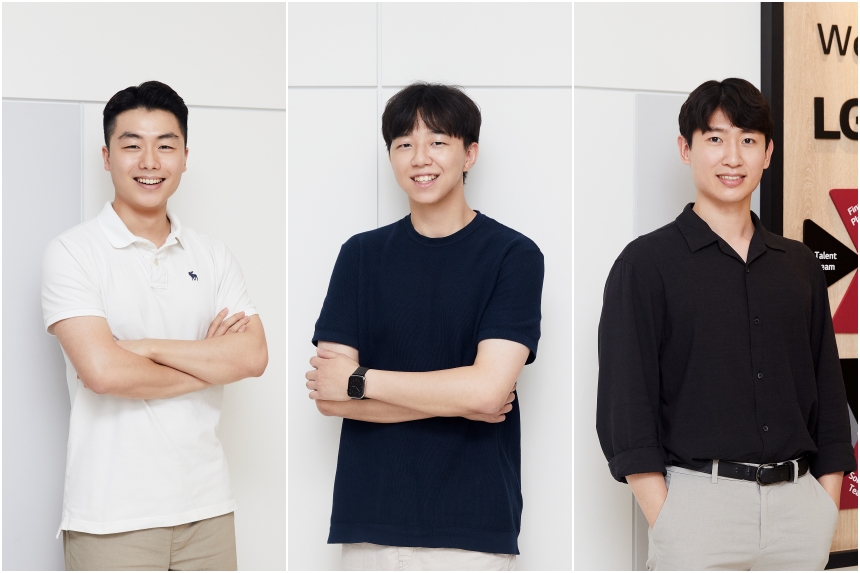
(Left to Right) Jaeho Kim, Hongjun Yang, and Jihwan Jeong, who are interns at LG AI Research
It’s my first time at LG
Q. What motivated you to study AI?
Jaeho Kim (Kim): During my undergraduate course, I worked as an intern at a start-up that my university senior opened. It’s a business applying AI technology that upscales low-quality images to high-quality images for medical devices. That was when I first learned about AI. At that time, I was not familiar with this kind of technology, so I was skeptical even after being briefed on what it was. My dream is to start my own business, so if AI is such a great technology, I thought I should learn more about it and know how to use it for the sake of my future business. That’s how I started to study AI in earnest.
Hongjun Yang (Yang): I, too, had an opportunity to intern at a data visualization lab during my undergraduate course. As I was exposed to various types of data, I thought there will be a lot of things that I could do with data. I became very curious about that possibility including what kind of things can be done. I found that answer in AI. The fact that computers learn data by themselves was very interesting. Naturally, I majored in AI for my master’s course.
Jihwan Jeong (Jeong): I studied chemistry for my undergraduate course, but I found out that I was more interested in sustainability or environmental issues rather than chemistry. After completing the undergraduate course, I underwent an internship program at the United Nations. During that time, I contemplated a lot about how I could contribute to the world as a STEM field graduate. Then I found out that AI can not only help people make various decisions but is also more capable of making optimal decisions than human experts. I was fascinated by the potential of AI in solving countless problems of the world. I believe that is why I entered the field of AI research.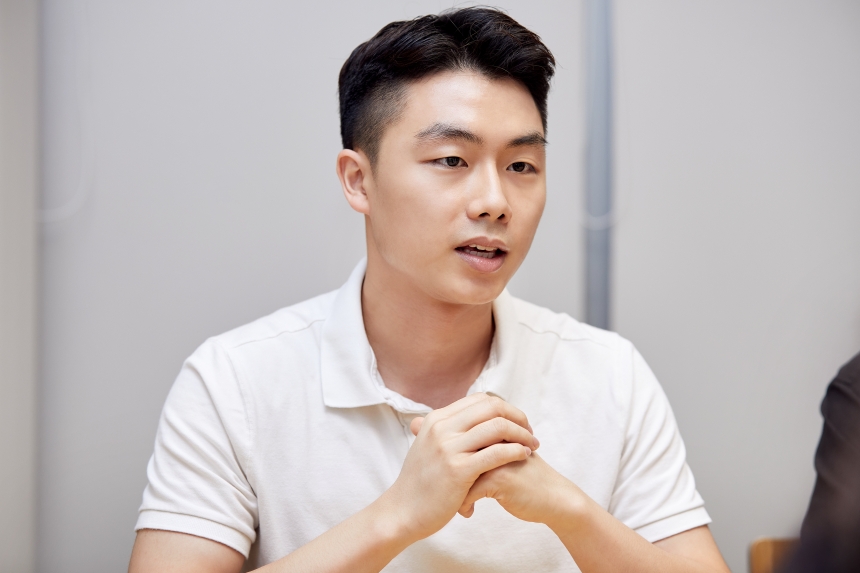
Jaeho Kim, an intern at FR Lab of LG AI Research
Jaeho Kim and Hongjun Yang are from the same graduate school, gaining the opportunity to undertake the summer internship as winners of last year’s LG AI Hackerton. Jihwan Jeong joined the internship program through a rather special path. Jihwan Jeong participated in an industry-university collaborative project with LG AI Research during his doctorate course overseas. During his temporary stay in South Korea due to the COVID-19 pandemic, the research fellow at LG AI Research, who worked together with Jeong during the collaborative project, introduced the internship program. Jeong joined the internship program through document review, coding test, and interview.
Q. Please tell us about your duties at work.
Kim: I am currently working on the Neo-Antigen project at the Fundamental Research Lab MI Squad (Link). The purpose of the project is to find substances that help an individual patient’s body produce an anticancer immune response instead of other types of cancer treatment that entail greater side effects, and to utilize such substances in treatment to minimize side effects. I am making algorithms that select and predict candidate substances using an AI program.
Yang: In the same squad, I am part of a project that develops organic luminescent materials used to produce OLED. Molecular design is important for luminescent materials for OLED. Due to the nature of organic materials, however, it is not easy to design and verify the materials, and the search space is broad, all of which make it difficult to develop them. I am developing a predictive/optimization model that deduces candidate molecules within the range of valid molecules using an AI program.
Jeong: I am working on an offline reinforcement learning project. Usually, AI produces a high level of performance when the agent, who is the decision maker, collects countless volumes of data through online interaction with the environment. Offline reinforcement learning is a training method that enables AI to make an optimal decision based on the existing data only without the online interaction. It is a model-based method that is to learn an environmental model using the existing data. As a result, it can produce a high level of performance only with a small amount of data. Right now, I am analyzing various problems that can occur when using fixed offline data for training. I also develop algorithms that can solve such problems. The project is still in the early stage, so I don’t have a squad that I am affiliated with. My goal from this internship is to submit a thesis at an AI conference in early October.
What is it like to actually work at LG AI Research?
Q. Is your actual experience at LG AI Research different from your previous idea of how LG AI Research was going to be?
Yang: Since a large proportion of LG’s business is manufacturing, most stories I heard before I came here were from my friends who worked in the (manufacturing) business. I expected it to have a more rigid atmosphere than the lab environment at the university. Since the Research is a workplace and an organization, I expected more rules to follow than in the university. I prepared myself mentally to change my attitude. However, I am still the same, so I guess the culture is very flexible.
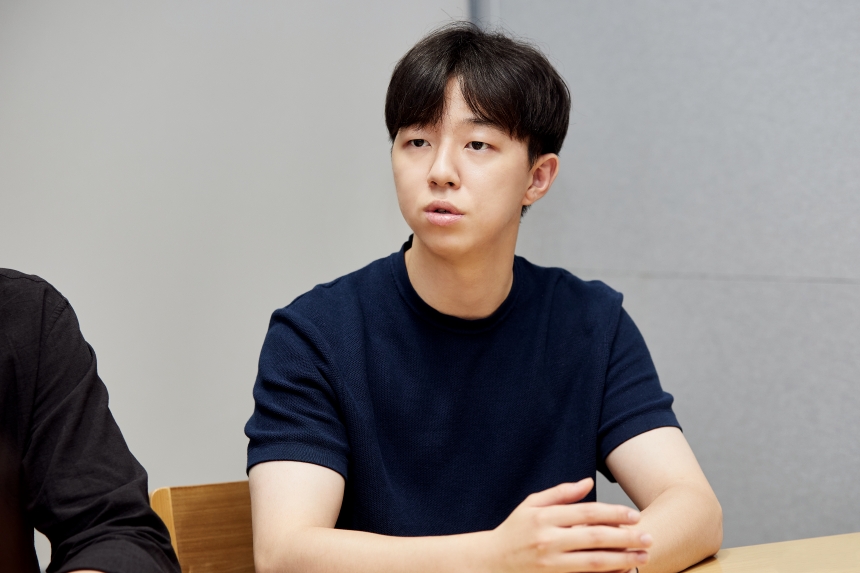
Hongjun Yang, an intern at FR Lab of LG AI Research
Kim: I thought it would have a vertical structure since it is a conglomerate. I was also worried that I would spend all my time making coffee for others like in the TV drama “Misaeng.” (Laughs) The organizational structure was more horizontal than I thought, and other team members also help me make contributions to the team in a relaxed atmosphere. It helped me a lot to adjust to the team. I am having a lot of fun in the project.
Q. Do you have any tips you can share with people who are preparing for this internship?
Jeong: I went through a document review, and a coding test first. Then I had a 1:1 interview with CSAI Honglak Lee. In terms of the coding code, I normally think a lot about writing a code that can be applied to a general problem rather than a specific problem. I think that was helpful. The interview took place in the form of a presentation wherein I shared my research portfolio. It would be helpful to make a presentation material on the research work through a well-connected story.
Q. Did you learn anything while working on the projects with other researchers at LG AI Research?
Kim: I found it impressive that the researchers contemplate on how a model can be used in a service instead of focusing on simply improving the performance indicators. I thought I should think about how AI can be used in actual situations rather than focusing on getting high numbers for the performance evaluation when doing my own research.
Yang: Previously, I took the existing algorithms or methodologies to solve problems without thinking too much. Since I started to work here, I have faced difficult problems that were considered “dilemma,” so I was often unable to apply the methods that I used so far. Although I may be able to find a way to solve the problem while talking to colleagues who are working on the project with me, I should be able to provide a basis for the technique and method and know the details. I learned that I should pay attention to details thoroughly.
Jeong: Working on a project that had a deadline made me impatient, because I wanted to create an outcome quickly. Other researchers in the team told me that identifying which problem in the current research is worth solving is more important than producing fast results. I realized that I could’ve missed more important things that can make the research more influential by focusing too much on short-term goals.
Life after the internship
At the end of the internship period, they are going back to their previous life, finishing academic courses and preparing for their work life. One thing that we know for sure is that their research will continue. The experience that they gained through the internship program will be a foundation for their future research. How would the summer 2021 be remembered by the interns?
Q. What is your biggest gain through the internship?
Kim: When I approached a problem in the past, I used to think that nothing is more important than getting a good outcome. Here, I gained many insights about what the nature of the problem is and how to approach a problem. I even had the realization that I need to focus more on my thesis when I go back to the university.
Yang: I was actually feeling a bit lethargic before I started the internship. I only have one semester left for my master’s course. The idea of not being a student after spending almost 20 years of my life as one made me lose interest in everything. Learning new things in a new environment with outstanding researchers became a good stimulus for me. I now have a better idea of how to prepare myself during the rest of my course.
Jeong: While I was trying to decide whether to do the internship, I had high expectation from the fact that I could receive advice directly from CSAI Honglak Lee. Interactions such as reporting my research work to CSAI Honglak Lee and receiving feedback through team meetings were very meaningful to me. In addition, when I work on my doctorate thesis, I tend to focus on my research topic. Here, I gained a broader perspective on how AI is used by listening to other teams’ research presentations.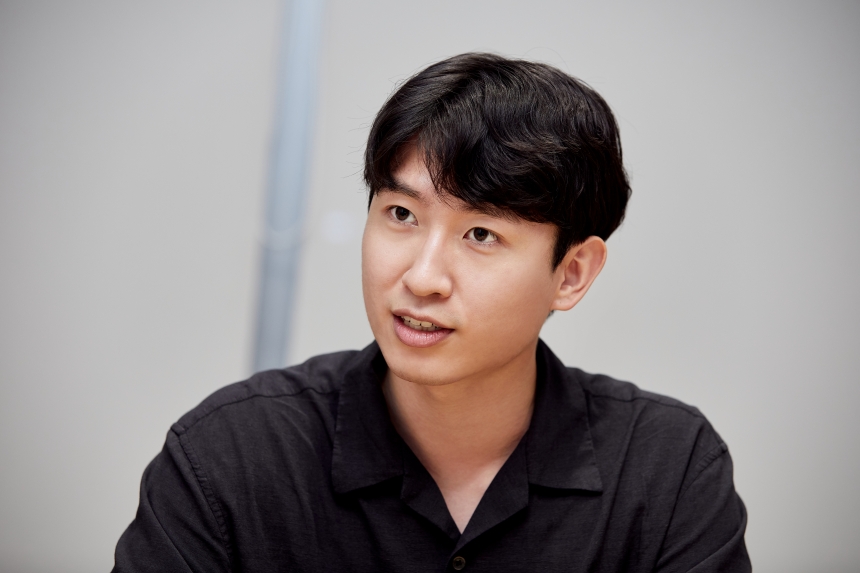
Jihwan Jeong, an intern at FR Lab of LG AI Research
Q. What is the research area or topic that you want to study in the future? Do you have a goal as an AI researcher?
Kim: I am very interested in meta-learning and associative learning. I am thinking about ways to apply these techniques to the medical field. Research on AI technology is still being conducted in theoretical or limited settings. I would like to apply these technologies to solve practical medical problems.
Yang: I am interested in reinforcement learning and generative model, which make computers do something by themselves with minimal human involvement. My short-term goal is to gain skills that allow me to apply the two methodologies in various domains. A long-term goal is to use such skills to pioneer areas where AI is not utilized to solve various problems.
Jeong: I would like to study how to solve various obstacles to continue to commercialize reinforcement learning. I believe offline reinforcement learning is an important research topic in this aspect. My long-term goal is to use such AI technology for sustainable growth. For example, reinforcement learning can be applied to smart grid operation to reduce carbon emissions, or we could help developing countries with limited access to technologies through AI technology. In poor technological environments, a small about of data must be utilized efficiently to adapt to the target environment. In this aspect, I am also interested in meta-learning.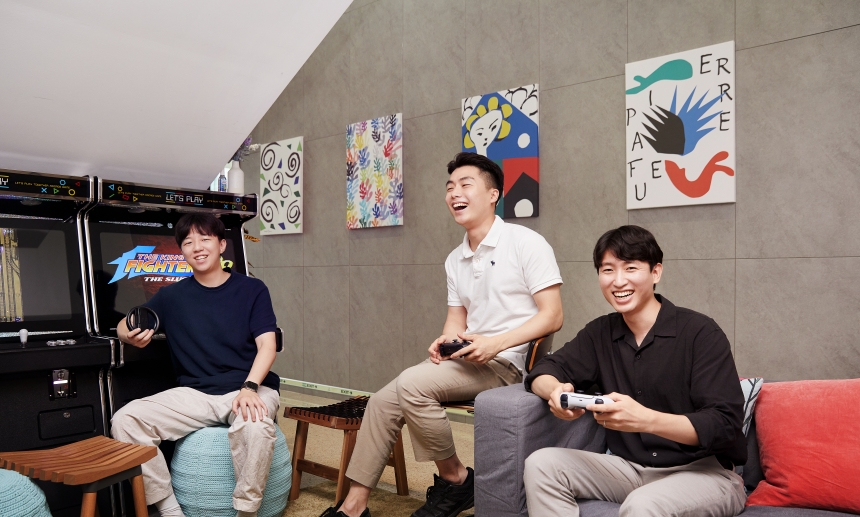
(Left to Right) Hongjun Yang, Jaeho Kim, and Jihwan Jeong, who are interns at LG AI Research
Q. Do you have anyone you would like to give special thanks to?
Kim: I would like to thank my squad team leader and all my teammates. If I have to pick only one person, however, I would like to thank Rodrigo, who was my direct supervisor. Since we won the LG AI Hackerton together last year, we had been speaking to each other from time to time. Rodrigo had started the internship program before me, and he introduced various projects that I would find interesting. Thanks to Rodrigo, I could prepare my mind even before starting the internship and understand work-related situations very quickly. He also helped me a lot during the project, so I am always grateful to him.
Yang: I would also like to thank my direct supervisor, Daewoong Jung. He explained the general flow of the assignment very easily, which helped me adapt to the workplace quickly. Whenever there was something I didn’t know, he gave me a lot of help. Thanks to such help, I could enjoy the assignments although they require a lot of domain-specific knowledge. Should I pick only one person? Actually everyone always encourages and helps us interns settle in the environment smoothly and achieve the best result possible.
Jeong: My special thanks go to Hyunwoo Kim at FR Lab. I met Hyunwoo Kim for the first time through the university-industry project between the University of Toronto and LG AI Research. He found out that I was temporarily staying in South Korea due to the COVID-19 pandemic and introduced this internship program to me. Thanks to him, I could do fun research with great individuals. Even now, he is conducting offline reinforcement learning research with me, mentoring me and teaching me various things that I should know as a researcher. Thank you.
Check out LG AI Research Intern Recruit (Link)