 Kyungkoo Min
2021.09.09
Kyungkoo Min
2021.09.09
How far has LG AI Research’s MRC Project come thus far?
MRC (Machine Reading Comprehension) is the technology enabling a machine to read and understand a document just like a human does. For instance, when a person asks a question about a given document, a machine can find the answer to the question from within the document. While Q&A systems of the past had to prepare questions and answers about a designated document in advance, the advantage of MRC is that a machine is able to give an answer freely even to a random question without needing such FAQ list.
Last year, LG AI Research Language Lab successfully developed a Korean language model based on BERT (Bidirectional Encoder Representations from Transformers) to which salient span masking and stack-attention are applied. This model currently shows a performance level exceeding that of a human’s reading comprehension (KorQuAD No. 1, July 2020).
Open-domain QA that searches and replies on its own
At LG AI Research Language Lab, research is being expanded to the domain of Open-domain QA wherein, when a question is given “without specifying any document,” the machine finds documents as well as the answer through its own search. To achieve this, the R3 (Retriever/Re-ranker/Reader) structure is used for the research. Encoding of data is performed through a dense vector model in the bi-encoder structure; and by comparing the extracted vectors and based on the degree of similarity, the most appropriate sentences for the question are selected after being rearranged.
The MRC technology has been good at finding information expressed in common text format within a document but has shown limitations in locating an answer from contents organized as a table or a list. Since much of the essential information in a document is recorded in tables, research on “Table MRC” technology, which searches tabulated information by natural language queries, is also in progress.
Table MRC: finding the answer in a table
Table MRC is a type of MRC technology that enables bringing the answer from a table by understanding the relation between natural language query and table structure. There are two ways to understand a table and provide the answer: learning the mark-up language that expresses a table’s structure and acquiring the answer from a table saved in a database through natural language queries. We are currently researching both methods, and I am going to introduce the latter method.
In MRC utilizing a database, it is essential to convert a natural language query into a proper SQL, which is why an SQL must be created in such a way that it is capable of analyzing a user query in a tree structure and performing complex calculations. The Aggregation function was used to apply expressions like sum, average, and maximum and minimum; the Schema linking model was also applied to be able to analyze the structural relationship among multiple tables related to the question.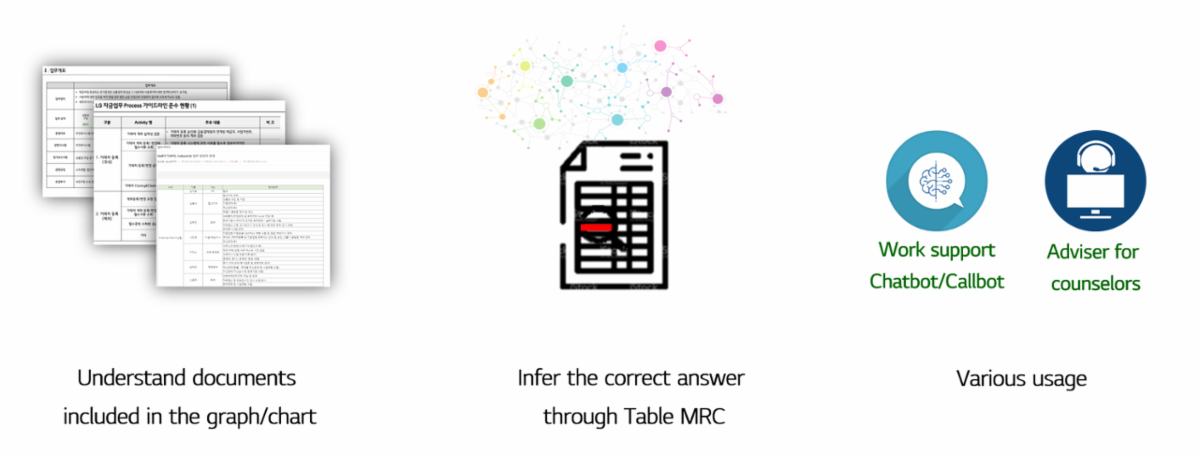
The Table MRC technology can be used in all tasks that handle documents with tables, and we are currently seeking points of its application in the chatbot for work support and adviser for counselors.
TV MRC, AI that understands meanings
Applying the MRC technology, which finds answers from documents, to video contents search on TV, we have obtained the “TV MRC” technology as a result. TV MRC is what searches contents of a movie, a drama, or a TV show among the information open to the public and applies the searched results to MRC so it is able to provide answers to more natural questions than any of the previous means of search, aside from offering more updated and detailed information.
The voice search of TVs in the past was a method that prepares search words and answers in advance to match keywords, so it was impossible to give an answer to a search word that does not exist in the database. For instance, if “I Live Alone,”which is the exact title of a TV show, is searched, the search works fine; but if you enter the description as “a TV show featuring celebrities who live alone,” you will not get any answer in return. If the MRC technology is applied here, however, the TV will be able to understand the meaning of the question to find answers, so the correct answer of “I Live Alone” can be found in such case as well.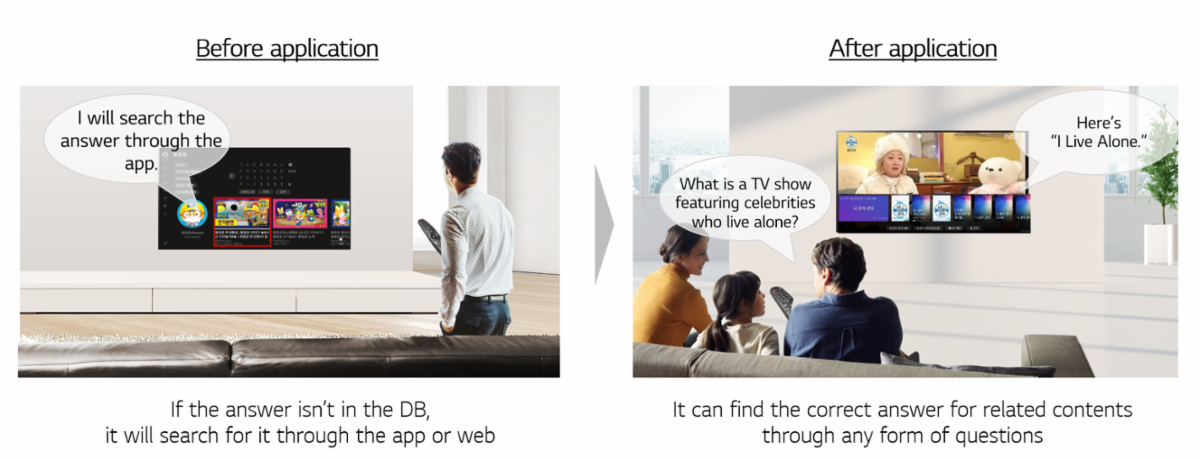
As you can see, the TV MRC technology can satisfy any contents-related curiosity that a smart TV user may have and quickly and easily find the desired contents.
Last May, LG AI Research unveiled the “Super-giant AI” research and its plans for a significant volume of investments in infrastructure. By utilizing the deep learning model acquired from the Super-giant AI research, LG AI Research Language Lab continues to enhance the performance of MRC.