 LG AI Research
2021.09.24
LG AI Research
2021.09.24
LG AI Research Acknowledged With Its Global No.1 MRC in English Going Beyond Korean
LG AI Research Language Lab won the SQuAD, an AI machine reading competition held by the Stanford University.
The AI program developed by LG AI Research Language Lab earned 95.719 points at the SQuAD 1.1 (Stanford Question Answering Dataset 1.1), winning the first place in the competition. This is even higher than the records earned by a human who solved the same questions, which was 91.221 points.
The SQuAD is an MRC test where a computer reads and understands given questions to find correct answers. After it became the winner at the KorQuAD 1.1, the AI machine reading evaluation in Korean, in July of last year, LG AI Research Language Lab was ranked no.1 again at the SQuAD, the same test of an English version.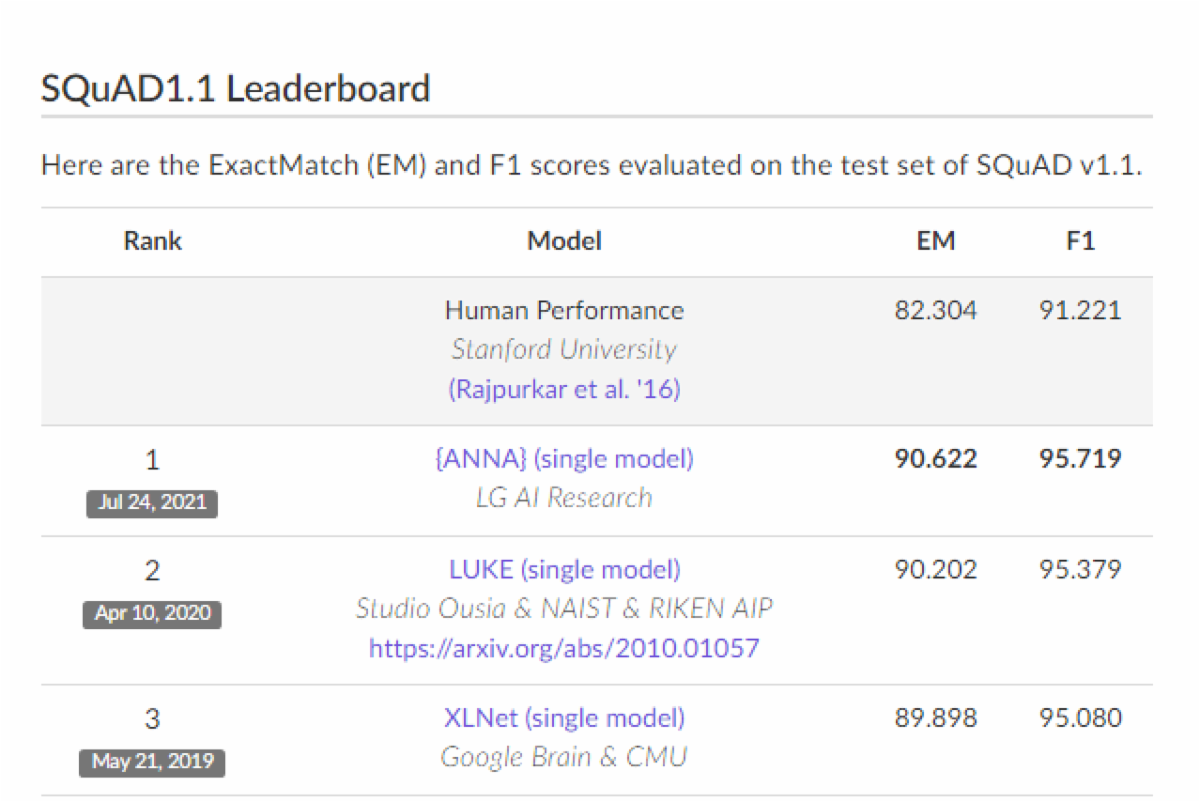
SQuAD 1.1 Record of LG AI Research ⓒ The Stanford Question Answering Dataset official website
The MRC (Machine Reading Comprehension) technology is the core subject of the researches conducted by LG AI Research Language Lab. It enables a machine to read and understand a document as a human does. Presently, LG AI Research is developing a technology to enhance convenience of customers by converging MRC with the TV's search function. For instance, when the user asks, “What is the variety show where several alternate characters play?” the TV will show you the search result: “Hangout with Yoo.” This means a TV can understand a question based on the MRC technology and search the right answer. As LG AI won the SQuAD this time, it has proven its proficiency in English MRC as well.
According to Director Kyunghoon Bae of LG AI Research, the research team will take a challenge to participate in GLUE and SuperGLUE—comprehensive competitions in the field of MRC—with a super-giant AI technology, an even advanced version of MRC.
LG AI Research announced in May this year that it will develop a super-giant AI technology, meaning that the LG AI will learn a super-giant parameter model of 300 billion, which is larger than 175 billion, the parameter size of GPT-3 made public by OpenAI. This technology is planned to be applied and distributed to affiliates of LG Group starting late October this year. Generally, the larger the size of the parameter of a language model, the higher the function is even with fewer data, researchers report.
How far has LG AI Research’s MRC Project come thus far? (Link)