LG AI Research Participates in Yonsei University's AI Workshop
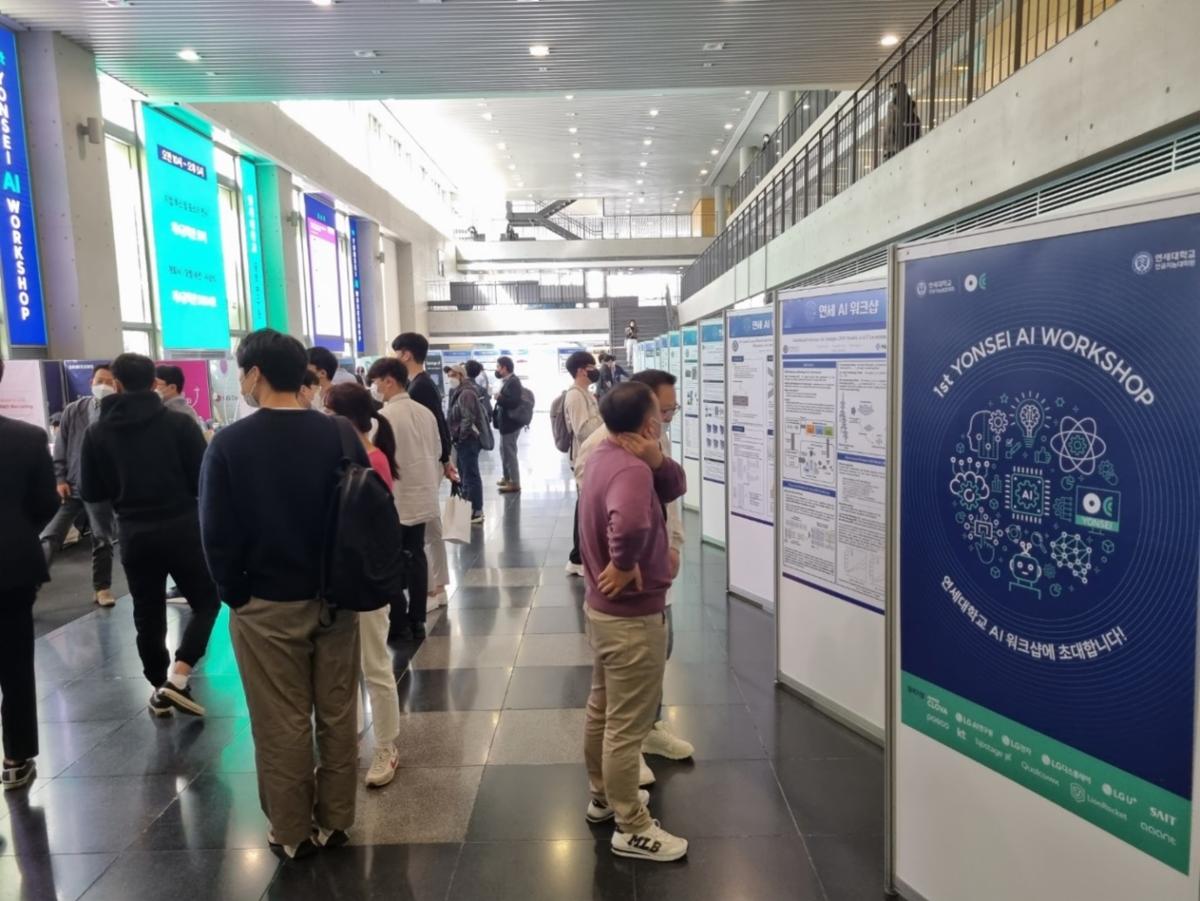
Yonsei University's AI Workshop
The First Yonsei University AI Workshop was held in Yonsei University's Engineering Hall #4 on Oct. 7, 2022. Outstanding students studying AI and companies leading the AI industry had a time of sharing recent research trends and interacting with one another during the AI workshop that was held for the first time this year. Companies affiliated with the LG group such as LG Electronics, LG Display, and LG Uplus took part in the event to communicate with students, along with NAVER CLOVA, POSCO, KT, Upstage, Qualcomm, and many more.
The Yonsei University AI workshop consisted of a corporate session that introduced AI companies, an oral session in which researchers directly introduced their studies, and a poster session where research outcomes were introduced through a poster.
During the opening session, Hojung Cha, a Dean of the College of Computing at Yonsei University, said, “This year's AI workshop was planned to share various AI research conducted at Yonsei University. It is expected to serve as a place to communicate and exchange ideas with various companies,” and expressed his hopes for the event by stating, “We hope this AI workshop enables researchers to plan various joint corporate-academic projects and provides an on-campus recruiting opportunity.”
Following the opening remarks, a corporate session introducing 12 participating companies was held. LG AI Research, LG Electronics, LG Display and NAVER CLOVA presented at the first corporate session.
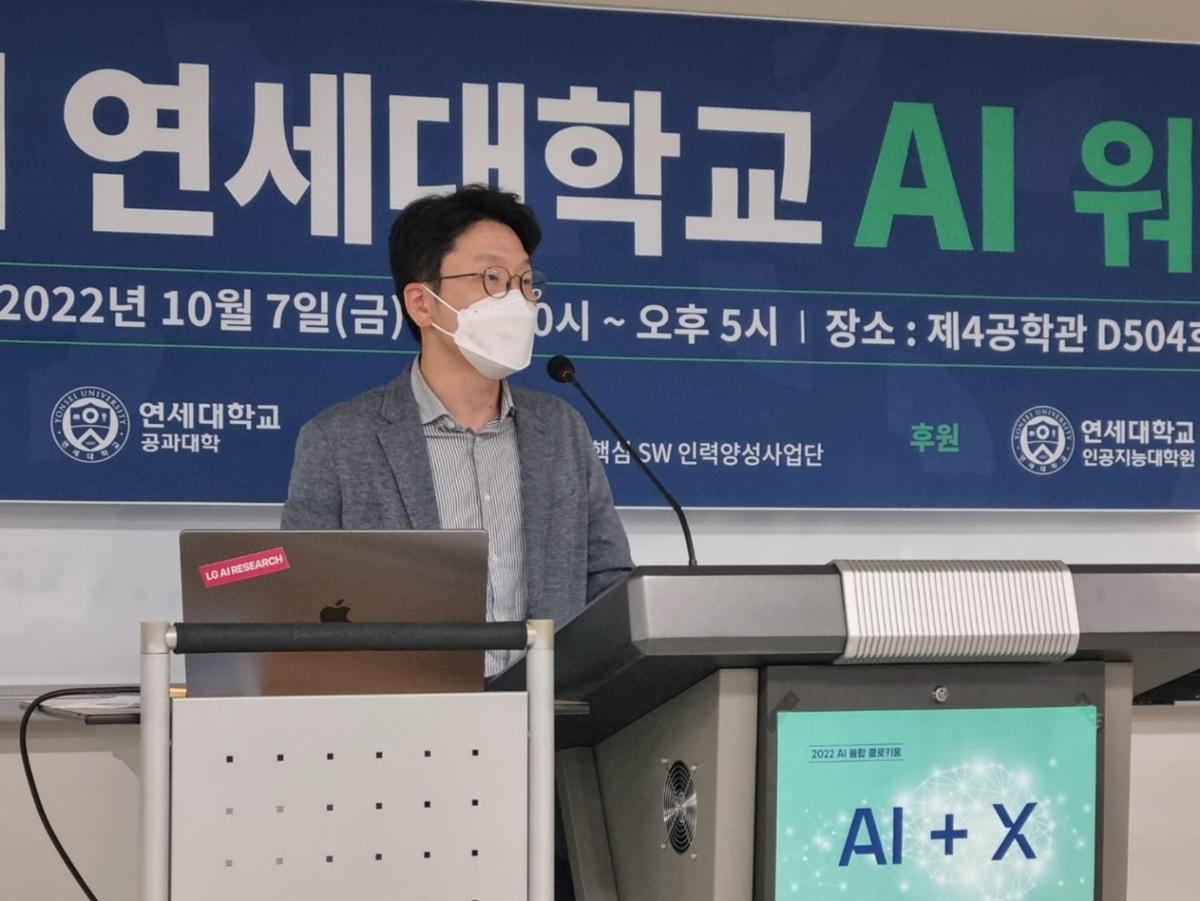
Woohyung Lim, Applied AI Research Lab Leader of LG AI Research, during the corporate session
Woohyung Lim, Applied AI Research Lab Leader of LG AI Research, introduced the goal and ongoing researches of the Applied AI Research Lab as well as various research organizations within LG AI Research.
Lim commented, “We are striving to apply AI technology to various real-life problems such as optimization and vision inspection that innovate batteries, material development, product design, and the production process. In the communication sector, we are carrying out research to apply AI technology to customer service along with researching AI technology such as voice recognition and language processing.” He also added, “We are undergoing advanced research in consideration of expanding future areas of research to prevent research for research's sake.
Team Leader Daehwan Kim from the PRI Manufacturing AI Solutions Team of LG Electronics explained the manufacturing AI that is being researched by LG Electronics by saying, “We focus on research where AI can carry out product design which was previously done by humans. In this process, AI can pre-detect anomalies in facilities using data. We are using countless AI data from the process and automated facilities to predict product quality and future prospects.”
Giseok Jang from the AI Research Team of LG Display commented that they are conducting AI research that can be used in designing various areas such as materials, panels, and elements required for displays. “AI technology is planned to be actively used in data analysis as well. We are developing a technology that can allow AI to automatically analyze various image data that are produced during the research and process work to improve the convenience of engineers,” he said.
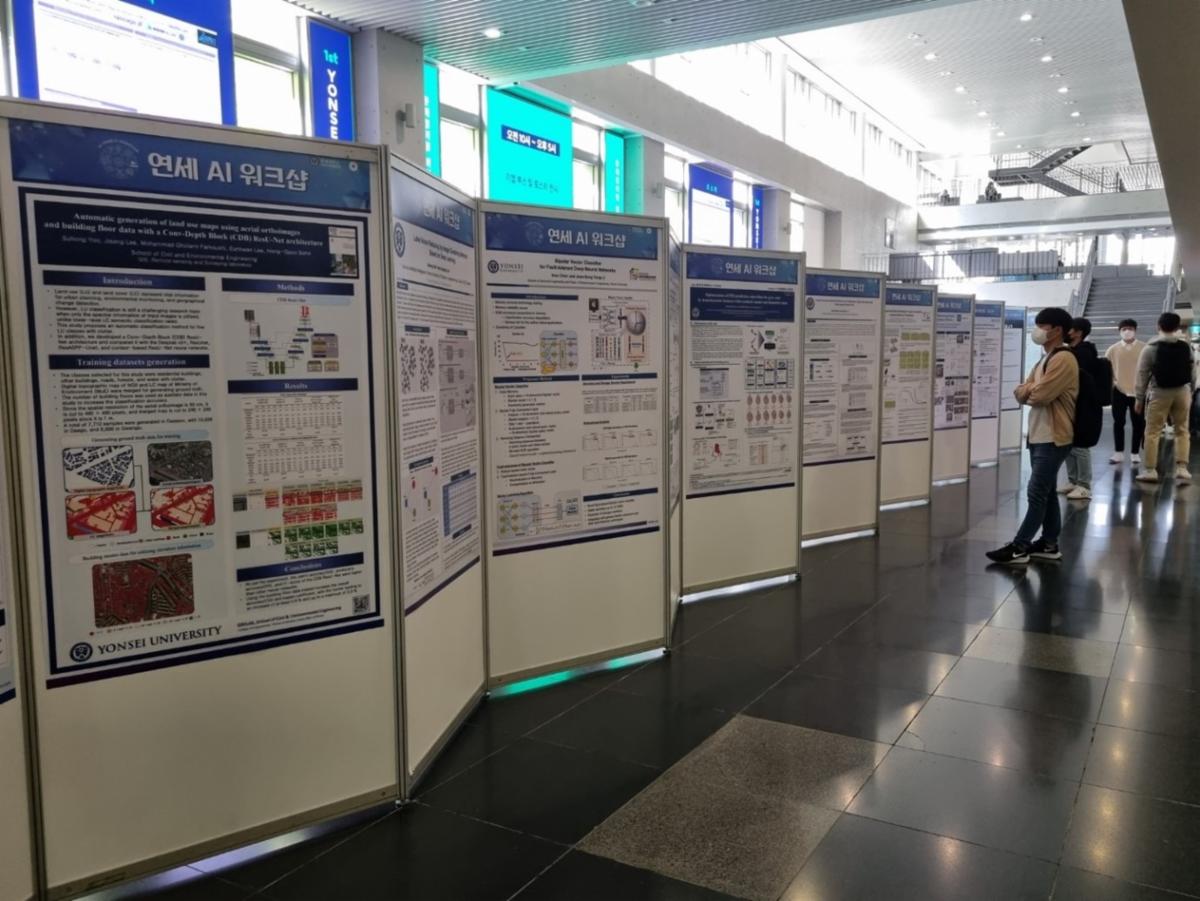
Research posters in the Yonsei University AI Workshop
LG AI Research introduced two papers during the following poster session.
[NeurIPS 2022] Transformers meet Stochastic Block Models: Attention with Data-Adaptive Sparsity and Cost – Sungjun Cho, Fundamental Research Lab (Link)
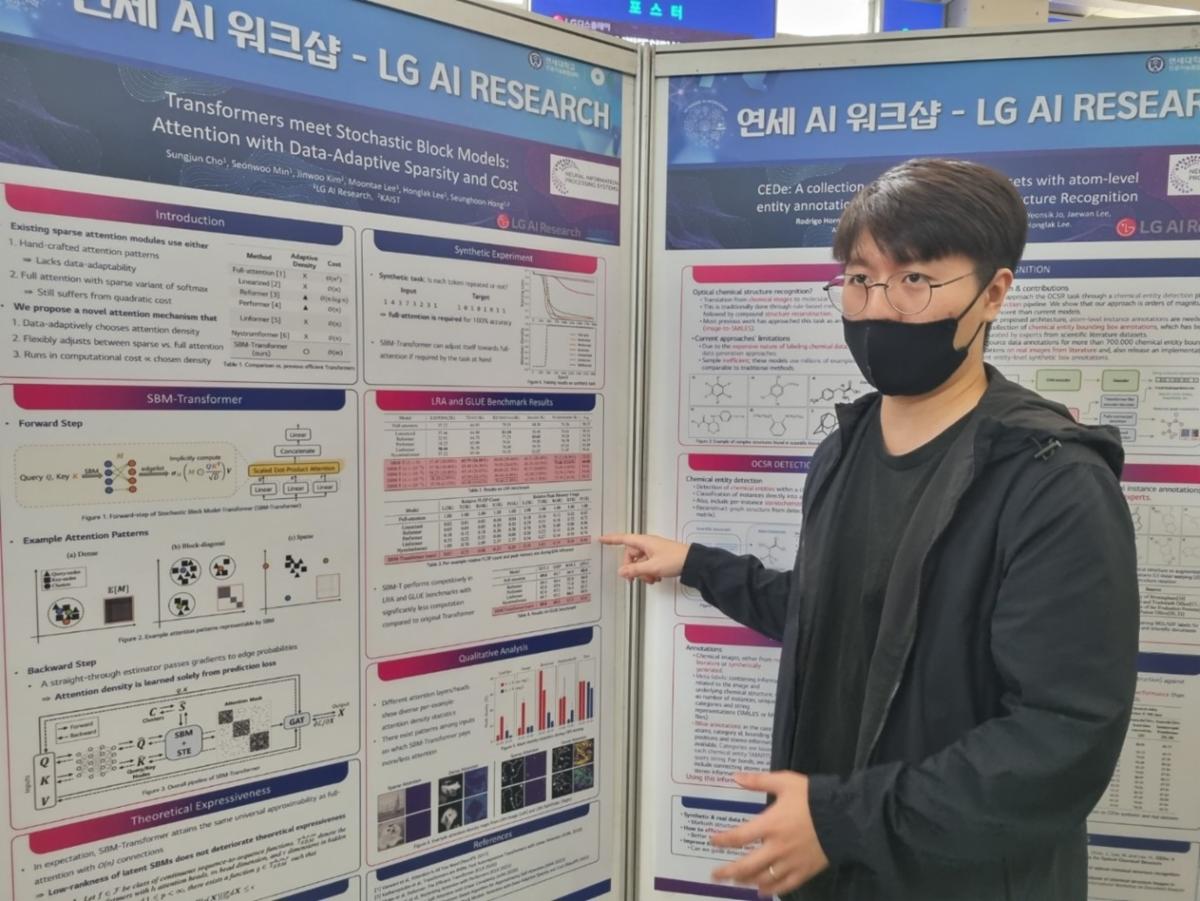
Sungjun Cho from the Fundamental Research Lab explaining his study
The first paper presents a new technology that improves transformers. Sungjun Cho from the Fundamental Research Lab said, “When the sequence length gets longer, it starts using more memory, thereby making it difficult to model long phrases or whole documents during language modeling. Although many solutions were proposed to solve this problem, there lies a common problem of lacking data adaptability that adjusts attention according to data, which became the reason for carrying out this research.”
Cho added, “Using new attention mechanisms presented in the paper, the amount of attention required for data can be freely adjusted, and the amount of required attention can be made proportional to time and memory cost."
[NeurIPS 2022] CEDe: A collection of expert-curated datasets with atom-level entity annotations for Optical Chemical Structure Recognition – Rodrigo from the Materials Informatics Lab (Link)
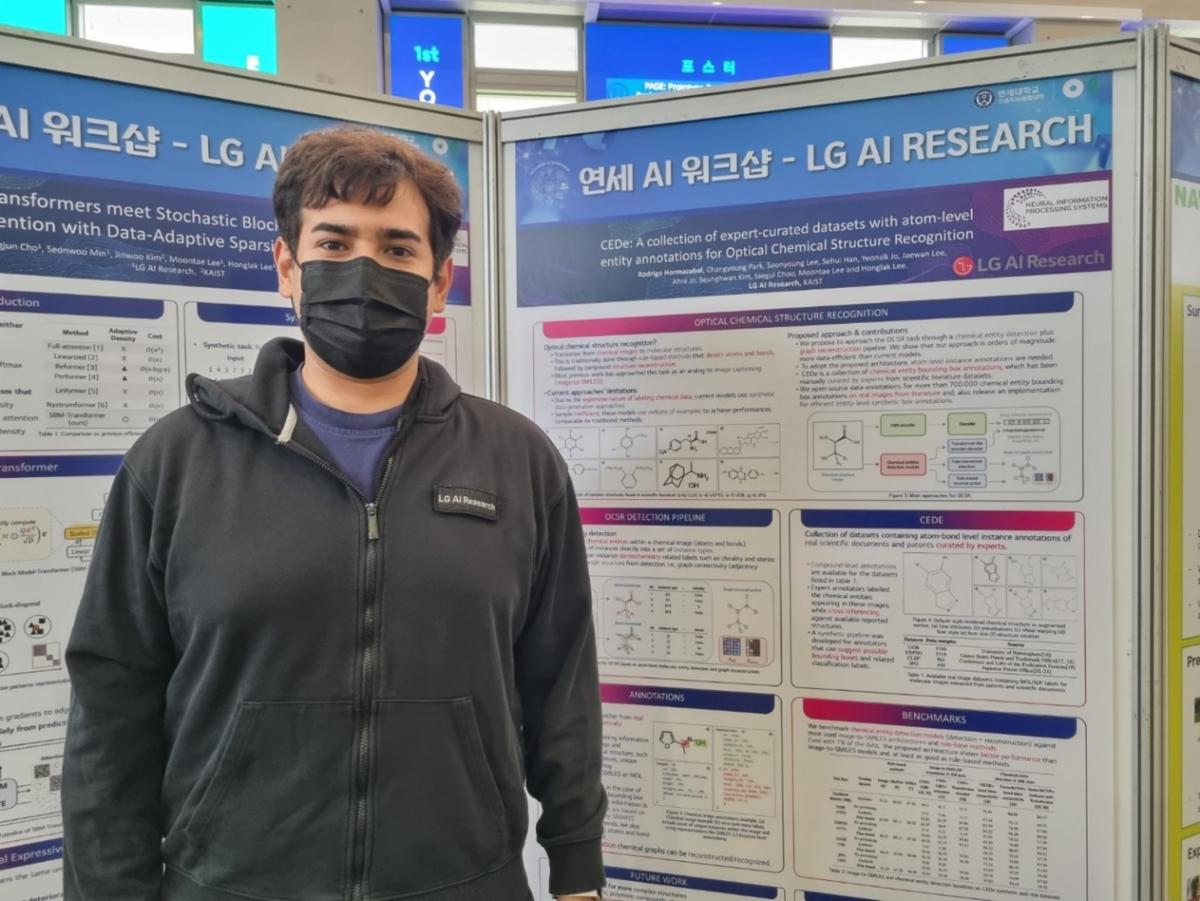
Rodrigo from the Materials Informatics Lab explaining his study
The second paper is about the Optical Chemical Structure Recognition (OCSR) technology that converts chemical images into molecular structures. This paper provides a new method of approach through molecular entity detection and graph reconstruction technology.
Rodrigo explained, “The method provided in the paper reduces atoms such as nitrogen and carbon one by one and predicts the adjacent parts of the structure. The graph can be reconstructed if there is information on the atoms and connection points. Synthetic data was created to train model and create image labeling.”
If a million images were required using existing approaches, this new method suggested by researchers from LG AI Research only requires 10,000 images, thus increasing data efficiency by up to 100 times.
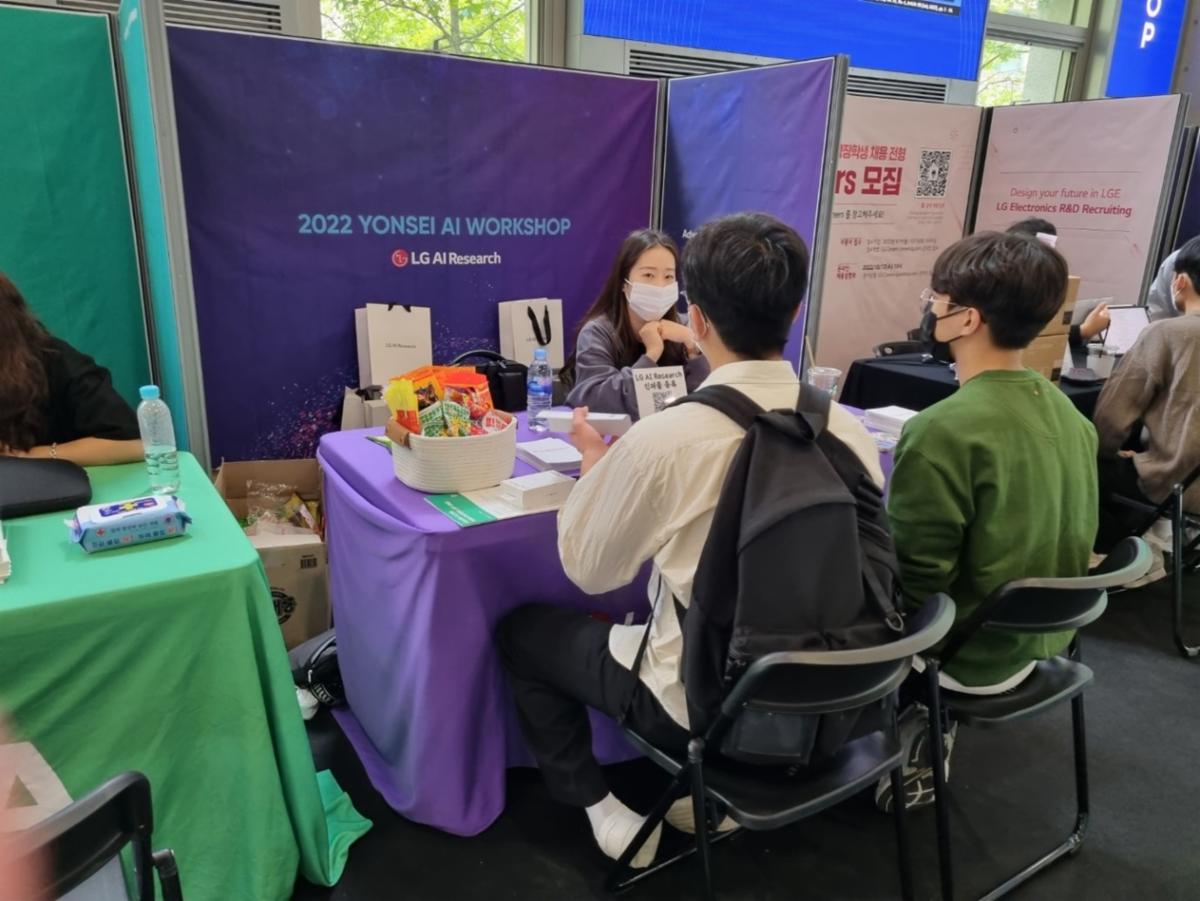
Students consulting at the LG AI Research booth
LG AI Research set up a career booth to actively communicate with students. A research-related Q&A with Sungjun Cho and Rodrigo who introduced their research in the poster session was carried out along with job consultation related to internship and employment targeting Yonsei University students. In addition, LG AI Research introduced the NeurIPS conference that will be held in December and requested interest and participation from students.
Yonsei University's first AI workshop served as a place where talented students studying AI and researchers from LG AI Research communicated and interacted with each other. LG AI Research introduced its research work through a corporate session and carried out talent recruitment through the job booth, as well as presented papers in the poster session to boast its research achievements. LG AI Research will continue to actively communicate with talented individuals by participating in more events for the exchange between the industry and academia.