 Soyoung An
2024.02.21
Soyoung An
2024.02.21
 Myoungshin Kim
2024.02.21
Myoungshin Kim
2024.02.21
LG AI Research in the Global Forum on Ethics of AI

Figure 1. Onsite at the UNESCO Global Forum on Ethics of AI ⓒ Ministry of Digital Transformation, REPUBLIC OF SLOVENIA
The UNESCO Global Forum on Ethics of AI, Where Experts from around the World Gather
The 2nd UNESCO Global Forum on Ethics of AI was held in Kranj, Slovenia from February 5 to 6, 2024 (local time). The theme of this year’s forum was “Changing the Landscape of AI Governance.” This topic suggests that global AI governance is changing just as rapidly as AI technology is evolving. The forum was attended by more than 500 participants from 67 countries, including governments of UNESCO Member States, businesses, international organizations, academia, and civil societies from around the world. Notably, LG AI Research stood out as the sole domestic company to participate in the UNESCO Global Forum on the Ethics of AI. It was a gathering where individuals with diverse experiences and expertise, transcending borders and disciplines, came together to learn from each other and engage in discussions about the impact of AI. LG AI Research, with firsthand experience on-site, will share the topics and key insights discussed during the forum.
Different Countries, One Global AI Governance

Figure 2. Group photo at the UNESCO AI Ethics Global Forum ⓒ Ministry of Digital Transformation, REPUBLIC OF SLOVENIA
The forum was attended overwhelmingly by developing countries, which are often underrepresented in the international discussion of AI cooperation. This is because UNESCO, as an international organization, emphasizes inclusiveness, which means that no country or region should be excluded from the benefits of AI. As we heard the voices of different countries, we realized that the direction of AI governance in each country is bound to vary greatly depending on the level of technology and policy development.
Countries such as Morocco, Somalia, Jamaica, Oman, Estonia, and others expressed a strong desire to not be left behind in the development and utilization of AI technologies. They mentioned concerns about a lack of data, infrastructure, and talent, along with a need for policies supporting education and infrastructure to enhance accessibility to AI.
On the other hand, those leading the way in AI technology development like the United States, UK, Western Europe, and East Asia showed greater interest in managing the risks of AI technology. There was an interest in policies that aim to redistribute AI technologies, which are concentrated in specific companies, to be utilized and advanced by a majority of their citizens. The United States and the UK also proposed to strengthen international collaboration by establishing an AI safety lab.
China emphasized that the situations of developed and developing countries aren’t the same. They argued that global governance must take into account diverse perspectives to ensure that the benefits of AI are shared regardless of country size, power, or ideology.
Establishing global AI governance that garners agreement from members worldwide doesn't seem to be an easy task. However, even though AI governance in various countries may emphasize different areas, the positive aspect is that they all share the same goal: to ensure the safe and effective use of AI. While it's not possible to agree on everything from the start, the forum concluded on a positive note with a commitment to working together, taking small steps, and continuing discussions on global AI governance.
Making AI Work for Everyone
Many people are benefiting from using AI, but not everyone is. What more is needed for AI to become a good tool that everyone can use? The discussion included UNESCO, G20 Brazil, the United Nations High-level Advisory Body on AI, the European Council, the Alan Turing Institute, the World Trade Organization, the Center for AI and Digital Policy (CAIDP), and the Global Partnership on AI (GPAI), recognized as the world's first international consortium dedicated to AI-related matters.
First, various inequality issues were cited as potential risks posed by AI. Examples include job displacement by AI, digital access gaps, inequality due to gender and nationality, and AI technology monopolies. Solutions to these challenges included diversity, individual control of data, infrastructure support, regional collaboration, a stronger public role, sustainable AI research, and literacy education. In particular, there was a consensus that as the use of a single AI model increases globally, efforts should be made to prevent the loss of cultural diversity across countries. While the discussion couldn’t be fully narrowed down, everyone agreed that inequality related to AI isn’t just a technical issue, but rather, is closely linked to social and economic issues.

Figure 3. Onsite at the session of Women4Ethics ⓒ Ministry of Digital Transformation, REPUBLIC OF SLOVENIA
One of the things that struck us about the UNESCO Forum, which emphasizes inclusiveness, is that the organizers’ high-level leaders are all women including Ministry of Digital Transformation in Slovenia, Director-General of UNESCO, etc. Notably, the “Women4Ethics” session, in which all panelists were women, discussed the gender gap in AI technology and how to address it. As the 'Recommendation on the Ethics of AI' released by UNESCO provides gender-related policies that "contribute to achieving gender equality throughout the life cycle of the AI system," we could see the forum implementing them.
For example, it was pointed out that the gender distribution of AI data and results differed from reality. Only 3% of the AI-generated images depicting female judges are actually female. However, according to the American National Association of Women Judges, 34% of judges in the United States are women. In this session, there was a strong emphasis on the significance of implementing various safety measures to prevent the unintentional perpetuation or distortion of real-world inequalities during the development and research processes of AI technologies.
Preparing a Company for AI Ethics Implementation

Figure 4. Onsite at the UNESCO Global Forum on Ethics of AI ⓒ Ministry of Digital Transformation, REPUBLIC OF SLOVENIA
The importance of “execution” was also repeatedly emphasized in AI governance discussions. Good governance only makes sense if it’s actually executed. That's why AI companies, the entities doing the work, were invited to participate in this forum. In November of the previous year, LG AI Research was chosen as UNESCO's inaugural domestic partner for AI ethics implementation, making it the sole Korean company to receive an invitation to the forum. Business Council members (GSMA, Microsoft, Salesforce, Telefonica, etc.), including LG AI Research, which has been a leading practitioner of AI ethics, shared their AI ethics practices and achievements during the corporate session.
The companies invited to the corporate session all agreed that AI ethics is an important task. This is because AI ethics is directly related to customer trust, a top business priority. Each company shared examples of how they have continuously assessed and monitored social impact throughout the entire AI lifecycle based on AI ethical principles. Notably, Microsoft emphasized that as an AI cloud provider, they provide free tools like impact assessment on their website to help customers utilize and deploy AI responsibly. Mastercard emphasized its policy of returning all ownership, control, and benefits of customer data to the customer.
At the corporate session, Youchul Kim, Strategy Unit Leader of LG AI Research, introduced the risk management process as a prime example of the AI ethics principles. Based on our experience in bringing together the different perspectives of technical researchers, business managers, and ethicists through this process, he shared with UNESCO our plans to create a new AI ethics course for professionals. He also introduced our AI Accountability Report on AI Ethics, which documented our progress in this endeavor and received a lot of interest from participants.
▶Check out LG Accountability Report on AI Ethics (Link)
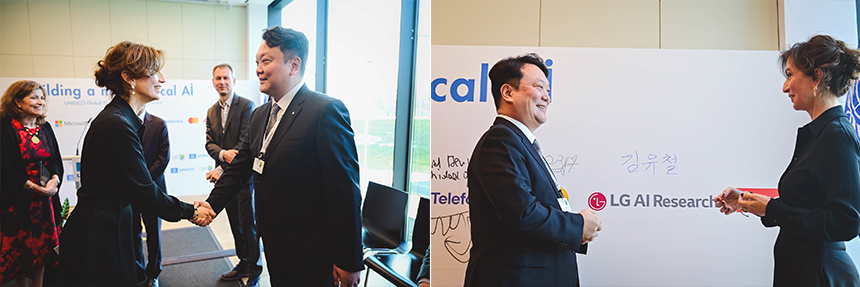
Figure 5. Youchul Kim, Strategy Unit Leader of LG AI Research, is signing on a joint declaration
ⓒ Ministry of Digital Transformation, REPUBLIC OF SLOVENIA
Eight companies, including LG AI Research, who participated in the session also issued a joint declaration to work with UNESCO on AI ethics. In this joint declaration, we pledged to take practical steps to minimize the risks that AI technology can bring and maximize its positive impact on society. We recall a moment during the signing ceremony when, while everyone else was signing in English, LG AI Research signed in Korean, eliciting an outpouring of admiration. It was a moment of diversity shining in the global AI community, with the participation of a Korean company. We hope that this declaration will lead to positive changes that spur concrete action by AI companies at home and abroad.
Participation of Private Sector AI Ethics Consortium in UNESCO Business Council

Figure 6. Companies joined the ‘UNESCO Business Council’ are introducing participation plans
ⓒ Ministry of Digital Transformation, REPUBLIC OF SLOVENIA
Moreover, during this forum, LG AI Research joined the UNESCO Business Council, an AI ethics consortium in the private sector. The Business Council, co-chaired by Microsoft and Telefonica, and including global companies like Salesforce and GSMA, actively advocates for UNESCO's AI ethics recommendations. Serving as a platform for developing and operating tools for AI ethics impact assessment, as well as disseminating best practices, it aims to proactively showcase leading examples of AI ethics practices on the international stage. Additionally, it plays a crucial role in conveying the voice of the domestic AI industry and encouraging not only active participation but also leadership in the global discourse.
This forum was a reminder that while we’re all excited about the future that AI will bring, we need to continue to think about how to address the inequalities and challenges that may arise along the way. As AI develops further and the scope of its societal impact expands, we can expect to see more global discussions in the future. LG AI Research will continue to be part of the international movement to maximize the positive impact of technology and minimize its potential negative aspects.