 Kyunghoon Bae
2020.10.28
Kyunghoon Bae
2020.10.28
Creating a playground where AI scientists’ dreams unfold! - Kyunghoon Bae, Head of LG AI Research
“LG has a diverse business portfolio including electronics, chemistry, telecommunications, batteries, new drugs, and life sciences. LG AI Research is the only place in the world where you can access various issues and data of LG affiliates to study real-world problems, which turns into business performance, and I think this is our biggest advantage.”
LG has designated AI as one of its future businesses and is striving to strengthen its AI capabilities. At the center is the recently established LG AI Research. We met with Kyunghoon Bae, who is leading the LG AI Research, to learn about the founding purpose and future plans. 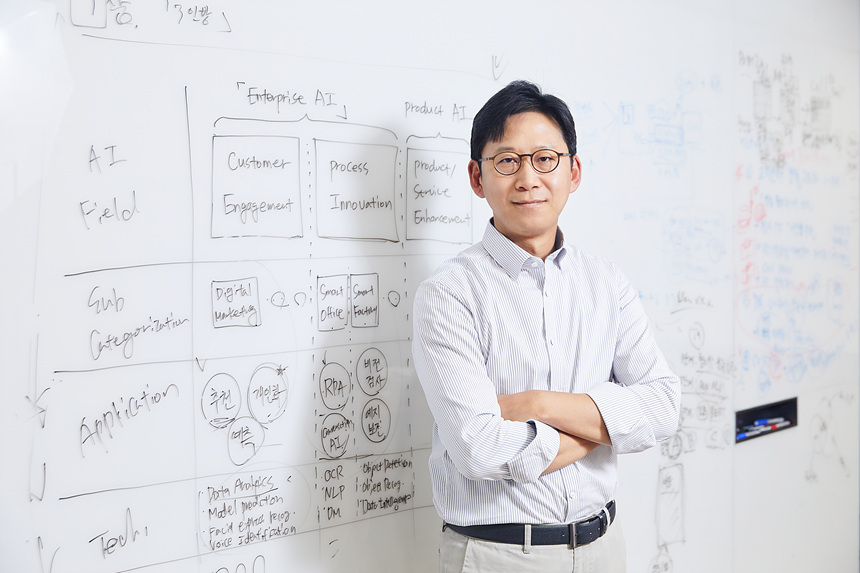
LG draws a big picture for AI technology
Q Each LG affiliate has been conducting AI research. What is the background of the launch of a new independent organization called LG AI Research this year?
“The first and foremost reason for LG to establish AI Research is to secure and nurture the best AI talent. After all, AI depends on how people use the technology. So, it is very important to have good talent. However, these days, talent becomes scarce and “the war for talent acquisition” is heating up. LG AI Research is designed to create a research environment that allows for basic research with the best specialized institutions and diverse applied research among LG affiliates, thereby attracting and nurturing the best talent. This is why it has been established separately from the existing research organizations.
Secondly, the AI research that LG has been conducting so far remains at the level of partially utilizing AI to differentiate products or services. In order to fully take advantage of AI, it is essential to secure the latest AI technology through prior research, etc., which has been impossible as each affiliate is focused on AI development for business application. At the group level, we will reinforce basic research to secure the latest AI technology and link it to applied research such as solving problems with big business implications, thereby strengthening LG's AI capabilities.
The third is to create an AI development environment at the group level. High-performance computing resources are essential for deep learning research based on large-scale data. As AI technology advances, computing resources are becoming more intelligent and expanding on a large scale. This is also directly related to the cost issue. It is difficult for all affiliates to secure such computing resources, and for the sake of resource efficiency, a system needs to be in place to share the AI development environment at the group level."
Q. What activities is LG AI Research actually doing?
“LG AI Research focuses on securing the latest AI technology, tackling common tasks and challenges among affiliates, securing and nurturing talent, and establishing an AI development infrastructure at the group level.
First of all, we are conducting joint research with the University of Toronto, a leader in AI research, to secure the latest AI technology. Internally, we have secured the latest deep learning technologies, and developed to the point of commercialization Continual Learning, Transfer Learning, Explainable AI, GAN, etc., to transfer among affiliates.
In terms of tacking common tasks/challenges, we are promoting vision inspection and chatbot research to strengthen the group's common AI capabilities. We are focused on the issues of which business value is worth at least 10 billion won, and we are already making tangible results in the development of new drug candidates, battery life prediction, and patent literature analysis.
In terms of securing and nurturing talent, we plan to recruit as Chief Scientist of AI (CSAI) Professor Honglak Lee of the University of Michigan, the world's leading authority in the field of unsupervised/reinforced learning, and secure the best and the brightest from around the world. In addition, we hold hackathons to recruit AI talent with practical skills, and AI Talk Concert to share technological achievements to strengthen LG's internal AI capabilities, and Advanced AI Problem-Solving Course to solve practical issues on the ground with AI researcher mentors.
Furthermore, LG AI Research has created and operated AI Hub where various affiliates can share best practices. The findings from Advanced AI Problem-Solving Course are shared in the AI Hub for other affiliates with similar issues, and we plan to provide an easy and convenient AI development environment through Public Cloud and Private Cloud.
LG AI Research is also actively collaborating with external research institutes. We are conducting Enterprise AI research together with the University of Toronto, and we have signed a joint research agreement with the AI Research Institute of Seoul National University. Recently, we are building partnerships with industry beyond academics. I participated as a founding member of the “The Alliance for AI-Accelerated Materials Discovery (A3MD)”, centered on the University of Toronto, along with French energy and oil company Total.
Q. Why are you actively promoting research cooperation with various external organizations?
“We seek to complement our own AI research capabilities as there may be limitations by creating an external ecosystem. AI technology is just a tool for problem-solving, and in order to utilize the technology, we need to understand problems on the frontlines and domain knowledge.
LG is already applying AI technology to various products and services, and has sufficient technical expertise and field experience but finds it difficult to secure original AI technology necessary to acquire differentiated competitiveness. This is why we are collaborating to secure original AI technology with the University of Toronto, which has produced Professor Jeffrey Hinton, the founder of deep learning, making great results in the field of enterprise AI.
The same goes for A3MD, an AI material development consortium. Ted Sergent and other world-class experts participate in this consortium, so you will learn a lot of know-how from them. We look forward to creating a network that complements our shortcomings and attracts the best talent through various research collaborations.”
Merit-based compensation, various challenges and growth opportunities
Q. In which direction do you think AI technology will evolve in the future? I am curious about how LG AI Research is preparing for the future of AI development.
“AI technology is not yet complete. This field is still growing through the knowledge and experience of many AI scientists, and it is hard to predict where it will end.
To this date, LG AI Research has been advancing AI technology research in the enterprise area, such as battery life/capacity prediction, new drug candidates discovery, and smart factory vision inspection. Going a step further, we are keen to how to enhance customer value by using AI based on customer data. Google's search and YouTube's recommendation technology are also based on AI, and we are preparing to discover business areas that can increase customer value by utilizing AI technologies such as personalization/recommendation. We plan to continuously expand our boundaries from basic research to applied research.”
Q. How can you define the goals and vision of LG AI Research?
“The first goal is to strengthen the AI capabilities of LG Group. We aim to transform the manufacturing-based company into the leader in enterprise AI. To this end, we will focus on solving issues on the frontlines to create best practices, and to share and transfer the findings and know-how among affiliates.
The second goal is to realize customer value through AI. It is important to solve realistic problems with AI to reduce repetitive tasks and increase efficiency, but using AI as a medium for communication between machines and humans can create work that increases customer value. Customer value here means creating better value by understanding and communicating with customers beyond making products or services valuable. Another goal is to create new products and solutions with AI that can impress customers by identifying their various hidden needs.
The last goal is to secure excellent AI talent. The vision of LG AI Research is to use AI well to solve real-world problems and make impossible problems possible. To this end, it is important to create an environment where AI talent with superb capabilities can exert their full potential. Securing various research tasks and data allows researchers to take on a variety of challenges and develop competencies, which will in turn attract more talent. Eventually, the gathering of the best minds will create a virtuous cycle in which they solve higher-level problems that LG has.”
Q. You talked about the importance and difficulties of talent acquisition. What kind of research culture and environment will LG AI Research provide to its researchers?
“few places in the world have as many research subjects and data as LG. While many AI companies struggle with limited research topics, LG has many ideas that require AI. This will become a venue like a playground where AI scientists can solve various problems, and high-level issues from affiliates, contributing to business performance and enjoying a sense of achievement.
In terms of organizational culture, we are building a new merit-based evaluation and compensation system. We plan to operate a compensation system in which competent researchers are compensated as much as senior or executive levels regardless of seniority. We will provide opportunities for every talent to grow evenly so that there will be no one left behind by dividing compensation levels to prevent over-competition while treating well the highest performers. LG AI Research is not a hierarchical, but flexible and agile organization in which researchers can choose and rotate between their assigned jobs.”
AI ecosystem created by LG AI Research
Kyunghoon Bae is an R&D leader who has both technical knowledge and management ability. He understands well the grievances of AI researchers because he is also a researcher. He started his career as an AI researcher by studying computer vision technology. He researched various AI technologies through a number of autonomous driving and robot projects even before the AI era began in earnest, and studied content-based AI technologies at telecommunications companies, accumulating experience in all AI areas including vision, language, voice, data intelligence, etc. He has published 50 papers, including in 15 SCI-level international journals, and has conducted research activities actively enough to be listed in one of the world's top three biographies.
Q. You have been doing AI research for a long time. What do you think is the most important thing in AI research?
“I think the most important factor in determining the success or failure of AI research for companies is “problem discovery.” Rich AI infrastructure and data do not guarantee a good research environment. If you cannot define a problem, it's as if there's no data to solve with, and in the end, there's nothing to apply AI to. If you discover and solve quality problems in the real world, and the results lead to business outcomes and their value is properly recognized, more talent will be willing to work at LG.
LG AI Research has a well-established collaboration system with each LG affiliate. Affiliates also have strong needs to understand and use AI well, creating an environment to solve common issues together. Of course, beyond LG's internal problem-solving, it is also necessary to discover new business areas through AI. This is one of the tasks we need to work on going forward.”
Q. As an AI researcher and R&D leader of LG AI Research, what do you want to achieve in this field?
“We hope to be recognized for the best technology in at least one or two fields in AI, just as LG ranks first in home appliance and battery. This not only means being recognized for our technological prowess by publishing a paper in the top conferences, but it also means applying the AI technology to business to secure the world-class technology.
Also, we want to create a self-sustaining AI ecosystem centered on LG AI Research. I hope that our researchers will voluntarily study the subject of their preference that can naturally lead to results. If we create and spin off AI companies by each subject area and support those companies, a larger AI ecosystem will be created centered on LG AI Research. To this end, we hope to create an environment and opportunities for researchers to exert their full potential.”
Q. As a colleague and senior who walked on the path of an AI researcher first, what do you want to say to your junior researchers?
“I would like to tell you to stay patient, digging a well to the end. AI is attracting much attention now, and I feel that competition for AI talent is becoming overheated between companies. I hope that you will not be swept away by this trend and accumulate enough experience from basic research to applied research and commercialization.
With AI becoming instrumental, it is now an era where anyone can easily use AI. However, mathematical knowledge and basic research are required to define and solve problems by understanding data properly. If you look deeply into AI as a discipline and learn from the ground up, you will be able to solve any problem given. If the AI bubble disappears with sufficient supply of AI talent someday, then those who have various experiences in the AI field based on a solid foundation will survive.”