 Hyunwoo Kim
2020.10.28
Hyunwoo Kim
2020.10.28
LG's Continual Learning Wins First in CVPR 2020 Continual Learning Challenge
'Continual Learning (Incremental Learning, Lifelong Learning)' refers to a learning method that implements an artificial intelligence system that can respond to changes in the new environment in real time by sequentially learning new data given continuously. In the case of training based on the current deep learning, the past data is erased as the data accumulates, and an error called Catastrophic Forgetting often occurs in which a result is derived primarily from new data. Continual learning is a technique that can solve such error.
The current AI technology, even if it is a prediction model that has elaborately learned large amounts of data at the beginning, gradually becomes less accurate over time when it encounters new data due to changes in the surrounding environment and the addition of new classes. In the field of computer vision, for example, even if AI is set up in the actual factory for vision inspection for defect detection, its accuracy would suffer when new types of defects arise such as lighting changes, equipment aging, etc.
In this case, creating one huge data set that combines both the existing and newly acquired data on which the AI system retrains has worked to maintain its accuracy. However, these methods inevitably consume huge amounts of computing resources as they have to relearn whenever new data are given.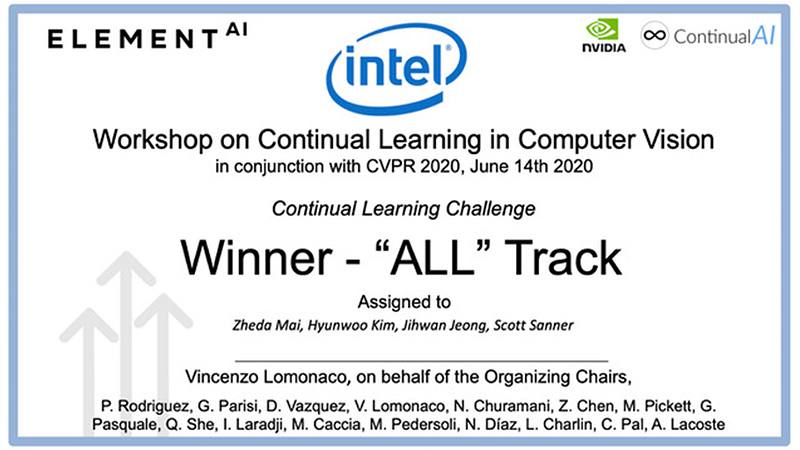
the certificate of LG winning the CVPR 2020 Continual Learning Challenge
LG's technology unveiled at the 'Continual Learning Computer Vision Challenge' of 'CVPR 2020' [1] is aimed at solving such issue. It is a technology that combines a small amount of existing data and newly acquired data to learn faster and more efficiently than the existing model, as there is no need to learn from scratch, it can significantly reduce resource waste. In particular, such efficiency allows for learning on low-power and low-memory devices rather than on the cloud, which is advantageous when dealing with sensitive security information.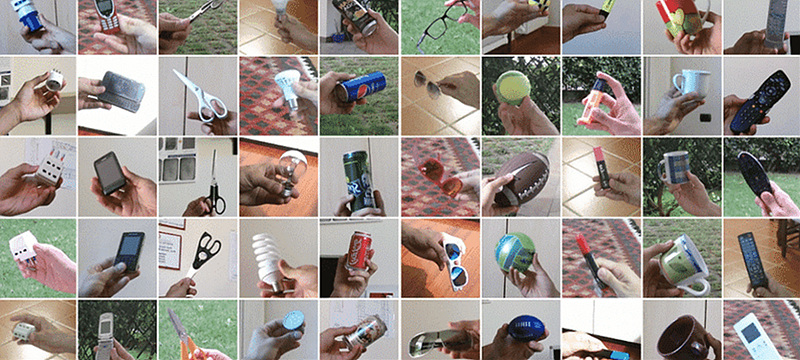
Data used for the CVPR 2020 Challenge. Data produced for the performance test of continual learning in a setting in which data, background, lighting, and the positon of objects change diversely
At the continual learning technology contest held for the first time this year, LG took the first place as a joint research team with the University of Toronto, beating a total of 79 teams including Amazon, Chinese Academy of Sciences, and the University of Tokyo. The victory holds great significance as this was the first time LG ever participated in the CVPR contests in 2020[2]. They performed memory computation at the batch level to improve the efficiency of the existing mini-batch method, and added a review step to minimize catastrophic forgetting.[3]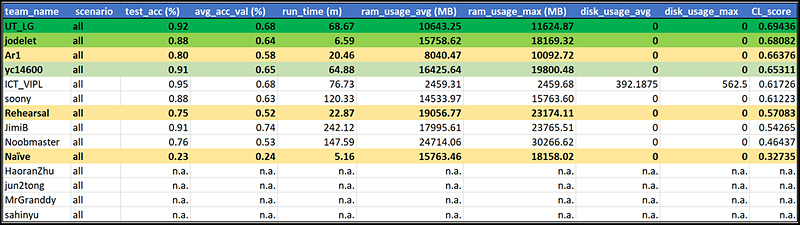
The full ranking list of the CVPR 2020 Challenge. LG took the first place among several competent research teams in all three categories, ranking the top in the world.
LG, which has achieved such achievement at the CVPR 2020, is currently reviewing the latest research findings for presentation at prestigious AI conferences, and plans to promote LG's technology[4], and at the same time, is holding discussion on the transfer of software technology they have developed so far, in order to enhance product competitiveness of each LG affiliate.
- 참고
- [1] A conference co-hosted by the world's most prestigious Institute of Electrical and Electronics Engineers (IEEE) and the Computer Vision Foundation (CVF) since 1983. A large number of world-class research institutes and companies participate the conference to present and share artificial intelligence (AI) research results such as methodology and application papers for processing images and images with computers.
[2] CLVISION CVPR Challenge(https://sites.google.com/view/clvision2020/challenge)
[3] Batch-level Experience Replay with Review for Continual Learning (https://arxiv.org/abs/2007.05683)
[4] Adversarial Shapley Value Experience Replay for Task-Free Continual Learning (https://arxiv.org/abs/2009.00093)