 Hansol Jang
2020.10.28
Hansol Jang
2020.10.28
Dreaming of a world where everyone connects and communicates through AI, Researcher Hansol Jang
Among various research fields based on AI technology, natural language processing is a technology that analyzes, understands, learns, and generates human language using a computer. Ultimately, it allows machines and humans to communicate in one language.
LG AI Research is actively conducting research in the fields of machine learning and natural language processing and is recruiting the best talent in the relevant fields. One of them is Hansol Jang at Language Lab, who has recently joined LG AI Research as a new researcher.
A Korean literature major who likes mathematics meets Big Data
Researcher Hansol Jang has majored in liberal arts from high school through graduate school. After graduating from a high school specialized in foreign language studies, she majored in Korean language and literature, and statistics in university, and linguistics in graduate school. On the surface, she undoubtedly looks like a liberal arts major, but there is a twist here.
“I liked solving equations since I was a little kid. I went to a high school specialized in foreign studies with no STEM majors, and I majored in Korean language and literature in college, but double-majored in statistics related to math that I liked. Statistics deals with unstructured data such as language and pictures along with numbers, but as a Korean literature major, I got interested in language data. At the time, the big data boom began in full swing, and while studying statistical tools and big data in the big data college club, I made up my mind to study language data. After hearing the news that the Graduate School of Linguistics has a computer language lab, I went on to the Graduate School of Linguistics.”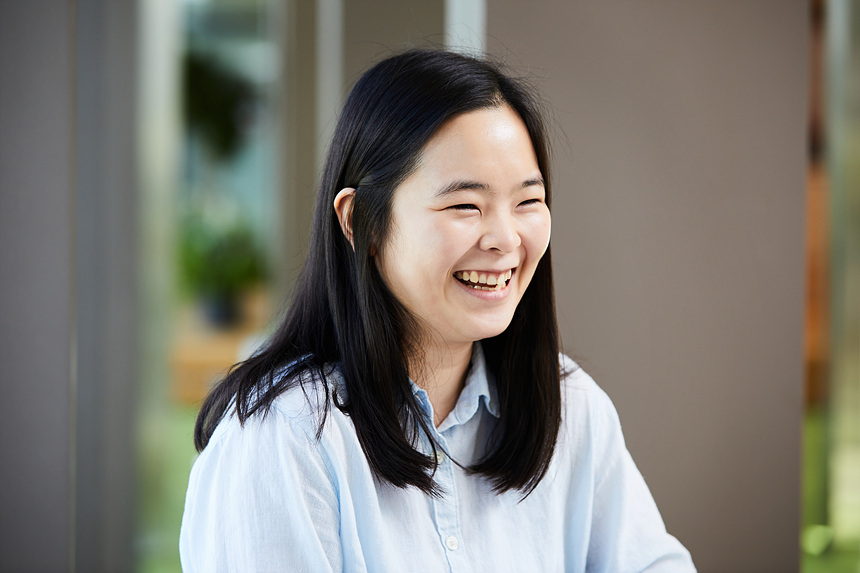
Her tendency to somehow see the end of what she has started led her on the path of research. While she humbly said that she didn’t have the courage to quit, she ended up finishing each work till the end, and her willpower to find a way to the end without giving up in a given situation has become a great asset to research.
“Even when I was in high school, my friends who found themselves suited to STEM majors transferred to another school in the middle. But I decided to finish the school once I got in. I didn't force myself to do what I didn't want to do, but I had a greater desire to finish what I started with. I ended up on this career path with a double major in statistics at undergraduate school, so my choice back then wasn’t bad at all.”
She had to learn computer skills separately, but after learning the basics enough, her knowledge in Korean Literature, helped study language processing. It's because she was used to dealing with a variety of vocabulary, and when analyzing linguistic data, she was able to see them in more depth with a different perspective.
“Because I knew that I was less knowledgeable about programming and algorithms than STEM majors, I studied in various ways even before entering graduate school. I took lectures and attended academies, working hard to make up for my shortcomings. In graduate school, while doing off-campus group-study activities in the field of natural language processing, I met people in the AI field and tried to learn what research is currently being conducted. In a job interview with LG AI Research, they must have appreciated the fact that I worked hard to overcome my shortcomings.”
Researcher Hansol Jang still recalls vividly when she felt embarrassed in front of a computer with errors during her early days of AI research. At the time, dealing with a machine felt like a high entry barrier, but now she knows that when you put data into a computer, it's rarely passed at once, and as always, you'll find a way. It was the result of enduring numerous trials and errors and building up successes.
“I remember a study that I took part in at graduate school to learn a language model by dissecting the syllable structure in Hangul, the Korean alphabet. The study was to train a machine to correct and learn by itself many grammatical errors in the consumer reviews posted on the internet.
For example, if you let the machine learn the Korean phrase “재밋는뎅(jaeminneundeng)”, basically meaning “It’s fun”, it has to learn the expression as a whole repeatedly. Usually, machines recognize language as syllable units, but we used a tokenizer suitable for Korean langauge to distinguish the onset, nucleus, and the coda in the syllable structure. It’s like ‘jaemi’+‘n’+‘neunde’+’ng’. The study took into account the characteristics of the Korean language, and I was proud that the results contributed to the linguistic understanding.”
“I wanted to do research in a place that offers more opportunities”
Those who take on the path of research stand at a crossroads upon the completion of postgraduate study. ResearcherHansol Jang also had to choose whether to continue on research at school or get a job at a company or research institute. She challenged herself in a new environment of the corporate laboratory.
“I wanted to solve real problems we are facing now through artificial intelligence. Of course, schools also do research that focuses on solving practical problems, but they use more refined data than actual data, as their ultimate goal is publish a paper. For me, who is interested in how to apply the results of my research to the reality, it seemed like a corporate lab that deals with real data would be a better fit.”
She faced another dilemma because she had to choose where to work from so many companies in need of AI researchers as they were starting to fully engage in AI research. She often saw that her colleagues who had already worked in industry faced limitations during research due to limited data and resources, and this is why she chose LG AI Research, which has a variety of data and excellent research infrastructure.
“When choosing a company, the most important thing I considered was “how many opportunities does this company offer?' I thought I could grow more in a place where I can study various real-world problems. Language modeling requires a large amount of data and a high-performance machine that can handle it. LG AI Research has machines such as TPU[1], and above all, it has been dealing with various data to solve the issues on the ground that the affiliates are experiencing. This felt the most appealing to me as a researcher.
Even before joining the company, I heard that LG is preparing a lot of AI-related things, and despite being a large company, I felt that it has a clear direction to do as many attempts as possible with deep learning rather than remaining complacent. As I’ve actually joined this company, those around me always encourage me to do more without being afraid of failure, and generously offer me the support necessary for research.”
A person who does not get tired and has fun studying
Researcher Hansol Jang is currently conducting research on Korean Language Machine Reading Comprehension (MRC) technology and Open-Domain Question Answering[2] at LG AI Research. In July of this year, LG AI Research ranked first in terms of MRC on the test set of “KorQuAD 1.0”, Korean standard dataset for AI learning, being recognized for its unrivaled technological capacity in the field of language processing. The excellent achievements of seniors also inspire and motivate her research.

“I would like to study a language model called “Generative Model” that does not find an answer from an existing text, but makes its own answer. There are a lot of language models recently like GPT-3[3] that use machine learning to create their own answers. When the generation model is applied to the current technology, not only chat-bots that generate new answers according to user inquiries, but also translation that fluently turns Korean into other languages, summarization that understands and regenerates the entire paragraph, and grammar error flection technique that correct grammatical errors will be more sophisticated.”
When not doing research, researcher Hansol Jang takes a café tour, looking for coffee with strong acidity and relieving stress by singing loudly in a coin operated karaoke. She, who once dreamed of becoming a drama producer, is the average 20s who strolls in the park and clears her mind when the research does not go well, and gets comfort from singer Jeong Seung-hwan's songs. She hopes to discover elements of fun in research, just as she enjoys finding things she likes in her busy daily life.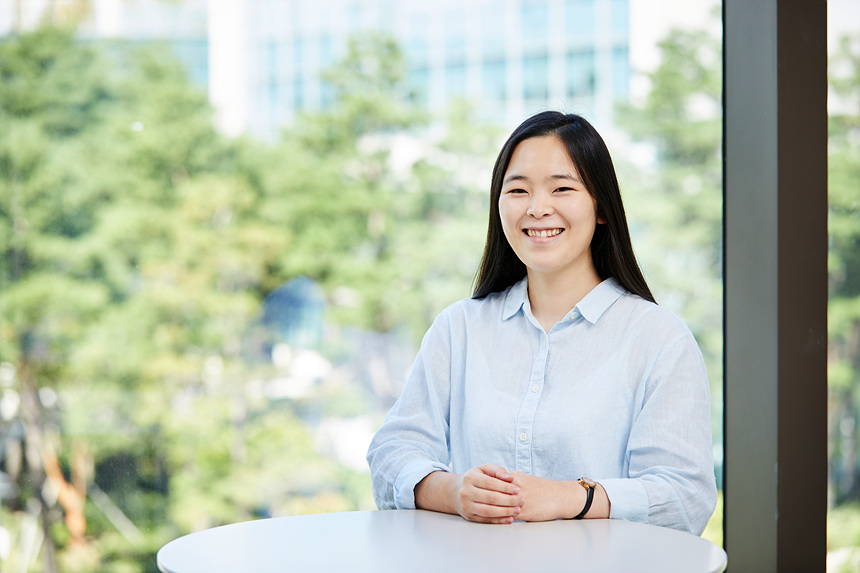
“When I was in graduate school, I participated in an overseas conference called NAACL (North American Association for Computational Linguistics). One of the presenters delivered a presentation on a study based on joke data, and he looked very excited from the time he came out, eager to announce what he had found. He looked as if he was really enjoying his research without losing any interest in the subject. Looking at him, I thought to myself to find an element of fun in whatever research I do.
Now, since I’ve joined the company recently, I am concentrating on doing the missions given as quickly as possible by reducing trials and errors, rather than setting up big goals and plans. In the near future, I want to have great research capabilities that I may not feel ashamed of. AI research eventually gets completed, but it requires a lot of trials and errors in the process. I want to study happily while finding elements of fun rather than feeling frustrated every time I encounter any setback.”
- 참고
- [1] It is a machine learning chip developed by Google and is optimized for Tensor Flow, Google's AI machine learning engine. TPU is 15 to 30 times faster than the latest GPUs and CPUs, and AI computation performance is 30 to 80 times higher per 1W of power consumption.
[2] A language model for asking and answering questions based on large amounts of open data such as on Wikipedia.
[3] GPT-3 is an artificial intelligence text generator recently unveiled by OpenAI, an artificial intelligence research institute in the United States. It is a machine learning-based natural language processing model that predicts and presents the next word given only a few words or sentences.