LG AI Research Unveils K-EXAONE 2.0, Korea's Largest 750-Billion-Parameter AI Foundation Model
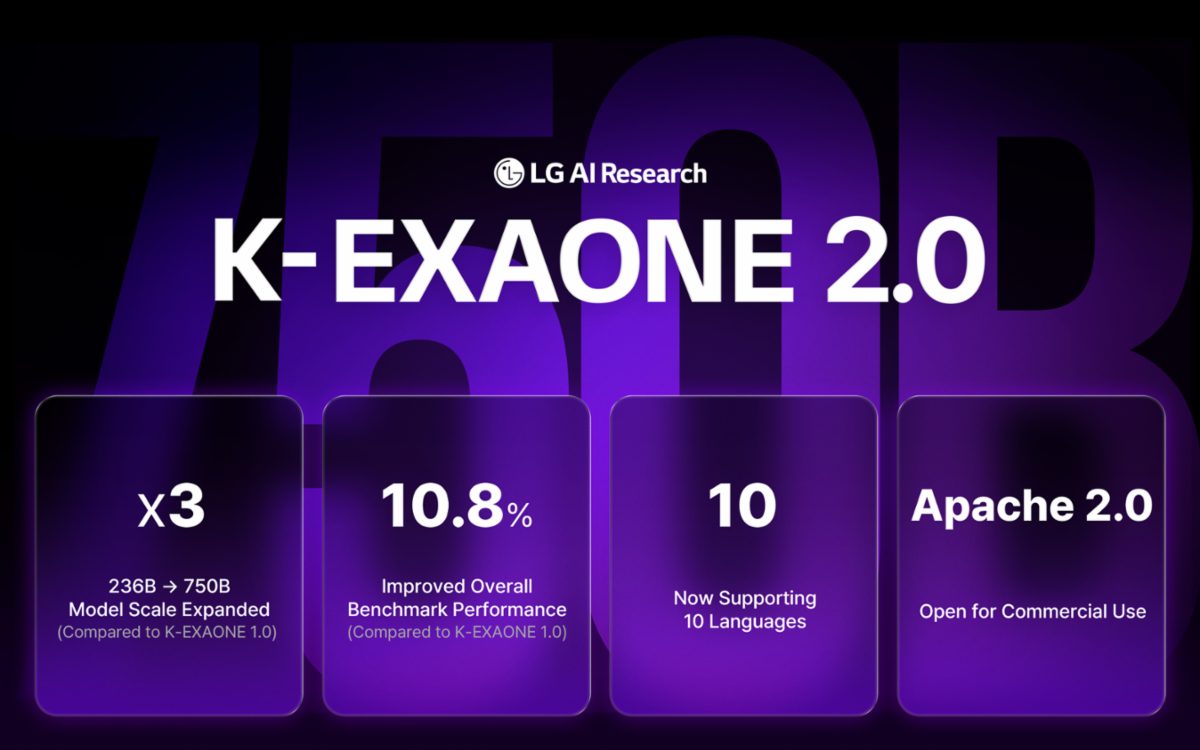
LG AI Research has released K-EXAONE 2.0, the second model developed under the Korean Ministry of Science and ICT's Sovereign AI Foundation Model Project, on the open-source platform Hugging Face on July 31.
With 750 billion parameters, K-EXAONE 2.0 is the largest AI foundation model developed in Korea to date, representing more than a threefold increase in scale compared to the first-phase model (236B). To further promote openness and adoption, LG AI Research has also transitioned the model's license to Apache 2.0, allowing commercial use without restrictions.
Alongside the model release, LG AI Research published the results of comprehensive evaluations across 24 benchmarks in nine categories, including the official evaluation criteria used in the Sovereign AI Foundation Model Project. K-EXAONE 2.0 achieved an average score of 70.1 across the 24 benchmarks, representing an improvement of more than 10% over the first-phase model's score of 63.3. Notably, performance across three major coding and agentic coding benchmarks improved by approximately 30%.
The model also demonstrated performance that is competitive with, or exceeds, leading global foundation models across key capability areas, including long-context understanding, agentic capabilities, and instruction following. In long-context understanding, K-EXAONE 2.0 achieved 94.4 on OpenAI-MRCR and 89.6 on Ko-LongBench, outperforming GLM-5.1 (71.5 and 83.6, respectively). Across three representative long-context benchmarks—OpenAI-MRCR, AA-LCR, and Ko-LongBench—the model achieved an average score more than 10% higher than GLM-5.1. For agentic tool-use capability, K-EXAONE 2.0 scored 14.2 on Tau3-Bench Banking, outperforming GLM-5.1 (11.5) and Qwen3.5 (13.4). In instruction-following evaluations, including IFEval and IFBench, the model demonstrated performance on par with leading global models such as GLM-5.1, DeepSeek V4 Pro Max, and Qwen3.5.
LG AI Research has also expanded K-EXAONE 2.0's multilingual capabilities. In addition to Korean, English, Spanish, German, Japanese, and Vietnamese, the model now supports French, Italian, Portuguese, and Polish, bringing the total number of supported languages to 10. "The model currently supports the largest number of languages among Korean-developed AI foundation models," an LG AI Research representative said. "This expansion provides a stronger foundation for sovereign AI technologies to serve not only Korea but also global markets."
Beyond performance, LG AI Research also placed significant emphasis on safety and responsible AI aligned with both Korean societal contexts and international ethical standards. K-EXAONE 2.0 achieved an average score of 94.6 across KGC-Safety, which evaluates compliance with Korean-specific and global AI safety standards, and ROK-Fortress, which assesses safety in geopolitically sensitive contexts. These results surpassed GLM-5.1 (71.3), DeepSeek V4 Pro Max (65.2), and Qwen3.5 (89.0).
LG AI Research has also successfully completed large-scale training of a 750B-parameter foundation model—the first of its kind in Korea—and built the full infrastructure required for model evaluation and inference. The significance of this achievement lies not only in scaling the model, but also in demonstrating practical performance across diverse real-world scenarios while marking the beginning of Korea's effort to compete with global frontier AI models.
"K-EXAONE 2.0 represents far more than simply building a larger model," said Woohyung Lim, Co-President of LG AI Research. "Our research team independently completed every stage of development—from model architecture and data preparation to large-scale distributed training and inference infrastructure—for a 750B-parameter foundation model. This demonstrates that we have established the capabilities required to compete alongside global frontier models, which is the central objective of the Sovereign AI Foundation Model Project." He added, "The current model is not the final destination but the starting point for fully unlocking the potential of frontier-scale AI models. We will continue advancing K-EXAONE through higher-quality data, continued post-training, reinforcement learning, and more sophisticated inference technologies."
■ K-EXAONE Expands Across Manufacturing, Bio, Finance, and the Public Sector
Alongside the release of K-EXAONE 2.0, LG AI Research continues to accelerate R&D efforts to expand the K-EXAONE ecosystem across a wide range of industries and everyday applications, including manufacturing, biotechnology, finance, and the public sector. Earlier this year, the institute introduced EXAONE 4.5, its latest vision-language model (VLM), as part of this broader initiative.
EXAONE 4.5 demonstrated state-of-the-art multimodal performance, outperforming GPT-5 mini, Claude Sonnet 4.5, and Qwen3-VL on the average score across 13 evaluation benchmarks. These include three benchmarks measuring general visual understanding, as well as five benchmarks evaluating document understanding and reasoning over complex multimodal content such as infographics and technical documents that combine images and text.
The model is also being deployed in real-world public services. EXAONE 4.5 has been selected as the AI engine behind the Ministry of the Interior and Safety's AI Safety Reporting System, where it will analyze more than 39,000 public safety reports per day. It has also been adopted by the Ministry of Food and Drug Safety to power an AI-assisted drug review system, helping significantly reduce the time required for new drug approval evaluations.
LG AI Research is completing the development of a public evaluation platform as part of the second-round assessment for the Sovereign AI Foundation Model Project. The platform is designed to evaluate real-world usability, and the institute is also preparing a service that will allow the general public to experience K-EXAONE 2.0 firsthand. Also LG AI Research plans to further strengthen its portfolio of domain-specialized Expert AI models by unveiling another industry-focused AI foundation model next week, expanding AI innovation across both industrial environments and everyday life.