 Woohyung Lim
2021.02.16
Woohyung Lim
2021.02.16
 Hyemin Jung
2021.02.16
Hyemin Jung
2021.02.16
 Hyeseung Cho
2021.02.16
Hyeseung Cho
2021.02.16
Data Intelligence Lab, To Make Optimal Decisions Everywhere
'Life is C between B and D.' As philosopher Sartre once said, we make choices at every moment of our lives. And we make these choices not only in business but also in our daily activities. Data Intelligence is an AI technology that helps us make optimal decisions.
From sensor signals generated in the manufacturing process to the flow of logistics and funds, and patterns of people's use and consumption of products, every kind of data could be the subject of Data Intelligence research. Among all AI technologies, Data Intelligence is the most widely researched and used technology. Let us meet with Woohyung Lim who leads Data Intelligence Lab and learn more about the lab and their research.
Data Intelligence, AI that goes beyond mimicking human
Dr. Lim, the Lab Leader, is an expert in speech recognition field. After his PhD study in speech recognition, he worked at an electronics and telecommunications company and researched in relation to speech recognition services and platforms. And then, in 2019 he joined LG Sciencepark. Realizing the demands and potentials of Data Intelligence here, Woohyung expands his research scope and is currently researching Data Intelligence based on complex data. 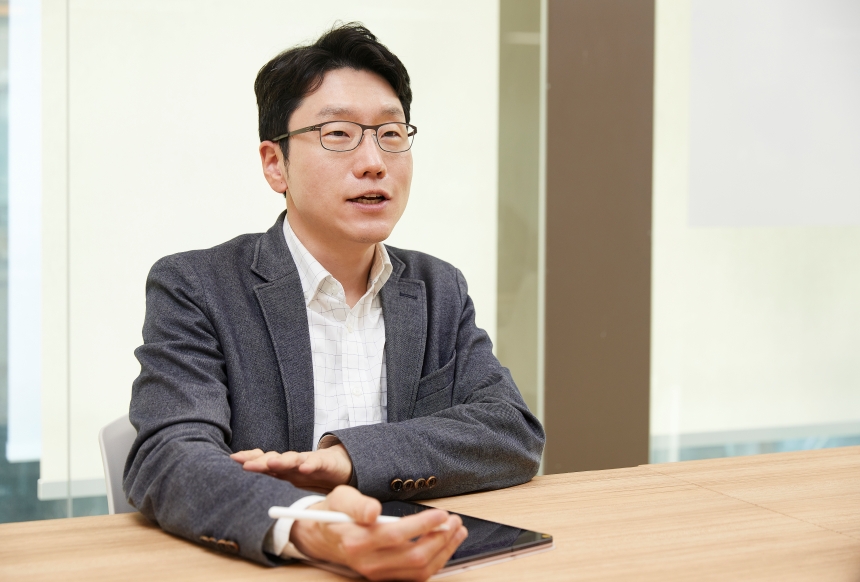
Q. How did you first become interested in AI? Were there any motivations for your AI research?
“I have been interested in AI since I was a child. It was interesting to see machines imitate humans and interact with them. Growing up, I liked robots, engineering, and computers, and as it was compatible with my interests I got my Bachelor's degree in Electrical and Computer Engineering and did robotics as part of extracurricular activities. At the same time, I was curious about humans themselves and how they thought at a higher-level using intelligence, which is why I did separate study on cognitive psychology.
I started my research in AI, specifically in Speech Recognition from my Master's course as I wanted to research the process of machines recognizing and understanding human language, and also to create AI that can communicate with humans. As I continued my research, I discovered demands and opportunities in the Data Intelligence field. Having similar characteristics to speech recognition related research, I was easily able to expand my research scope to Data Intelligence.”
Q. What are some characteristics of Data Intelligence research, and how does it differentiate from other AI researches?
“Data Intelligence goes beyond merely emulating humans and help to make optimal decisions on more complex levels. In general, people think of AI as machines thinking and acting 'like humans.' For example, the ultimate goal of AI research in the video or language sector is to create AI that mimics humans well.
However, machines can outperform humans with Data Intelligence. AlphaGo is a good example. Although Go is a simple game of using black and white stones in a limited board space of 19X19, it is more about calculating and predicting the numerous variables and deciding which move to make next. Whereas people rely on intuition and past experiences to make this move, AI does this through theoretical and probabilistic calculations, thus outperforming humans as seen with the match between AlphaGo and Sedol Lee.
Data Intelligence provides a logic to mathematically and systematically make the decisions that people normally make with uncertainty as they do it based on intuition and experience. This is what differentiates Data Intelligence from other AI researches.”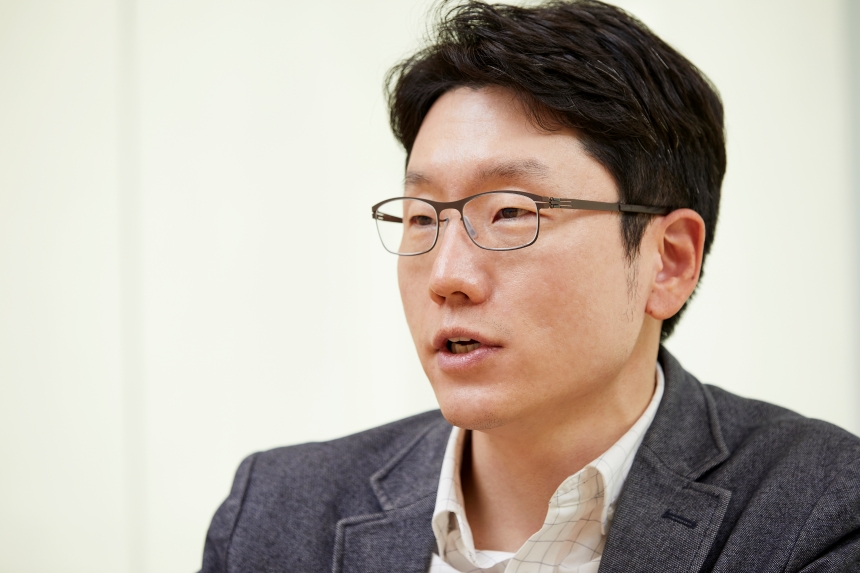
Q. The types of data and the range of its use must be different as well.
“Any numerical data, including ones generated in a product development process, log data such as past sales figures, performance data, and so on, could all be subjects of research. So, instead of limiting the application areas of Data Intelligence, it could basically be used in any area as long as there is data.
We actually worked on a project where we had to detect battery abnormalities, predict lifespan and capacity of batteries as well as foresee abnormalities in a telecommunications network and IPTVs. There was another one where we managed inventories and prepare for production based on the prediction of customer’s demand. We are also discussing doing a project in relation to recommending personalized contents in the entertainment field.”
Q. What are some unsolved challenges in the Data Intelligence field?
“We are still working on automatically sorting out core meaningful numbers among large and complex numerical data, and incorporating the knowledge and information behind the given data into the framework of machine learning.
Relatively speaking, high-performance models in the video and language sector, such as ImageNet related models and GPT-3, are being developed through building large scale. However, in the Data Intelligence sector, real field data often exist in small quantities in diverse situations. So it is difficult to create AI that automatically derives insight from these data. This is why we're researching ways to combine human knowledge with machine learning, and we believe it will have an immense impact on all aspects.”
Dreaming of AI that will be applied everywhere
Q. Which AI technologies are being used for research at Data Intelligence Lab?
“We are currently carrying out research in 5 sectors; Prediction, Time-Series Forecasting, Anomaly Detection, Optimization, and Recommendation.
We're currently focusing on battery anomaly detection and capacity prediction more. Battery anomaly detection research refers to finding solutions to prevent accidents in advance by detecting battery abnormalities using AI. Although various anomaly detection algorithms have been used in the past, there were limitations on understanding and modeling data patterns generated from the battery by a human. We are working on getting differentiated performances by using the latest AI technologies including Variational Autoencoder, Adversarial Autoencoder, and so on.
Research on battery capacity prediction refers to being able to predict the battery's actual capacity using only partial data from the battery's charging and discharging. These prediction models can be developed using the traditional prediction algorithms based on statistics, but we are working to enhance the prediction performance by applying the latest AI algorithms such as DNN/CNN Ensemble models.” 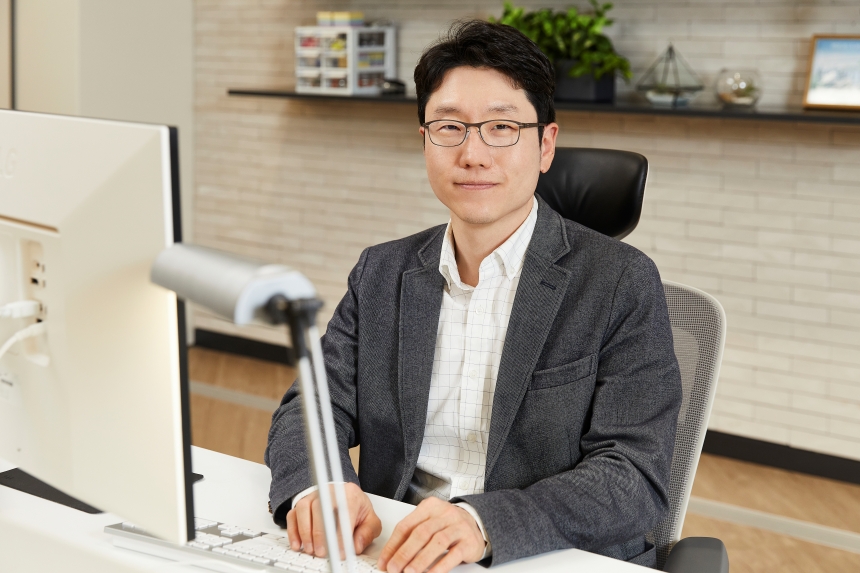
Q. What is Data Intelligence Lab's biggest milestone, or major achievements?
“Our major achievement would be the last year's battery anomaly detection and capacity prediction projects. We still have a long way to go before on-site execution but we believe it is a major achievement to be able to prove the possibility of solving prediction problems at an advanced level using the latest AI technologies. Through these verifications, we are making various attempts in making a breakthrough in problems that have had limits in the past.”
Q. What are the vision and goals of Data Intelligence Lab?
“We dream of using AI in all parts of our society. This means creating AI that is used in our daily lives like our mobile phones and AI that helps people with challenging tasks. In particular, we want to create AI that can solve problems that require complex thinking.
AI can be used as various tools depending on the user. When used in a company, it can be a tool used for business decision making that maximizes management, manufacturing, and R&D efficiency. I believe AI will not only be used for particular purposes but be always by our side and used in any way possible.”
An organization that enjoys research while looking at the big forest
Data Intelligence Lab consists of 12 people including Lab leader, Woohyung. There are some researchers joined this team while carrying out research in other fields, just like Woohyung did. The team is divided into Squads for each research project and lab members can also freely carry out different researches according to their needs and interests.
Q. What is the culture and organization of the Data Intelligence Lab? What type of organization are you planning to lead?
“Data Intelligence Lab is an energetic place where team members can freely have discussions and go to one another for any questions they may have. It's a place that requires a lot of studying and identifying new research topics, but I can assure you, it's the most exciting place when we have a team dinner.
The work culture here is very horizontal and free but I don't want this lab to be a comfort zone. I hope our researchers experience personal growth during their time in this lab and are able to broaden their views while having an interest in other members' researches. So I plan on holding regular sessions where all lab members gather to share their research studies.”
Q. What do you emphasize usually most to members?
“I want our lab members to have fun with their research and not get tired of continuing their work. So instead of sticking to making short-term achievements, I ask them to constantly think about their ultimate goals. It is easy to be worn out when you're stuck with a single problem. To continue doing good research, it is important to get yourself out of the problem itself and see if you're going in the right direction, and constantly ask yourself if there are other options or solutions.
This applies to research in Data Intelligence as well. Rather than rushing to solve a particular problem, it is important to generalize and abstract the situation, then understand the essence of the problem, and figure out which core AI algorithms to use for the solution. In order to do this, I always ask my lab members questions that require abstract thinking and give them enough time to think it through. At first, they struggle but as time passes they start to build up their in-depth thinking experience and it's a great reward to see their growth.”
Q. Are there any goals you would like to achieve at Data Intelligence Lab?
“I would like for at least one or two of our technologies created in the Data Intelligence field to be the world's best. Just as how DeepMind naturally comes up with Deep Reinforcement Learning, I would like for all researchers to think of LG AI Research's Data Intelligence Lab on some aspects of Data Intelligence. And I also would like to make good technologies and examples that all researchers want to work with us. hope to make Data Intelligence Lab a place where researchers desire to work at, a place for people to grow, and an organization that will have a positive impact on others.”
MINI INTERVIEW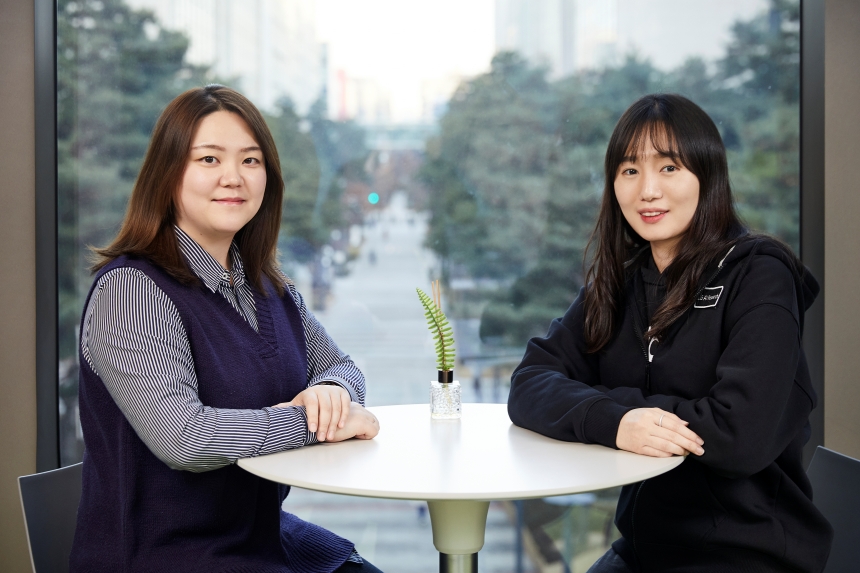
Data Intelligence Lab Hyeseung Cho(left), Hyemin Jung(right)
Q. Can you tell us about your current work at Data Intelligence Lab?
Hyemin: I am researching recommendation algorithms and anomaly detection algorithms in the Data Intelligence Lab. I first came across Data Intelligence while carrying out research in road speed data prediction for Seoul city during Graduate School. I wanted to develop skills to solve problems in both research and on-site so I started working at LG AI Research's Data Intelligence Lab.
Hyeseung: I am currently researching anomaly detection algorithm. I think it can be referred to as time-series anomaly detection. More specifically, my research requires detecting abnormal movements of batteries in ESS(Energy Storage System) or electric vehicles.
Q. What are some on appealing factors in Data Intelligence research?
Hyemin: Data Intelligence research goes through the process of throwing a fundamental question and finding solutions. I find this process itself to be very appealing. For example, to solve specific problems such as prediction and recommendation, we need to ask ourselves a question on how we can draw core characteristics and patterns contained in the data. We then need to apply mathematical knowledge such as probability and linear algebra as well as theoretical knowledge including machine learning, deep learning in order to find the answer, and this whole process is appealing to me.
Hyeseung: As Data Intelligence research covers all range of data excluding computer vision and language, the range is broad and we still have a lot of challenges to overcome. We encounter problems as 'invisible signals' known as 'data' accumulate in unexpected situations like inside EV batteries, a manufacturing process of chemical plants, and IPTV networks. I find it appealing that there are various problems that arise in the research process. It feels good to solve these real problems and I feel like I'm contributing to the world.
Q. What kind of organization is Data Intelligence Lab? What kind of lab leader is Woohyung Lim?
Hyemin: Here at Data Intelligence Lab, we actively exchange ideas on research topics that we have a common interest in, and seek to find solutions to challenges that we encounter while solving problems on-site. Our lab leader not only enjoys doing research, but he knows each members' personality, strengths, and interests so he helps in creating a joyful workplace. He's also the type of leader that doesn't focus only on what we're facing at the moment, but help find answers to what we want to achieve and would like to research.
Hyeseung: The biggest advantage of our lab is that the work culture is horizontal and free. We are able to exchange ideas regardless of our work experience and I feel like we can overcome any challenges because of our strong confidence in one another. Our lab leader values happiness in the workplace more than anything. He's always interested in the kinds of research we want to do and guides us through any hardships we encounter. In fact, we go to our lab leader for consultation whenever we face difficulties. His research achievements are also outstanding so we admire him for many reasons.
Q. Are there any goals you want to achieve at Data Intelligence Lab?
Hyemin: I would like to be able to identify the necessary questions needed to solve a certain problem using AI, and have the insight to find solutions to these problems. I would like to identify the limitations of existing methods in my field and find solutions to overcome them.
Hyeseung: With the explosion of data, I believe there is a growing importance of time-series anomaly detection. Although it's a field where data characteristics vary, I want to develop my own methodology that can overcome the limits and be applied in various studies.