 LG AI Research
2021.03.17
LG AI Research
2021.03.17
LG AI Spring Party March 2021, A Look into the Latest AI Trends and Best Practices
On March 4th, LG AI Research invited AI experts and employees of LG subsidiaries and held 'LG AI Spring Party' to share diverse information and research performances. LG AI Spring Party was held in three sessions including BP(Best Practice) Conference which shared best practices of LG subsidiaries that have solved issues through Advanced AI Problem-Solving Course, AI Talk Concert where AI experts introduced the latest AI research trends, and lastly the AI Hackathon awards ceremony.
All events were broadcasted live via webinar as participants were unable to gather face-to-fcae due to Covid-19. Here is a look into LG AI Spring Party, a day filled with exciting AI stories.
AI Talk Concert, Introducing the Hottest AI trends
Trend in Large Language Models (Feat. GTP-3) / Minjoon Seo Assistant Professor at KAIST Graduate School of AI 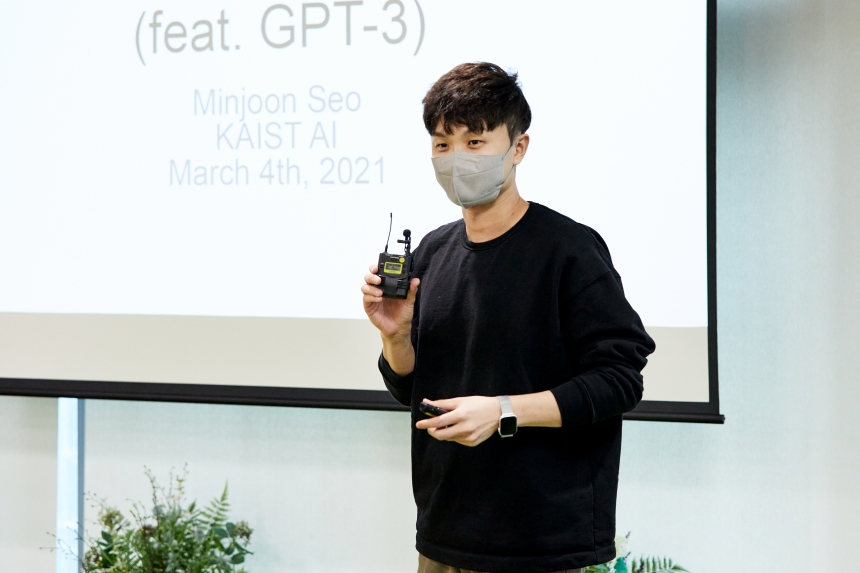
As the first speaker of AI Talk Concert, Professor Minjoon Seo who is an expert in the natural language processing field highlighted the latest trends in language models. Professor Seo introduced large scale language models including the popular GPT-3 and Dall-E models, and talked about the recent trend of language models that are gradually increasing in scale, diverse applications, as well as the limitations and risks of these language models.
In addition, Professor Seo showed research results showing that despite various factors that enhance the performance of language models, it is the scale of the models that have the greatest impact, thus when allocating resources, most should go into model scale, and then according to the size of dataset and workload. Professor Seo also introduced MoE(Mixture of Experts) Transformer, Switch Transformer models, and the latest multilingual, conversational models.
Attention-Based Autoregression for Accurate and Efficient Time Series Forecasting / U Kang, Associate Professor at Seoul National University, Department of Computer Science and Engineering 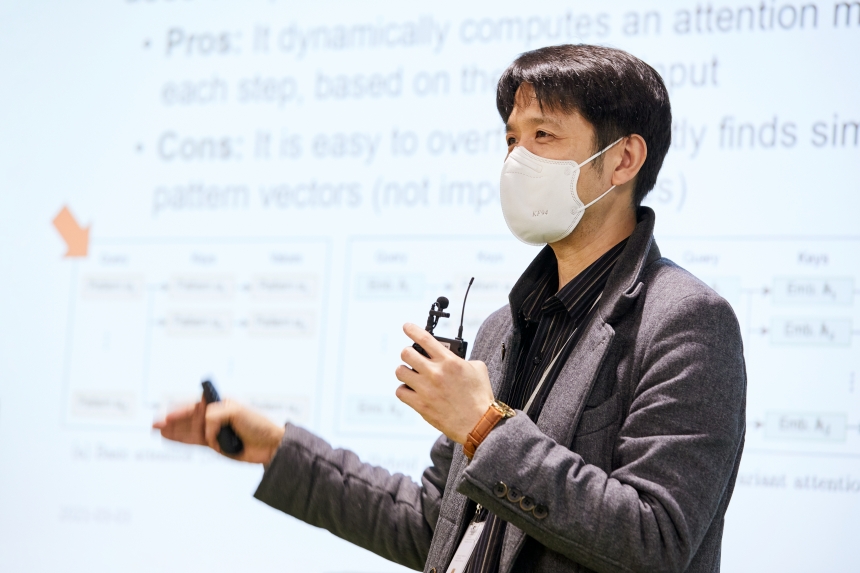
Time series forecasting is a technology that makes predictions about the future based on past data. Typical time series forecasts include city traffic volume, electricity consumption, stock price forecasts, product sales and equipment lifespan forecasts. When talking about multivariate time series forecasting, Professor Kang said considering multiple units of information simultaneously instead of individual units can enhance the performance of forecasting models.
Professor Kang talked about the features and limitations of existing time series forecasting models including AR(Autoregressive) based models, VAR(Vector AR) models, MF(Matrix Factorization) based models and TRMF, as well as RNN based models. He also introduced his latest AttnAR(attention-based autoregression) model research studies. The AttnAR model is a model that consists a framework of three modules including extraction, attention and prediction,. It gives best performance when MCE(mixed-convolution extractor) module and TIA(Time-invariant attention) modules are used together, and also showed excellence by exceeding the performance of existing models in terms of accuracy and effeciency.
AI Ethics and Regulations / Hyunsil Ahn, Head of the Korea Economic AI Research
As AI technology advances, companies are announcing AI ethics policies. As the third speaker of AI Talk Concert, Hyunsil Ahn, Head of Korea Economic AI Research gave a lecture on the topic 'AI ethics and regulations'. Referring to Adam Smith's 'The Wealth of Nations' and 'Liberalism', he mentioned that morality could be a more useful tool for corporate activities than legal regulations. In addition, Ahn pointed out that while smart regulations promote innovation, we must look out for regulation abuse that deter innovation as a way to protect the benefits of certain vested interests. He also stressed that the most important factor in AI revolution is creativity and automony, thus we need to set regulations and ethics accordingly.
Towards Multi-Modal Representation Learning / Seunghoon Hong Assistant Professor at KAIST School of Computing 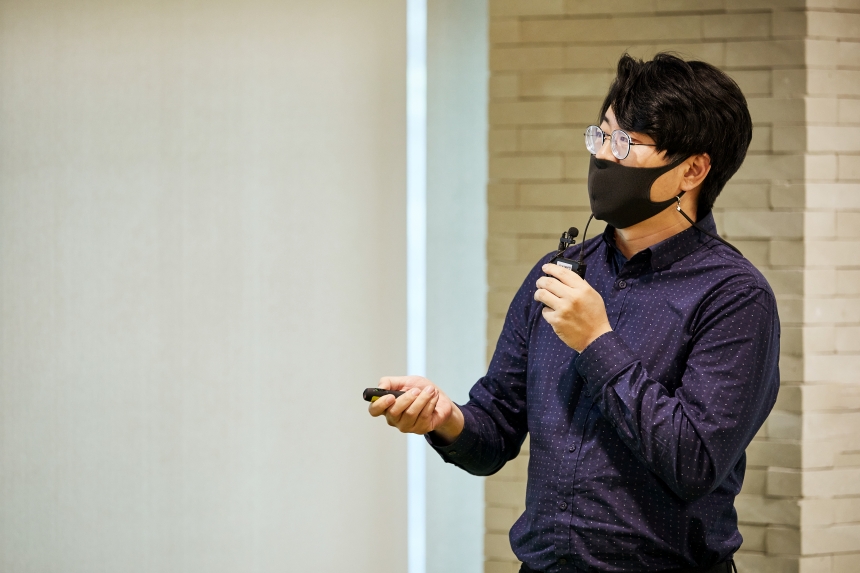
Professor Seunghoon Hong, who was the last speaker of AI Talk Concert introduced the Multi-Modal Representation Learning model that simultaneously learns data from various types of sources including video, audio and text in order to derive results. He talked about the challenges in multi view expression learning and introduced research studies that can help solve the problems.
Professor Hong performed a simulation using incomplete data where partial view was omitted in order to create a model that can estimate a complete expression with only partial view as input value, and one that can generally be applied to other tasks. He also presented research results of the PMVRL(Partial Multi-View Representation Learning) model which has linear expandability even when the view types increase when a methodology based on Total Correlation is applied to existing multi view expression learning. This model can process using partial data and be applied to other tasks.
LG AI Hackathon Awards Ceremony, Finding Data Analysis Talents that Think in Customers' Perspective
LG AI Hackathon Awards Ceremony was followed by AI Talk Concert. LG AI Hackathon is a competition where people interested in AI compete for ideas to solve industrial problems using AI. The theme of this hackathon was 'predicting users' inconvenience caused by changes in system quality'. Participants of the hackathon were to identify factors that caused this inconvenience by analyzing logs and numerical data from diverse equipments and services.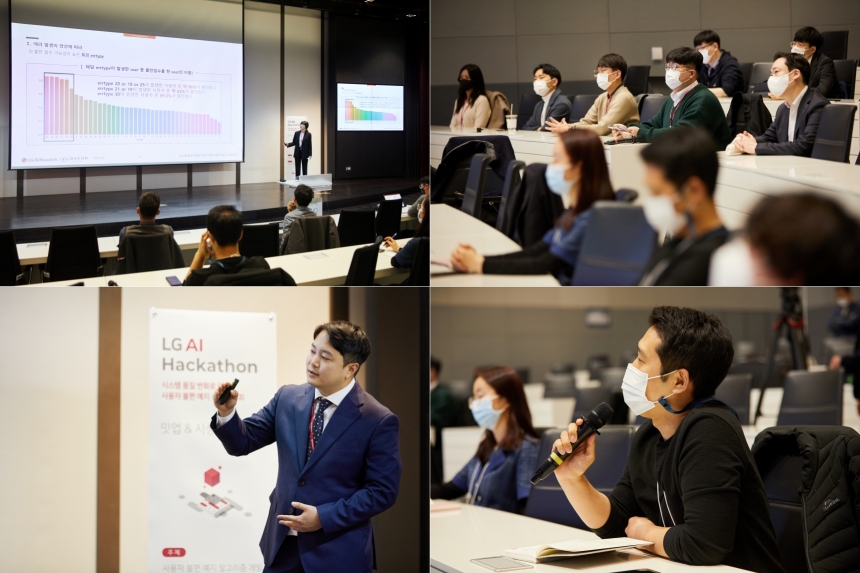
The hackathon was held online from January 6th through February 18th with 1,352 participating teams, the highest number of participants which showed people's high interest and passion for AI. The top three winning teams presented their researches and held a Q&A session. Top ranking teams with outstanding data analysis from customers' perspective will be awarded KRW 10 million and receive a resume screening exemption when joining LG.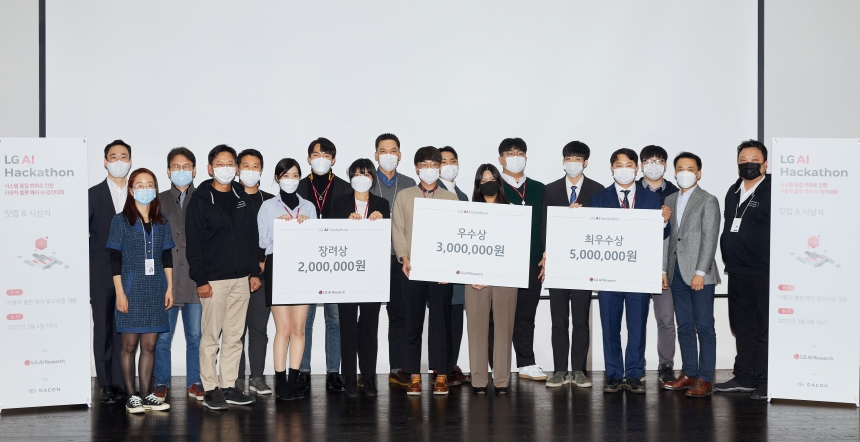
Concluding the LG AI Spring Party, Kyunghoon Bae, Head of LG AI Research said “Through Advanced AI Problem-Solving Course BP Conference and AI Talk Concert, we were able to explore LG's future direction for AI development with our experts and through Hackathon, we had a chance for young talents to gather and solve LG's issues using AI and share their solutions.” He went on and said “We will continue to hold AI related events in order to accelerate LG's digital transformation. We hope to receive continued support.”
LG AI Spring Party was an opportunity for its attendees to look into today's innovative AI technologies and the bright future of AI that young talents will mold. Through active discussions and diverse challenges, we saw great potential in the growth of the field of AI. LG AI Research will continue to hold diverse events to expand the horizons of AI development and make thorough preparations for the future. Through this, we look forward to seeing many AI related ideas and research achievements come to life.