 Changwook Jun
2021.04.22
Changwook Jun
2021.04.22
Researcher Jun Chang-wook’s Life of Learning, Sharing, and Growing
Researcher Jun Chang-wook of LG AI Research is more famous outside. Before he started working at LG AI Research, Jun had led DeepNLP Lab in Modu Labs, published a book about natural language processing, and shared his knowledge and information with AI scientists by giving lectures and by being active on SNS.
From Ordinary Developer to Mentor for AI Scientists
Jun’s knowledge sharing has been continuing since Jun joined LG AI Research. Aside from holding a deep-learning study meeting every Monday with employees of LG affiliates, Jun also has a study meeting twice a week with his TF members to share the latest natural language processing trends and technologies. In addition to conducting daily research activities and attending meetings like any other researchers, Jun, whenever he has spare time, answers the readers’ questions and posts papers and information about AI in the natural language processing community page on Facebook.
“I used to be a server and app developer, not an AI scientist. Until 5~6 years ago, I had absolutely no knowledge of deep learning. While looking into various areas to learn new technologies, I came across an application developed by graduate students using CNN technology at the Google HackFair in 2015. This is how my interest in deep learning began.”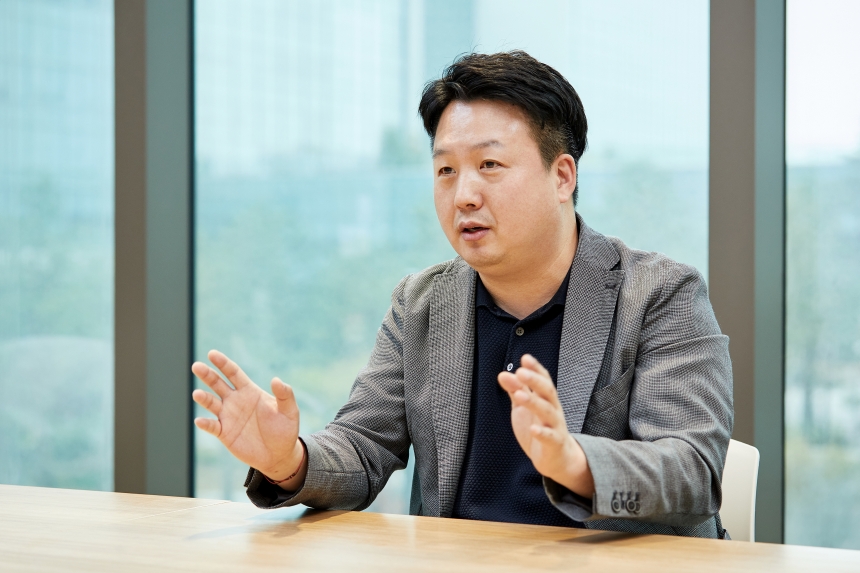
To Jun, who had frequently experienced limits while working on development projects because of the difficulty in technology implementation and the excessive man hour requirement, deep learning that enables overcoming such limits came as a shock. Thus, Jun embarked on an exciting yet arduous journey toward deep learning.
“At the time, it was difficult to find a place where deep learning was taught properly. Schools were not the place, either. I joined a private study group and studied about deep learning with the members after work and went to all conferences that were related to deep learning. Then, I found out about this place called ‘Modu Labs’ and started working there.”
Jun woke up early in the morning to prepare for presentations and read papers whenever he had time. During lunch breaks, he met with people who had knowledge of deep learning and asked them questions and learned from them as well. Many of the members of Jun’s deep learning study group had the same insatiable thirst for learning as he did. In 2016, after studying with these people for one year, Jun entered the Google HackFair with the “smart mirror” that he created using deep learning technology. The following year, Jun won the innovation award at the startup contest with an app that checks for abnormalities in the head shape of infants and toddlers by measuring the head using AI technology. In 2018, Jun developed the “keyboard for people with disabilities,” a device for predicting subsequent words using AI, and won the gold prize at the Competition on the Korean Information System. As such, Jun accumulated small achievements one by one.
“I had been an ordinary office worker who would spend time with family and play computer games after work. I had not read any books at all. But I had always been anxious. I had thought, how long can I go on living like this? How long will I be able to keep myself productive with the knowledge I have? After studying deep learning, I started making small accomplishments using this technology, and my anxiety disappeared. I think succeeding in something new one by one, no matter how small it may be, gives you confidence.”
The Power of Collective Intelligence and Connection
For a developer who had never had any writing experience, starting to write a book about natural language processing—a new field—was a real challenge. Having started from scratch, Jun could imagine how helpless the people who were new to the field of AI might feel, so he thought of sharing with others the knowledge he had obtained with help from many people around him. While writing the book, Jun was also keen to understand properly what he had known and had not known about the field.
“After deciding to write a book, I contacted a number of IT-related publishers. The response was not very favorable, however. Then, in the morning of a very rainy Sunday, the CEO of a publishing company came to the Startup Support Center in Pangyo. He had traveled from Paju by public transportation, so his clothes and shoes were soaking wet. He said, ‘Out of the 100 people who have come to me and said they will write a book, only about 3% actually do so. I am curious if you are one of the 3% or the other 97%. For two years after that day, I went to the Startup Support Center in Pangyo every weekend with my nine-year-old son.”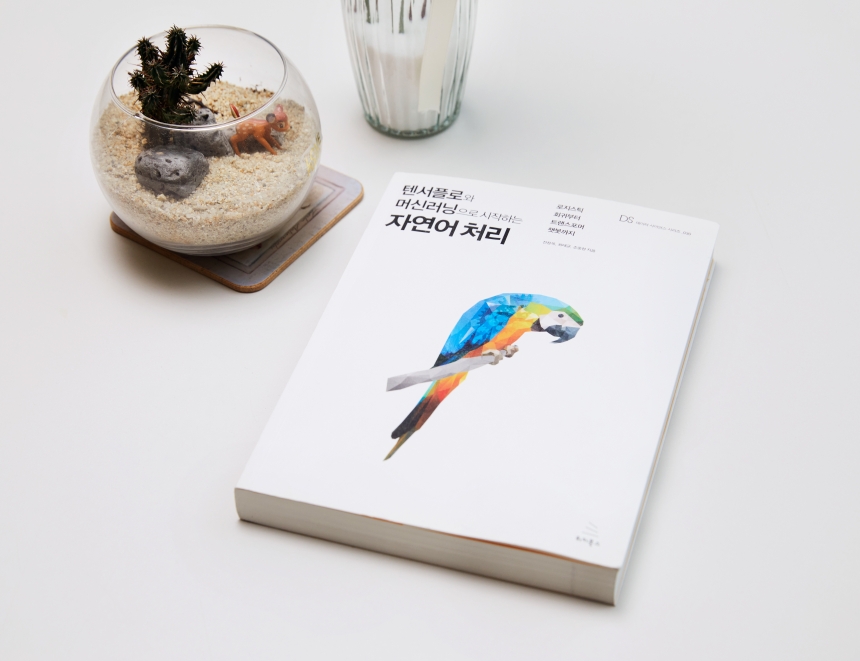
Natural Language Processing Started with Tensor Flow and Machine Learning,” a book whose lead author was Jun Chang-wook It was published in a revised edition considering the technological changes.
The writing of this book was started with eight authors. In the end, only four remained. This was because there was a strict rule that the authors must get together in the morning of every weekend to review their respective parts for one hour and finish writing the parts if they had not completed them. “Natural Language Processing Started with Tensor Flow and Machine Learning” a book completed through this process, was printed in several impressions and even in a revised edition, making Jun’s name known in the industry. Out of the four co-authors, three including Jun were not experts in the field of natural language processing at the time they were writing this book. After the book was published, however, all of them started working in related areas.
“I think together is better than alone. By ‘together’, I mean not just being with a number of people, but being with people who have thinking and determination similar to yours. When you work toward a goal with such people, you can make the greatest accomplishment. I believe that when you have a certain goal, you can succeed in achieving it by working with people who are earnest about the goal and are capable of accepting the culture. Moreover, you can continue working with such people. So I tend to spur on and push people around me continuously.”
At LG AI Research, Jun Chang-wook is conducting MRC/QA studies and developing language models using natural language processing technologies. Last year, Jun, together with LG Chem, developed an AI model to extract keywords swiftly and accurately from patents and papers by learning data from bioengineering fields using Google BERT. With this model selected as a success case for solving field issues through AI expert fostering, Jun won the LG Awards. In addition, Jun ranked first at the KorQuAD 1.0 contest with an MRC model he had developed himself. This year, by turning this model into an API platform so that it can be used by LG affiliates, he transferred the technology to LG Electronics, LG CNS, and LG U+.
“LG AI Research is a large enterprise, but it has a number of similarities to a startup. We are only given a goal, and we must try to find a way to achieve it individually. Many of its members are goal-oriented people who take the initiative. The leaders also trust the members and let them demonstrate their full competencies instead of controlling them. I think these are the strengths of LG AI Research.”
Living to Make the World a Better Place
Jun Chang-wook is an extensive reader who always holds a book in his hand. He has been keeping the habit of reading one book every two weeks for ten years. To Jun, books are a mentor that helps him set a direction in life whenever his purpose wavers and his determination weakens. 
“In my previous job, I often had to work over the weekend. This took a toll on my health. So I began reading books, and, in doing so, I found consolation. When I read books that deal with extensive knowledge, the problems I face in my life seem trivial. I also meet people I have never been able to meet by reading books. As the experience builds up, the direction in my life becomes clearer, and I can find a way that suits me best.”
His affection for books is so special that he even says he would bequeath good books, not money, to his son. At the request to recommend books for AI scientists, Jun selected several books without hesitation.
“As for AI-related books, I would recommend ‘The Master Algorithm’ and ‘The Beauty of Mathematics’. ‘The Master Algorithm’ clearly introduces not only the history of several schools of AI study but also their development progresses and aims. Jun Wu, the author of ‘The Beauty of Mathematics’, is dubbed the father of Google Search Engine. In this book, Wu kindly explains why mathematical algorithms are necessary for a search engine. This will be good for those who are interested in natural language processing. In addition, although not related to AI, I would recommend Carl Sagan’s ‘Cosmos’, Jared Diamond’s ‘Guns, Germs, and Steel’, and Yuval Harari’s ‘Sapiens’ for general reading.”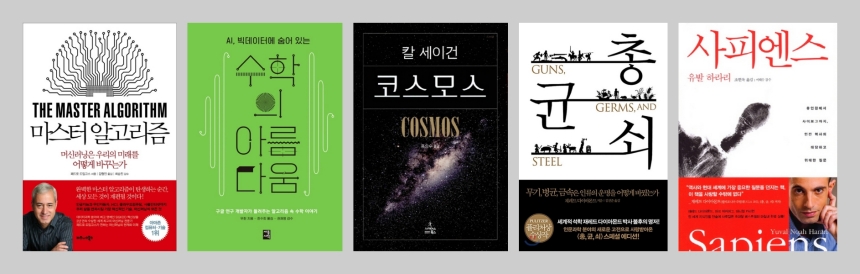
Books recommended by Jun Chang-wook recommends “The Master Algorithm” and “The Beauty of Mathematics” for AI scientists.
Jun Chang-wook enjoys the process of setting a new goal each year, sharing it with the people around him, and achieving it. His goal for this year, which he intends to fulfill at LG AI Research, is to develop a global language model.
“During the initial phase of my AI study, I felt joy in receiving recognition by winning in contests and competitions. Then, I found satisfaction from publishing a book and subsequently developing the most outstanding document reading model (KorQuAD) in Korea and beating other companies with it in a competition. I have obtained results to such extent in Korea. Now, my goal is to go abroad. I would like to make a global language model and compete against numerous global AI companies with it, something that we have not been able to do so far.”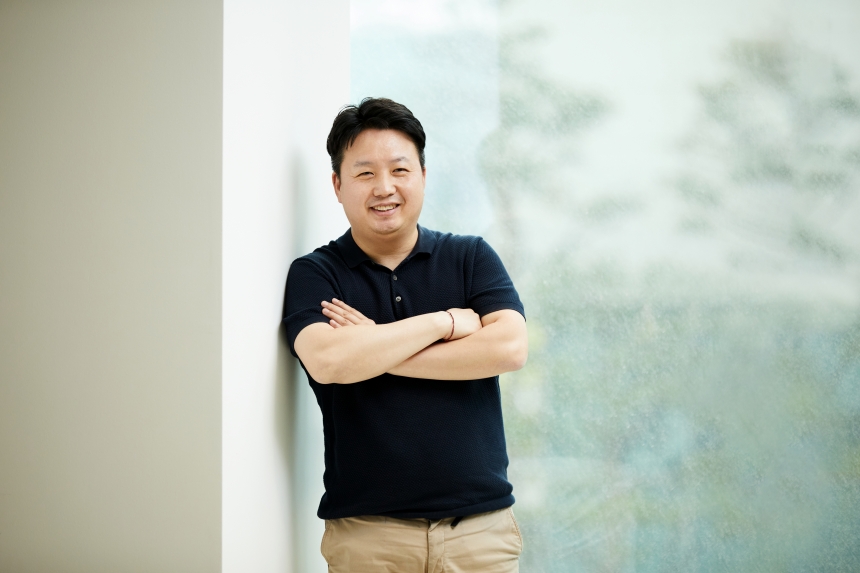
Jun’s SNS profile image displays Jun's motto, which is “living to make the world a better place.” From innovative products developed by Jun by applying deep learning technologies and submitted for competition to community operation and lectures to share his knowledge actively with the outside world and book writing, his every activity so far is in line with this motto.
“The company that has led the main trend in natural language processing so far is Google. It has been creating key algorithms for natural language processing by publishing papers and presenting technologies once every few years. As for Google, I would like to create algorithms that will change the main trend, the paradigm of natural language processing.
I have taken on challenges in new areas I had never tried before. I draw the greatest satisfaction from the fact that I had continuously and fearlessly challenged new fields, rather than the compliments I receive. Deep learning technology is advancing even at this moment. I would like to become a scientist who fearlessly studies new technologies in keeping with this change.”