 Soyoung An
2024.11.19
Soyoung An
2024.11.19
 Dasol Hong
2024.11.19
Dasol Hong
2024.11.19
[AI Ethics Seminar EP.3] Introduction to Key AI Toolkits for Designing Trustworthy AI Experiences and Practical Application Guide

|
Why do we study AI ethics? We believe that AI ethics research is essential to the development of AI that benefits people, so we’re always thinking about AI ethics throughout the entire AI lifecycle to make sure there are no side effects of the technology that we haven't considered. |
AI Toolkits for Designing “Trustworthy AI Experiences”
Generative AI technologies are unlocking new business value. While new AI-powered services and capabilities are emerging, there is a growing consensus that the limitations of generative AI technologies, such as hallucinations and data bias, need to be addressed, especially as they can undermine the trustworthiness of AI systems and extend to the reputation and legal liability of the companies that develop them.
In this context, there is growing interest in designing trustworthy human-AI interactions[1]. In particular, companies that develop AI are focusing on designing AI systems that are secure, trustworthy, and prioritize user experience. A variety of AI toolkits can be utilized to design AI systems, which can help companies increase the trustworthiness of these systems.
This post will reflect on the AI Ethics Seminar, where practical strategies and ways to maximize the trustworthy AI experience for users were discussed. It will discuss various AI toolkits, including Microsoft's Human-AI Experience Toolkit (HAX) and Google’s People+AI Research (PAIR) Guidebook, and how they can be used to consider risks and refine system design from the early stages of AI product development. It also introduces LG AI Research's AI Ethical Impact Assessment system based on reviews of various AI toolkits.
From Microsoft and Google to PwC
Launch of Various AI Toolkits for Trustworthy AI Experiences
1. Microsoft Human-AI Experience Toolkit (HAX)[2]
The first is the Human-AI Experience Toolkit (HAX), a guideline and toolkit for designing human-AI interactions developed by Microsoft. It consists of a variety of frameworks and tools to help AI understand and respond to user needs and earn their trust over time.
HAX Practical Application Guidelines
Microsoft provides guidelines for putting HAX into practice. The guidelines break down the interaction between AI systems and users into four steps and provide 18 guidelines on what to focus on for each step. Notably, the guidelines also take into account when AI-powered systems do not work correctly, and provide guidelines focused on resolving them.
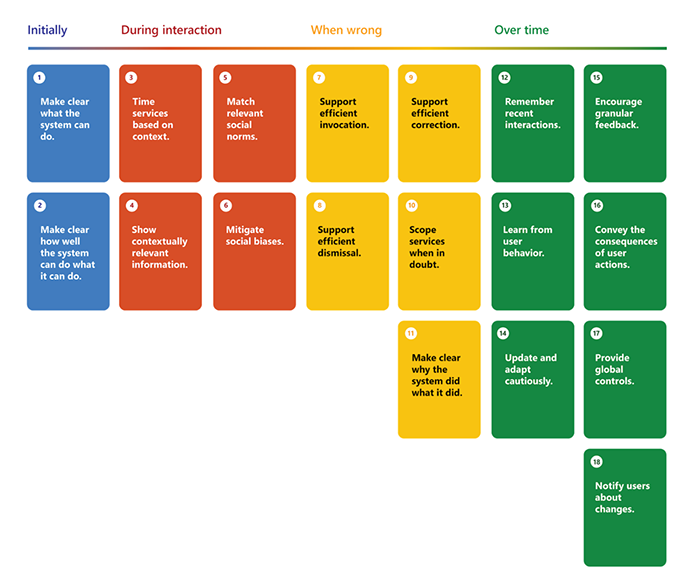
Image 1. Microsoft HAX Guidelines[2]
What practical preparations should be made to apply the guidelines to the development of actual AI systems? HAX largely specifies five major steps.
-
1) Stakeholder and product/feature selection
Applying HAX requires the participation of all teams involved in the development of an AI system. It is important to select stakeholders, such as system planners, designers, developers, data scientists, and AI researchers, and put a process in place to engage them in the application process. Then, they decide together which AI products or features to apply HAX to.
-
2) Guideline selection
It is also necessary to go through the process of determining which of the 18 guidelines provided by HAX are relevant to us. For each guideline, we evaluate whether we need it (we need it, we do not need it, we will most likely need it) and prioritize.
-
3) Expected application and verification of guidelines
It is also important to imagine what an AI system developed with the guidelines would look like and what the user experience of using it would be like. It is necessary to discuss the impact on the users when the guidelines are applied in practice and be able to supplement them.
-
4) User experience design
This step follows the guidelines to refine user experience scenarios and assess the amount of resources needed. This is the step to identify and refine the elements needed to turn imagination into reality.
-
5) Prioritizing
In this step, based on the results of the discussions in Steps 2 and 3, you prioritize the elements that will be reflected in the development of AI systems. You determine which guidelines to apply, and advance the system design and planning to actual development.
2. Google People+AI Research (PAIR) Guidebook[3]
The second toolkit to introduce is Google's People + AI Research (PAIR) Guidebook. To ensure that AI systems provide value to users, PAIR Guidebook suggests ways tailored to user needs to collect data, build explainability and trustworthiness, and continuously improve performance through feedback and error management schemes. The goal of the PAIR Guidebook is to help develop AI systems that enhance the user experience and build trust. The PAIR Guidebook provides guidance on how AI technology can build trust by focusing on enhancing the transparency and explainability of AI models and eliminating bias.
PAIR Practical Application Guidelines
In six chapters, PAIR Guidebook presents the important items in designing trustworthy AI experiences, each of which raises questions about practical considerations and provides guidelines on how to answer them.
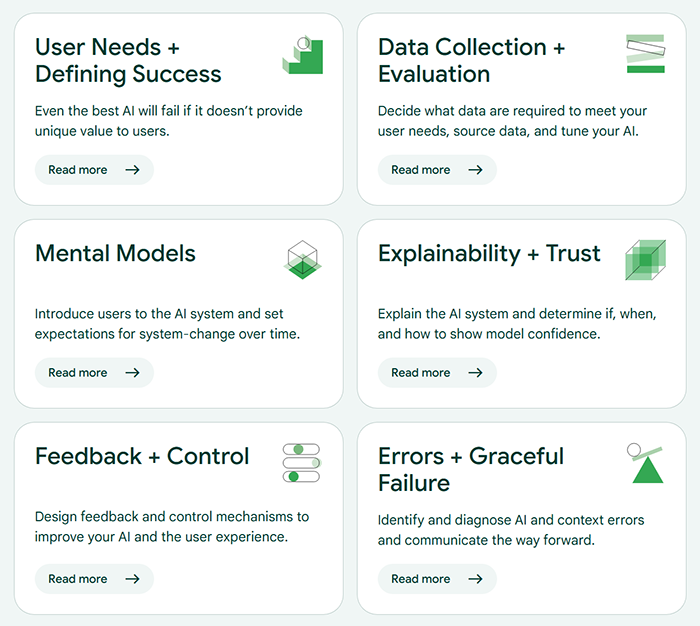
Image 2. Google PAIR Guidebook [3]
-
1) User Needs + Defining Success
First, PAIR Guidebook emphasizes the importance of identifying user needs, noting that even the best AI will fail if it doesn't provide unique value to users. It suggests defining how the AI will solve the user’s problem and the unique value it will provide in the process, and then ensuring that the AI is designed to meet the user’s expectations and using that as a measure of success.
- Which user problems is AI uniquely positioned to solve?
- How can we augment human capabilities in addition to automating tasks?
- How can we ensure our reward function optimizes AI for the right thing? -
2) Data Collection + Evaluation
It also covers training data, which is important for AI. It suggests determining the “data requirements”—what data needs to be collected to meet user needs—and establishing a data evaluation process to review the quality and fairness of the data, ensuring its accuracy.
- Does our training dataset have the features and breadth to ensure our AI meets our users’ needs?
- Should we use an existing training dataset or develop our own?
- How can we ensure that the data quality is high?
- How can we work with labelers to prevent errors and bias in datasets when generating labels?
- Are we treating data workers fairly? -
3) Mental Models
A mental model is a person’s understanding of how AI works, what principles it uses, and how their behavior can affect AI. It is a guideline that recognizes that AI technology and the systems it builds on will change over time and that people will need to change with it. It suggests elements such as explaining to users what AI can do and setting clear expectations for how AI will change.
- Which aspects of AI should we explain to our users?
- How should we introduce AI to the user initially—and thereafter?
- What are the pros and cons of introducing our AI as human-like? -
4) Explainability + Trust
AI systems need to earn the trust of users and emphasize the value of explainability. By being transparent and clear with users about the AI's decisions, users’ trust in the model can be increased.
- How much should the user trust the AI system?
- When should we provide explanations?
- What should we do if we can’t show why the AI made a given prediction?
- How should we show users the confidence associated with an AI prediction? -
5) Feedback + Control
Feedback from users is essential to improving AI systems. It proposes to improve the user’s experience by organizing feedback mechanisms to collect user feedback explicitly or implicitly, and by providing a means for the user to control or adjust the system.
- How should the AI request and respond to user feedback?
- How can we ensure our AI can interpret and use both implicit and explicit user feedback?
- What’s the right level of control and customization to give our users? -
6) Errors + Graceful Failure
PAIR also notes that the potential for errors or failures in AI systems should also be considered. It proposes a plan to identify potential errors in AI systems, develop a plan to prevent problems before they occur and provide a clear path to recovery in the event of an error to maintain trust in the system.
- When do users consider low-confidence predictions to be an “error”?
- How will we reliably identify sources of error in a complex AI?
- Does our AI allow users to move forward after an AI failure?
Effects and Limitations of AI Toolkit Application
In addition, there is also PwC’s Responsible AI (RAI) Toolkit. The RAI toolkit provides a framework for ensuring AI systems are ethical and held accountable. It examines the ethical, legal, and social issues that the introduction of AI can raise, highlights principles for addressing them, and helps companies reduce the risks of AI and achieve long-term business outcomes.
The beauty of various AI toolkits is that they can help companies design trustworthy AI experiences and make the design process more efficient and effective. In the case of HAX, it helps speed up the design and development of AI products by optimizing user experience and helps build long-term trust by meeting user expectations. PAIR contributes to reducing bias and uncertainty by designing it to make it easier for users to understand how AI systems analyze data and make decisions.
However, there are some things to be aware of when applying AI toolkits. It is difficult to apply them uniformly to all AI systems. This applies to both HAX and PAIR, which were introduced above. If your AI system has a complex structure or is used by a diverse user base, you will need to review and adjust the toolkit in detail to suit your system’s characteristics. This process may require more time and resources than expected during the initial design step of the AI system.
LG AI Research’s Sustainable User-Centric AI Experience
At LG AI Research, we are making various efforts to create trustworthy AI and provide experiences that meet user expectations. As part of these efforts, we have introduced AI Ethical Impact Assessment for all projects from this year onward. This is an attempt to go beyond providing ethical principles or guidelines and consider trustworthy AI experiences from the R&D process.
The AI Ethical Impact Assessment is the process of proactively identifying the characteristics of an AI task and discussing the social and ethical issues that may arise from that task. The assessment begins with a survey to identify task characteristics. This is to assess the task’s potential impact, which varies depending on its purpose, stakeholders, training data, models, etc. In doing so, participants consider not only technically meaningful performance but also the end-user and stakeholder environment.
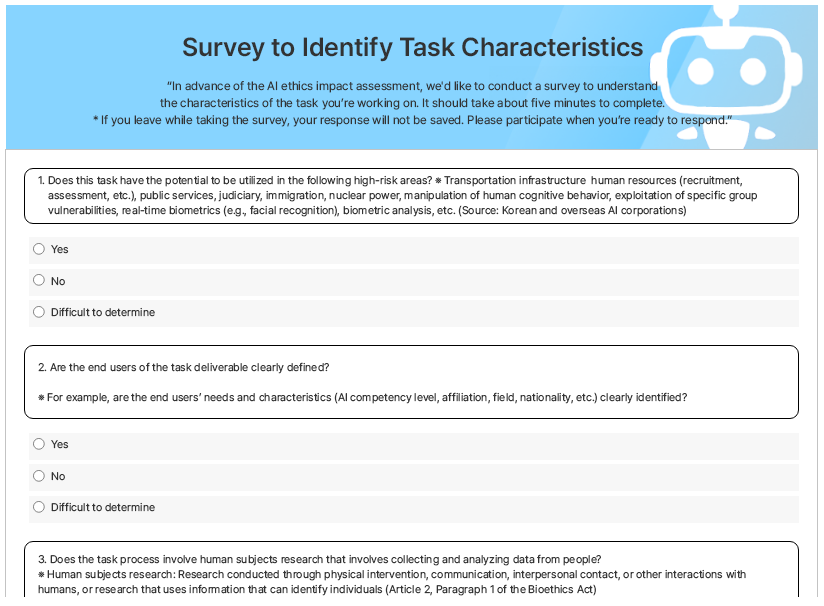
Image 3. Survey to identify task characteristics in an AI Ethical Impact Assessment
Specifically, this discussion involves project planners, researchers, business managers, and ethics managers. Task participants directly assess the ethical and social impact of the task and develop a plan to address any negative impacts. These discussions also help prevent trust issues with users that may arise later in the development process. LG AI Research will continue to improve AI experiences based on various user feedback as well as AI Ethical Impact Assessment to create trustworthy AI.
AI Ethics Seminar Series
#1. [AI Ethics Seminar EP.1] Red Team Research Trends and Applications for Generative AI
#2. [AI Ethics Seminar EP.2] Research aimed at properly understanding the risks of AI
#4. [AI Ethics Seminar EP.4] Building a Responsible AI Society through AI Agents
#5. [AI Ethics Seminar EP.5] AI Ethics from a UI/UX Designer's Perspective
- 참고
[1] Elizabeth M. Renieris, David Kiron, and Steven Mills, “To Be a Responsible AI Leader, Focus on Being Responsible Findings from the 2022 Responsible AI Global Executive Study and Research Project”, September 19, 2022
[2] Microsoft, HAX Toolkit, https://www.microsoft.com/en-us/haxtoolkit/ai-guidelines/[3] Google, People + AI Guidebook, https://pair.withgoogle.com/guidebook
[4] PwC, PwC Responsible AI Framework & Toolkit, https://www.pwc.com/sg/en/services/reimagine-digital/data-optimisation/what-is-responsible-ai.html