 Jiwon Ham
2024.12.23
Jiwon Ham
2024.12.23
[AI Ethics Seminar EP.5] AI Ethics from a UI/UX Designer's Perspective

|
Why do we study AI ethics? We believe that AI ethics research is essential to the development of AI that benefits people, so we’re always thinking about AI ethics throughout the entire AI lifecycle to make sure there are no side effects of the technology that we haven't considered. |
Generative AI services have brought convenience and new possibilities, but they also pose ethical dilemmas: privacy violations, bias in results, and lack of transparency. These ethical dilemmas can also be found in the UI/UX design of AI services. Let’s take a look at the ethical dilemmas of AI services found in UI/UX design, and also introduce the ethical UI/UX design applied to LG AI Research's ChatEXAONE.
1. Deceptive Patterns in UI/UX Design
UI/UX design in AI services, as well as IT services, sometimes includes elements that are designed to disadvantage users. Specifically, there are UI/UX design patterns intended to guide users toward certain actions or lead them to make unfavorable choices. These are defined as "Deceptive Patterns" or "Dark Patterns." These deceptive patterns can be ethically problematic as they prioritize the interests of companies or service providers over the interests of the user, and can distort the user's experience of the service. Below, we break down and provide examples of these patterns that may lead to ethical issues.
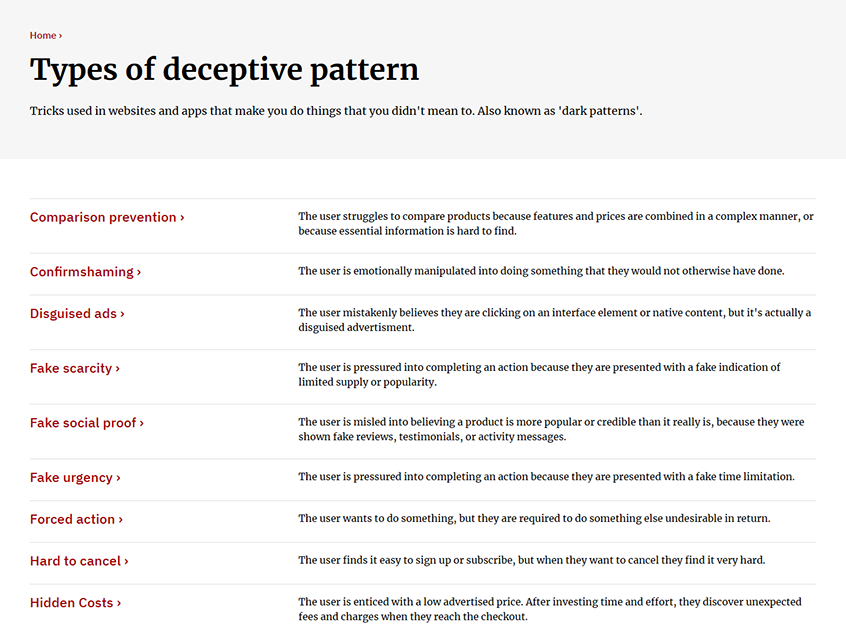
Image 1. Deceptive Patterns Design[1]
1) Forced Continuity
The first is forced continuity. These are UX patterns that are often seen in paid subscription services, where the subscription is automatically renewed or the payment continues unless the user cancels the subscription. One example is a service requiring users to enter their payment information for a free trial, and then automatically converting the user to a paid payment at the end of the free trial period. This is a common pattern for Terms of Use or service policies that require users to enter payment information before they can use any provided service.
2) Forced Consent
The second, forced consent, is a pattern of coercing users to agree to collect data or agree to the terms of service, even if they don't want to. This infringes on user choice through UI/UX designs that require users to sign up or agree to the terms in order to utilize certain services or features. For example, in the past, certain mobile apps were sometimes set to collect location data in the background, even if the user didn’t enable location services. More recently, some services only have a bulk consent button designed to prevent users from selectively changing their cookie settings, which also constitutes forced consent.
3) Privacy Zuckering
The third is a type of privacy zuckering that encourages users to share data they don't want to share. This pattern, which originated from Facebook, encourages excessive data sharing by having all default personal information set to public during the signup or initial setup phase, and not allowing users to easily change these settings.
2. UI/UX Design that Solves Ethical Dilemmas
How can we solve ethical dilemmas in UI/UX design? The most important thing is to integrate new technologies with ethical design. UI/UX designers need to be able to keep up with the ever-evolving trends in AI technology and develop and adapt new UI/UX patterns accordingly. They also need to be aware of global standards for AI ethics and adapt their design standards to keep up with global trends and services. The specific elements to focus on from a UI/UX design perspective include:
1) Transparent Information
First, information must be provided transparently to the user, and UI/UX design must be implemented so that the user can easily access and verify this information. Clearly, the kind of information that should be disclosed to users varies, but for AI services in particular, it’s important to be transparent with users about how the AI works to provide answers, what data the AI has learned, how it utilizes the data including answers given to the user and the possibilities and limitations of the AI.
For example, OpenAI's ChatGPT has a detailed and clear data usage policy for its AI service. It categorizes the personal information users provide as account information, user feedback, communication information, social media information, and more, and clearly discloses that it collects this information when users sign up and use the service, even for data generated by the use of ChatGPT.
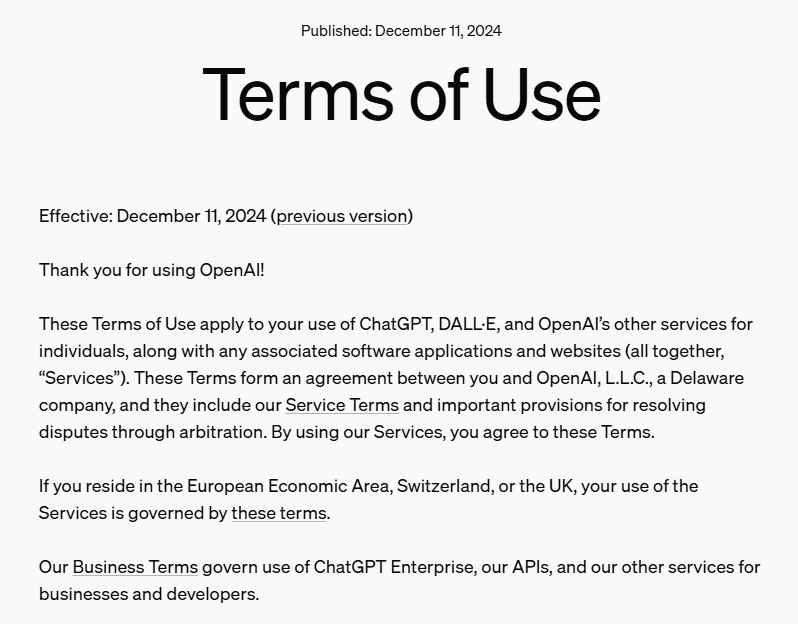
Image 2. OpenAI's ChatGPT Data Usage Policy[2]
2) User Control Features
Next, it's important to give users the ability to take control of themselves. For example, users should be with controls to manage access to their data on the page, and they should also be provided with a My Page in Settings, where they can freely request deletion and correction of their data. Google's privacy dashboard and Microsoft's privacy management tools are great examples of this in action.
3) Feedback Mechanism
A system for receiving user feedback on AI services should also be in place. This system should collect user opinions, analyze responses, and use the data to improve services, and should further outline procedures for receiving and handling user complaints. UI/UX design needs to be designed to make these procedures easily accessible to users. AI services are highly dependent on user utilization and feedback due to the nature of generative AI. This is why it’s important to build mechanisms that allow users to naturally provide feedback on their AI experience and use that feedback to improve the quality of AI services
4) Safety Mechanisms
Safety of the service is also a key factor in both AI systems and UI/UX design. Due to the nature of generative AI, it’s important to transparently acknowledge that inappropriate content may be generated and to build in technical mitigations to prevent this from happening. In the event that inappropriate content is generated, mitigation measures should be implemented in the UI design, such as a button for users to report it. All AI-enabled services must be able to control the risk factors of unintended interactions with users throughout the entire model creation iteration, from start to finish. This is why detailed planning and UX/UI design are necessary.
3. Ethical UI/UX Design Applied to ChatEXAONE
Based on the principles outlined above, here is how we applied ethical and AI UX/UI to ChatEXAONE.
1. We provide a Terms of Service page for ChatEXAONE
For a safe and reliable ChatEXAONE, we notify users of our Terms of Service, as well as the collection and use of personal information. Users may access and use the service on the condition that they comply with them. We have included relevant laws, ChatEXAONE’s Disclosure and Terms of Service policies, and other guidelines so that interested users can check our personal information policies at any time. We have also designed the page so that users can check the history of changes as the Terms of Service are updated.
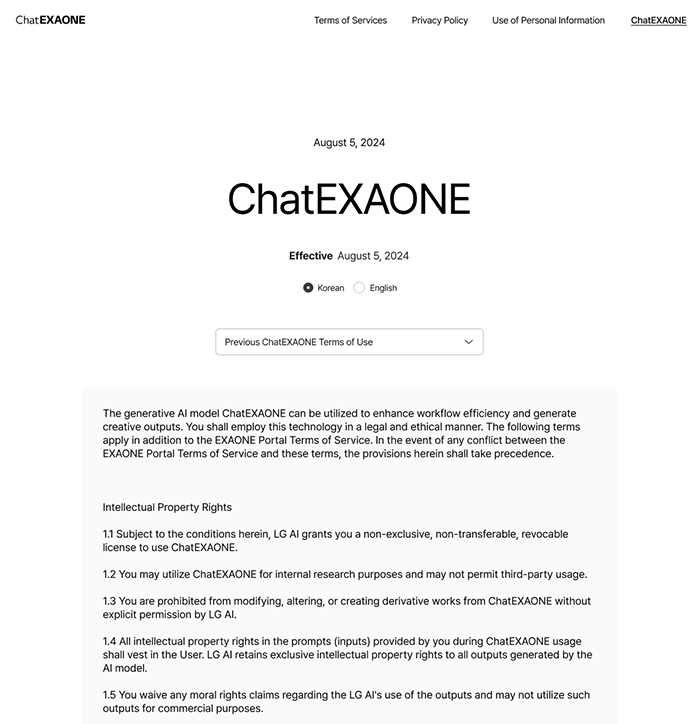
Image 3. ChatEXAONE's Terms of Service Page[3]
2. Multi-Step Reasoning
The Deep feature, which shows the generation result process in detail, allows users to check the keywords and references that EXAONE referenced during generation step by step. Up to nine keywords and references are shown for each step. The UX/UI design was also designed for more intuitive interaction, thus enhancing user trust. A keyword copy feature is also provided within Multi-step Reasoning so that it can be utilized as a prompt in other AI services.

Image 4. ChatEXAONE의 Multi-Step Reasoning[4]
3. Responses will not be generated when users enter personal information or inappropriate prompts
For example, ChatEXAONE doesn’t generate answers when users enter resident registration numbers and phone numbers. Masking is used to ensure that personal information is not used to generate answers, and we analyze the intent of inappropriate questions or socially sensitive issues to ensure that specific messages are displayed.
4. User Data Security
The data and personal information of users who use ChatEXAONE can only be viewed by authorized administrators, and we apply a process to enter and confirm a clear reason for utilizing data. In addition, files uploaded by users are deleted periodically in accordance with our archiving policy.
Improvements to Be Made in the Future
We are working to provide privacy controls and create a community for seamless feedback. In the future, for smooth use of ChatEXAONE, we will not only provide FAQs but also establish a community-based window to quickly resolve issues and continuously improve our service.
We are also building an internal design system in order to ensure a consistent UI/UX experience and efficient management across all services and platforms that LG AI Research creates. We are also in the process of establishing internal processes and procedures to ensure that the design system can seamlessly integrate with the front-end that users interact with directly. Once complete, LG AI Research’s design system will be released as open source. In alignment with AI that continuously drives innovation, we are preparing for changes in UI/UX as well.
AI Ethics Seminar Series
#1. [AI Ethics Seminar EP.1] Red Team Research Trends and Applications for Generative AI
#2. [AI Ethics Seminar EP.2] Research aimed at properly understanding the risks of AI
#3. [AI Ethics Seminar EP.3] Introduction to Key AI Toolkits for Designing Trustworthy AI Experiences and Practical Application Guide
#4. [AI Ethics Seminar EP.4] Building a Responsible AI Society through AI Agents
- 참고
[1] Deceptive Patterns, https://www.deceptive.design/
[2] ChatGPT Terms of Use, https://openai.com/ko-KR/policies/terms-of-use/